Expression of infrared fluorescence engineered in mammals
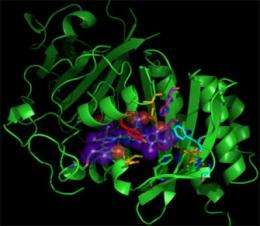
(PhysOrg.com) -- Researchers at the University of California, San Diego - led by 2008 Nobel-Prize winner Roger Tsien, PhD - have shown that bacterial proteins called phytochromes can be engineered into infrared-fluorescent proteins (IFPs). Because the wavelength of IFPs is able to penetrate tissue, these proteins are suitable for whole-body imaging in small animals. Their findings will be published in the May 8 edition of the journal Science.
"The development of IFPs may be important for future studies in animals - to find out how cancers develop, how infections grow or diminish in mice, or perhaps how neurons are firing in flies," said Tsien, professor of pharmacology, chemistry and biochemistry at UC San Diego and a Howard Hughes Medical Institute investigator. Tsien was one of three scientists awarded the 2008 Nobel Prize in Chemistry for discovery of the Green Fluorescent Protein (GFP) and a series of important developments which have led to its use as a tagging tool in bioscience.
The limitation of using GFP in living mammals is that its wave lengths are not long enough to allow light to penetrate far enough to allow inner cells to glow with fluorescent light.
First author Xiaokun Shu, PhD, of the UC San Diego School of Medicine's Department of Pharmacology and the Howard Hughes Medical Institute, coerced the phytochrome from the bacteria Deinococcus radiodurans to fluoresce - the first protein to glow in infrared and work in mouse models. A phytochrome is a photoreceptor - a pigment that plants and bacteria use to detect light - which is sensitive to light in the red and far-red region of the visible spectrum.
"IFPs express well in mammalian cells and spontaneously incorporate biliverdin, a green pigment that is present in humans and other mammals," said Tsien. Biliverdin is the substance responsible for the yellowish-green color of a bruise as it fades, for example. Biliverdin normally has negligible fluorescence. However, Shu was able to coax the biliverdin-containing protein to fluoresce by cutting off the parts of the phytochrome that divert the energy of the light.
"We hoped that by doing so, the light's energy wouldn't go anywhere else but would instead go out and become fluorescent," Shu said, adding that the protein is "moderately fluorescent, but we still have a long way to go."
Tsien stated that, while this work is promising for future studies in animal models, he doesn't think it will be applied directly to imaging in humans for several reasons.
"First, all fluorescent proteins derived from corals, jellyfish, and now bacteria are powerful in basic research because they are encoded by a gene," said Tsien. "Introducing such genes into people would pose big scientific and ethical problems."
He explained that, secondly, humans are still too thick and opaque for the infrared fluorescence to get deep inside our bodies, although scientists can now see faintly through a mouse with infrared, because mice are so much smaller.
The Tsien lab is working on a different project to develop a technique without these limitations, one that can be used for imaging in humans. His hope is that, one day, people will be able to go in for their annual check ups and know if they have cancer because tumors will light up by magnetic resonance imaging of diagnostic molecules.
But for now, Tsien, Shu and their colleagues at UC San Diego hope that the prototype they have developed can be used to make other, improved fluorescent bacterial proteins from among the huge numbers harnessed from other organisms - IFPs that can be used in important animal studies.
Source: University of California - San Diego (news : web)


