Ethanol vs. Electricity: Biomass converted into electricity could be more efficient than ethanol (w/Video)
May 7, 2009
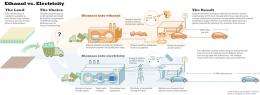
Ethanol vs. Electricity. Credit: McDade & Campbell/UC Merced
(PhysOrg.com) -- Concerns over petroleum gas prices and long-term effects of greenhouse gas emissions on the environment have prompted scientists to look for alternative renewable energy sources for transportation use. One of the questions at hand is determining what that preferred technology should be.
Scientists are examining biomass - plant matter that's grown and used to generate energy - as a potential power source. Two biomass technologies involve ethanol and electricity. Biomass converted into ethanol, a corn-based fuel, can power internal combustion vehicles. Biomass converted into electricity can fuel a vehicle powered by an electric battery.
A study by University of California, Merced, Assistant Professor Elliott Campbell and two other researchers in the May 8 issue of the journal Science suggests that biomass used to generate electricity could be the more efficient solution.
This video is not supported by your browser at this time.
Biofuels such as ethanol offer an alternative to petroleum for powering our cars, but growing energy crops to produce them can compete with food crops for farmland, and clearing forests to expand farmland will aggravate the climate change problem. How can we maximize our “miles per acre” from biomass?
In the study, Campbell, along with Christopher Field of the Carnegie Institution's Department of Global Ecology and David Lobell of Stanford University, the scientists found that biomass converted into electricity produced 81 percent more transportation miles and 108 percent more emissions offsets compared to ethanol.In other words, said Campbell, vehicles powered by biomass converted into electricity "got further down the road" compared to ethanol. As a result, Campbell continued, "we found that converting biomass to electricity rather than ethanol makes the most sense for two policy-relevant issues, transportation and climate."
The scientists based their study on two criteria: miles per area cropland and greenhouse gas offsets per area cropland. In both cases, scientists considered a range of feedstock crops (corn and switchgrass0 and vehicle types (small car, midsize car, small SUV and large SUV.
First, they looked at how many miles a range of vehicles powered by ethanol could travel versus a range of electric vehicles fueled by electricity. Second, they examined offsets to greenhouse gas emissions for ethanol and bioelectricity. Land use is an important factor to consider when evaluating each method. Globally, the amount of land available to grow biomass crops is limited. Using existing croplands for biofuels could cause increases in food prices and clearing new land, or deforestation, can have a negative impact on the environment.
The authors are careful to point out their study looked at two criteria, transportation and greenhouse gas offsets, but did not examine the performance of electricity and ethanol for other policy relevant criteria.
"We also need to compare these options for other issues such as water consumption, air pollution and economic costs," Campbell said.
Campbell joined UC Merced as an assistant professor in the School of Engineering in 2008. He earned bachelor's and master's degrees at Stanford University and his Ph.D. from the University of Iowa. Prior to joining UC Merced, Campbell received national attention for another study that concluded the United States Could meet up to 6 percent of its energy needs with biofuels produced on abandoned or degraded agricultural land.
More information: A copy of Campbell's abstract can be viewed online at http://sciencemag.org/
Source: University of California - Merced
-
Biofuels: More than just ethanol
Apr 05, 2007 |
not rated yet |
0
-
Producing ethanol and biodiesel from corn and other crops is not worth the energy
Jul 05, 2005 |
not rated yet |
0
-
Researchers advance cellulosic ethanol production
Sep 08, 2008 |
not rated yet |
0
-
More flexible method floated to produce biofuels, electricity
Oct 14, 2008 |
not rated yet |
0
-
Cellulosic ethanol may benefit human health and help slow climate change
Feb 02, 2009 |
not rated yet |
0
-
Engineers build first sub-10-nm carbon nanotube transistor
Feb 01, 2012 |
5 / 5 (23) |
21
-
Something old, something new: Evolution and the structural divergence of duplicate genes
Jan 31, 2012 |
4.6 / 5 (7) |
1
-
The hidden nanoworld of ice crystals: Revealing the dynamic behavior of quasi-liquid layers
Jan 30, 2012 |
5 / 5 (2) |
1
-
Stock market network reveals investor clustering
Jan 27, 2012 |
4.1 / 5 (21) |
8
-
Of microchemistry and molecules: Electronic microfluidic device synthesizes biocompatible probes
Jan 26, 2012 |
not rated yet |
0
-
Question about cloaking device
2 hours ago
-
Books on Wind Energy (offshore)
9 hours ago
-
Tennis Court Speed Measurement
Feb 03, 2012
-
Fastest way to cool water
Feb 03, 2012
-
Counter-weights
Feb 02, 2012
-
Composite electric glass heating elements
Feb 02, 2012
- More from Physics Forums - General Engineering
More news stories
Fold-it computer action set for Canada conference (w/ video)
(PhysOrg.com) -- What nonsense, sitting in front of one, single display screen and struggling with a split-screen view of multiple-sites plus data entry or word processing. Is this the way it has to be for ...
Apple, Motorola in patent struggle in Germany
Apple Inc. has temporarily blocked Motorola Mobility's attempt to have it withdraw several iPhone and iPad models from its Internet store in Germany, the latest twist in an extended legal duel over patents between the companies.
12 hours ago |
3 / 5 (2) |
3
HP awards new CEO Whitman with $16.5M pay package
Hewlett-Packard Co. ushered in Meg Whitman as its CEO with a $16.5 million compensation package that hinges on the one-time politician's ability to lift the stumbling technology company's stock price during the next two years.
12 hours ago |
not rated yet |
0
Chips and apps on tap for Super Bowl
Millions of American football fans will be watching the Super Bowl on television Sunday with one hand in the potato chips and the other holding a smartphone.
12 hours ago |
not rated yet |
0
Wireless power could revolutionize highway transportation, researchers say
A Stanford University research team has designed a high-efficiency charging system that uses magnetic fields to wirelessly transmit large electric currents between metal coils placed several feet apart. The ...
Technology / Energy & Green Tech
Feb 01, 2012 |
4.1 / 5 (19) |
51
|
Minnesota food company recalls eggs in 34 states
(AP) -- A Minnesota food company said Friday it is recalling more than a million hard-cooked eggs distributed to 34 states after testing revealed some may be contaminated with listeria.
Repulsive gravity as an alternative to dark energy (Part 2: In the quantum vacuum)
(PhysOrg.com) -- During the past few years, CERN physicist Dragan Hajdukovic has been investigating what he thinks may be a widely overlooked part of the cosmos: the quantum vacuum. He suggests that the quantum vacuum has ...
Researchers weigh methods to more accurately measure genome sequencing
Lost in the euphoria of the 2003 announcement that the human genome had been sequenced was a fundamental question: how can we be sure that an individual's genome has been read correctly?
Repulsive gravity as an alternative to dark energy (Part 1: In voids)
(PhysOrg.com) -- When scientists discovered in 1998 that the Universe is expanding at an accelerating rate, the possibility that dark energy could explain the observation was intriguing. But because there ...
Amazon fungi found that eat polyurethane, even without oxygen
(PhysOrg.com) -- Until now polyurethane has been considered non-biodegradable, but a group of students from Yale University in the US has found fungi that will not only eat and digest it, they will do so even in the absence ...
New super-earth detected within the habitable zone of a nearby star
(PhysOrg.com) -- An international team of scientists has discovered a potentially habitable super-Earth orbiting a nearby star. With an orbital period of about 28 days and a minimum mass 4.5 times that of ...
May 07, 2009
Rank: 1.8 / 5 (5)
1) what crop can we grow that will produce the largest mass of harvest with the least fertilizer, pesticide and water needed?
2) will the corn lobby and the politicians beholden to them work like crazy to supress any studies or movement in this direction?
(why yes, I am a pessimist, how did you know?)
May 07, 2009
Rank: 2.2 / 5 (5)
May 07, 2009
Rank: 4 / 5 (1)
1) don't make ethanol
2) use fossil based transportation fuels, not ethanol
3) burn non-edible plants to make electricity instead of using fossil fuels
4) replace vehicles with ones using electricity
Dozer: I think that answer to your 1) question will be algae. There has been news about algae energy use recently.
May 07, 2009
Rank: 4 / 5 (1)
May 08, 2009
Rank: not rated yet
Of course collection would likely use as much or more energy as could be collected, but meh. It's got to be collected anyways
May 08, 2009
Rank: 5 / 5 (1)
May 11, 2009
Rank: 1 / 5 (1)
May 12, 2009
Rank: 4 / 5 (1)
Means that, AT ANY GIVEN LOCATION, a 15% efficient solar-thermal plant can do the same job with 0.0165/15 = 0.0011 the area of the biomass plantation.
So which is better? 1 sq km of solar thermal which never needs re-planting and doesn't permanently damage anything, or 909.1 sq km of biomass plantation which depletes the soils, etc. etc. ? (HINT: the answer is solar thermal OR PV -> electrical)
Jun 07, 2009
Rank: not rated yet
While one can say that they would have to ignore the fact that after ethanol is made most of the biomass is still there in the leftover mash, corn stalks, cobs. So one can both have ethanol and burn wht's left for electricity.
Also left out is the mash is a better animal or even human feed than raw corn is.
Gasoline if taken by the same poor standard would be even less eff as one only gets about 1/4 of the output from the product.
And one can FT the biomass into gasoline, diesel which Shell, Syntroleum has already done but doesn't sell their GTL units so people could.
Taken together ethanol is no worse than other fuels and better than many.
A combo of NG, Ethanol, bio gasoline/diesel and EV's will be our future, especially EV's as they are 3x's as eff as any fueled car.
Which is why I built my EV. Sadly about the only way to get one. My 3wh service car style EV gets 600mph equivalent and my 2 seat EV sportswagon gets 250mpge.
The costs of oil are huge from pollution, CO2, subsidies, balance of payments, $500B/yr which go to our enemies like Iran, Russia, oil dictators and terrorist means ethanol and EV's, RE like wind, solar thermal, river/tidal power without dams, ect are very cheap comparatively.
WE need them all with eff, conservation and get rid of coal and imported oil. Oil hit $70 on 6-5-09 and going up with a bullet as the economy recovers will hit 150/bbl again by late next yr, 2010.
Jun 08, 2009
Rank: 1 / 5 (1)
New York to Miami in 2 hours - zoom zoom!