Far UV detector is part of new instrument to be installed on Hubble
May 7, 2009 Hubble Space Telescope

Enlarge

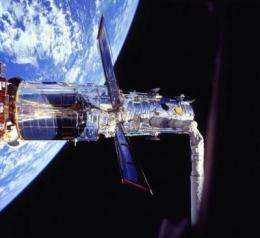
This is a photo of the Hubble Space Telescope. Credit: NASA

NASA's final mission to the 17-year-old Hubble Space Telescope, which begins May 11, will deliver a new instrument partly built by University of California, Berkeley, physicists to map the structure of the universe.

The Cosmic Origins Spectrograph (COS) contains both a far ultraviolet detector built at UC Berkeley's Space Sciences Laboratory and a near ultraviolet detector provided by Ball Aerospace & Technologies Corp. of Boulder, Colo. The spectrograph package was designed, assembled and readied for the Hubble by scientists at the University of Colorado, Boulder, under the leadership of the principal investigator James Green, professor of astrophysical and planetary sciences and a former UC Berkeley graduate student.

COS is designed to explore the "cosmic web," a rarefied network of hot and ionized gas lanes connecting and dating from the early , according to Barry Welsh, a UC Berkeley astronomer who will be working with the new data from COS. By studying this web of hot gas, astronomers hope to detail the evolution of the large-scale structure of the universe seen today as walls and sheets of galaxies surrounding huge voids.

"The main goal of COS is to look as far and as faint as possible to study the cosmic web of primordial gas to understand how galaxies formed," Welsh said.

With COS, astronomers also will look for chemicals and hot winds in the haloes of distant galaxies. This information can provide important insight into how early galaxies grew and how rapidly galaxies accumulated heavy elements from exploding stars. Other astronomers, like Welsh, hope to use COS to explore the origin of stellar and planetary systems and the cold interstellar medium.

The Space Sciences Laboratory was subcontracted to build the far UV detector in 1998, with research physicist Oswald H.W. Siegmund as lead scientist. The detector was completed in 2002 and, except for a brief upgrade in 2003, has remained in a vacuum chamber at Goddard Spaceflight Center in Maryland awaiting its launch into space from Cape Kennedy on the Space Shuttle Atlantis.

"The far UV detector is similar to what we built for NASA's FUSE mission, but with better resolution and much better sensitivity," said Siegmund, referring to NASA's Far Ultraviolet Spectroscopic Explorer satellite, which was launched in 1999 to study the universe in the far UV waveband. That mission, operated by Johns Hopkins University in Baltimore, ended in 2007.

During the upcoming 11-day servicing mission, astronauts will deliver a second new instrument, the Wide Field Camera 3, and attempt to repair the Space Telescope Imaging Spectrograph (STIS) and the Advanced Camera for Surveys, which has provided scientists and the public with beautiful images of galaxies in the early universe. STIS had ultraviolet capabilities complementary to the COS and was used in conjunction with FUSE when both were operational. The STIS spectrograph failed due to an electronic short in August 2004.

Source: University of California - Berkeley


print this article email this article download pdf blog this article bookmark this article     Stumble it Digg this share on Facebook retweet share on Reddit add to delicious
Rate this story - 5 /5 (2 votes)


May 7, 2009 all stories

Comments: 0

5 /5 (2 votes)
  • Stumble this up

  • Digg this

  • share this

  • hide
  • Related Stories

  • Spectrograph Team Awaits October Hubble Servicing Mission
    created Aug 22, 2008 | popularity not rated yet | comments 0
  • Hubble Survey Finds Missing Matter, Probes Intergalactic Web
    created May 20, 2008 | popularity not rated yet | comments 0
  • NASA Concludes Successful Fuse Mission
    created Oct 17, 2007 | popularity not rated yet | comments 0
  • NASA announces details of Hubble servicing mission
    created Jan 08, 2008 | popularity not rated yet | comments 0
  • IMAX Camera Returns to Space to Chronicle Hubble Space Telescope
    created Sep 25, 2007 | popularity not rated yet | comments 0


  • hide
  • Relevant PhysicsForums posts

  • The shape of our solar system's orbits.
    created Nov 07, 2009
  • Above or Below the Line of Nodes
    created Nov 07, 2009
  • Supernova vs. Nova?
    created Nov 07, 2009
  • Supernova's Gamma Rays and Comets
    created Nov 06, 2009
  • More from Physics Forums - General Astronomy

Other News

Deep creep means milder, more frequent earthquakes along Southern California's San Jacinto fault

Deep creep means milder, more frequent earthquakes along Southern California's San Jacinto fault

Space & Earth / Earth Sciences

created 15 hours ago | popularity 4.5 / 5 (4) | comments 0

With an average of four mini-earthquakes per day, Southern California's San Jacinto fault constantly adjusts to make it a less likely candidate for a major earthquake than its quiet neighbor to the east, the ...


Success in 'space elevator' competition (AP)

Success in 'space elevator' competition (Update 3)

Space & Earth / Space Exploration

created Nov 05, 2009 | popularity 4.3 / 5 (33) | comments 50

(AP) -- A robot powered by a ground-based laser beam climbed a long cable dangling from a helicopter on Wednesday to qualify for prize money in a $2 million competition to test the potential reality of the ...


In a Galaxy Far, Far Away...

In a Galaxy Far, Far Away...

Space & Earth / Astronomy

created Nov 06, 2009 | popularity 4.8 / 5 (5) | comments 17

(PhysOrg.com) -- Astronomers have published the discovery of the farthest known object in the cosmos: a star that exploded when the universe was only 630 million years old -- only 4.6% of its current age. ...


'Dropouts' pinpoint earliest galaxies

'Dropouts' pinpoint earliest galaxies

Space & Earth / Astronomy

created Nov 06, 2009 | popularity 4.2 / 5 (10) | comments 13

Astronomers, conducting the broadest survey to date of galaxies from about 800 million years after the Big Bang, have found 22 early galaxies and confirmed the age of one by its characteristic hydrogen signature ...


Space hotel taking bookings for 2012 opening

Space hotel taking bookings for 2012 opening

Space & Earth / Space Exploration

created Nov 05, 2009 | popularity 4.4 / 5 (21) | comments 11

(PhysOrg.com) -- The first orbiting space hotel is on track to open for its first customers in 2012, but hurry, as bookings are filling fast.