THEMIS: 'Singing' electrons help create and destroy 'killer' electrons
May 7, 2009 NASA's THEMIS: 'singing' electrons help create and destroy 'killer' electrons

Enlarge

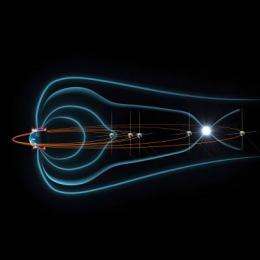
This is an artist's concept of the THEMIS main orbits, represented by red ovals. Blue lines represent Earth's magnetic field over the night side. The white flash represents energy released during substorms, which cause the night side magnetic field to act like a giant slingshot, propelling electrons toward Earth. Credit: NASA

Scientists using NASA's fleet of THEMIS spacecraft have discovered how radio waves produced by electrons injected into Earth's near-space environment both generate and remove high-speed "killer" electrons.

Killer are born within Earth's natural radiation belts, called the Van Allen belts after their discoverer, James Van Allen. Killer electrons are mostly found in the outer belt, which over the equator begins approximately 8,000 miles above Earth and tapers off about 28,000 miles high.

The high-speed electrons pose a threat to satellites in or near the outer belt -- those in medium-level and higher (geosynchronous) orbits -- like the and most communications satellites. They are known as "killer" electrons because they can penetrate a spacecraft's sensitive electronics and cause short circuits.

"This discovery is important to understand the physical processes that shape the radiation belts, so that one day we will be able to predict the moment-by-moment evolution of the radiation belts and be in a position to safeguard satellites in these regions, or astronauts passing through them on the way to the moon or other destinations in the solar system," said Dr. Jacob Bortnik of the University of California, Los Angeles, lead author of a paper on this research appearing May 8 in Science.
NASA's THEMIS: 'singing' electrons help create and destroy 'killer' electrons
Enlarge

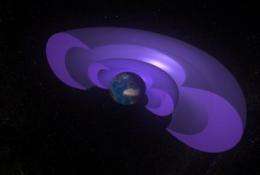
This is an artist's concept of the Van Allen radiation belts surrounding Earth. The blue, concentric shells represent the inner and outer belts. They completely encircle Earth, but have been cut away in this image to show detail. Credit: NASA Scientific Visualization Studio/Walt Feimer

Electrons are that carry negative electric charge, and we harness their flow every day as electricity. Electrons are also present in space in a gas of electrically charged particles called plasma, which is constantly blown from the surface of the sun. When this plasma interacts with Earth's magnetic field, some of it is shot toward Earth. The magnetic field over Earth's night side acts like a slingshot, propelling blobs of plasma toward Earth. When this happens, electrons in the plasma blobs release extra energy gained from the slingshot by "singing" - they generate a discrete type of organized radio wave called "chorus," which sounds like birds singing when played through an audio converter.

Scientists previously discovered that electrons in the outer radiation belt can extract energy from these chorus waves to reach near-light speed and become killer electrons. The new research, confirmed by the team's THEMIS (Time History of Events and Macroscale Interactions during Substorms) observations, is that the chorus waves can be refracted into the inner portion of the radiation belts by dense plasma near Earth and bounce around from hemisphere to hemisphere within the radiation belts. When this happens, the chorus waves become disorganized and evolve into another type of radio wave called "hiss," according to the team.

Hiss waves, named for the sound they make when played through a speaker, are of interest to space weather forecasters because earlier research showed they can clear killer electrons from lower altitudes of the outer radiation belt. Hiss deflects the speedy particles into Earth's upper atmosphere, where they lose energy and are absorbed when they hit atoms and molecules there. Despite its important role, it was not clear how hiss was generated.

"It is not immediately obvious that these two waves are related, but we had a fortuitous observation where the THEMIS spacecraft were lined up just right to make the connection," said Bortnik. "First we observed chorus on the THEMIS "E" spacecraft, then a few seconds later, we observed hiss on the THEMIS "D" spacecraft, about 20,000 kilometers (almost 12,500 miles) away, with the same modulation pattern as the chorus."

"Last year, we published a Nature paper that put forward a theory that seemed to explain just about everything we knew about hiss," adds Bortnik. "We showed theoretically how chorus could propagate from a distant region, and essentially evolve into hiss. We reproduced statistical information about hiss, and a few case-examples published in the literature seemed to agree with what we were predicting. The only problem was that it seemed really difficult to verify the theory directly -- to have a satellite in the (distant) chorus source region, to have another satellite in the hiss region, to have both satellites recording in high-resolution simultaneously, for the waves to be active and present at the same time, and for the satellites to be in the right relative configuration to each other to make the measurement possible. That's where THEMIS came in. It has the right set of instruments, and the right configuration at certain parts of its orbit."

According to the team, it's possible other mechanisms could contribute to the generation of hiss as well. "Lightning could certainly contribute, and so could 'in situ' growth - the high-speed particles in the belts could generate hiss with their own motion. However, it's just a question of which mechanism is dominant, and each might dominate at different times and locations. More research is needed to determine this," said Bortnik.

Source: NASA/Goddard Space Flight Center


print this article email this article download pdf blog this article bookmark this article     Stumble it Digg this share on Facebook retweet share on Reddit add to delicious
Rate this story - 4.1 /5 (7 votes)

Rank Filter

Move the slider to adjust rank threshold, so that you can hide some of the comments.


Display comments: newest first

  • robbor - May 07, 2009
    • Rank: not rated yet
    uh, on top of everything else we've got to deal with, do we need to worry about these killer electrons too?
  • PPihkala - May 07, 2009
    • Rank: not rated yet
    Robbor:
    I don't know to whom you refer with 'we need to worry', but I think us 'normal' people at earth are not affected. Those that need to take this into consideration are those designing technology that fly in related heights, like satellites and space craft.
  • E_L_Earnhardt - May 07, 2009
    • Rank: not rated yet
    Since high speed electrons are suspect in accelerated mitosis, (breaking hydrogen bonds), and malfunction of cells is a disease called
    "cancer", "killer" and "hiss" electrons should be investigated as a CURE FOR CANCER!!!!!
  • el_gramador - May 08, 2009
    • Rank: not rated yet
    Not unless you plan to kill somebody by frying them alive. That's usually why they use near-IR radio bands to fry cancer cells. Although those cancer cells do contain metal to direct the killing.
  • laserdaveb - May 08, 2009
    • Rank: not rated yet
    i'd like to hear the tapes!..especially the chorus!
  • blackle4ps3 - May 17, 2009
    • Rank: not rated yet
    when the chernobyl radioactive cloud covered entire northern hemisphere was anything changed

May 7, 2009 all stories

Comments: 6

4.1 /5 (7 votes)
  • Stumble this up

  • Digg this

  • share this

  • hide
  • Related Stories

  • Scientists identify origin of hiss in upper atmosphere
    created Mar 05, 2008 | popularity not rated yet | comments 0
  • Cluster helps to protect astronauts and satellites against 'killer electrons'
    created Dec 22, 2005 | popularity not rated yet | comments 0
  • Understanding Killer Electrons in Space
    created Jul 10, 2007 | popularity not rated yet | comments 0
  • Scientific breakthrough will help protect astronauts and spacecraft
    created Sep 07, 2005 | popularity not rated yet | comments 0
  • NASA Finds Lightning Clears Safe Zone in Earth's Radiation Belt
    created Mar 09, 2005 | popularity not rated yet | comments 0


  • hide
  • Relevant PhysicsForums posts

  • depolymerization of HDPE
    created 1hour ago
  • Blobs in shadows
    created 1hour ago
  • Resistance of a moving coil galvanometer value
    created 2 hours ago
  • Entropy vs. video game controllers
    created 5 hours ago
  • Electron oscillating in vacuum
    created 6 hours ago
  • Swings
    created 6 hours ago
  • More from Physics Forums - General Physics

Other News

Stars Fueled by Dark Matter Could Hold Secrets to the Universe

Stars Fueled by Dark Matter Could Hold Secrets to the Universe

Physics / General Physics

created Nov 03, 2009 | popularity 4.5 / 5 (50) | comments 40

(PhysOrg.com) -- The first stars in the universe may have been very different from the stars we see today, yet they may hold clues to understanding some of the mysterious features of the universe. These "dark ...


Second Law of Thermodynamics May Explain Economic Evolution

Second Law of Thermodynamics May Explain Economic Evolution

Physics / General Physics

created Nov 02, 2009 | popularity 4.3 / 5 (29) | comments 28

(PhysOrg.com) -- Terms such as the "invisible hand," laissez-faire policy, and free-market principles suggest that economic growth and decline in capitalist societies seem to be somehow self-regulated. Now, ...


High-performance plasmas may make reliable, efficient fusion power a reality

High-performance plasmas may make reliable, efficient fusion power a reality

Physics / Plasma Physics

created Nov 02, 2009 | popularity 4.7 / 5 (37) | comments 31

In the quest to produce nuclear fusion energy, researchers from the DIII-D National Fusion Facility have recently confirmed long-standing theoretical predictions that performance, efficiency and reliability ...


'Teapot effect' solved

Solving Teapot Effect

Physics / General Physics

created Nov 02, 2009 | popularity 4.9 / 5 (11) | comments 10

(PhysOrg.com) -- A team of scientists from France have worked out why teapots dribble at low flow rates, and how to stop them. The effect is called the "teapot effect", and solving it could finally put an ...


Laser accelerated protons to the highest energies so far

Researchers use trident laser to accelerate protons to record energies

Physics / General Physics

created Nov 02, 2009 | popularity 4.6 / 5 (5) | comments 10

An international team of physicists at Los Alamos National Laboratory has succeeded in using intense laser light to accelerate protons to energies never before achieved. Using this technique, scientists can ...