ESA to launch two large observatories to look deep into space and time
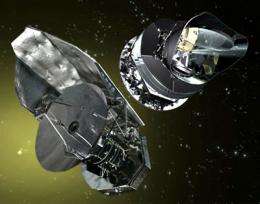
(PhysOrg.com) -- Two of the most sophisticated astronomical spacecraft ever built - Herschel and Planck - will be launched by ESA this month towards deep space orbits around a special observation point beyond the Moon’s orbit.
From there, both spacecraft will begin a revolutionary observation campaign that will further our understanding of the history of the Universe.
Herschel is a large far-infrared space telescope designed to study some of the coldest objects in space, in a part of the electromagnetic spectrum still mostly unexplored. Planck is a telescope that will map the fossil light of the Universe - light from the Big Bang - with unprecedented sensitivity and accuracy. The two missions are among the most ambitious ever carried out by Europe and mark the crossing of new frontiers in the field of space-based astronomy.
The pair will be lofted in tandem by an Ariane 5 ECA launcher. Lift-off is now scheduled for 15:12 CEST (13:12 GMT) on Thursday 14 May, from Europe’s Spaceport in French Guiana. Herschel and Planck will separate shortly after launch and head independently towards the L2 Lagrangian point of the Sun-Earth system, a gravitational stability point suspended in space some 1.5 million kilometres from Earth in the opposite direction to the Sun. While orbiting around that point, they will be able to conduct continuous observations in a thermally-stable environment, far from radiation disturbance caused by the Sun, Earth and Moon.
The 7.5-m-tall, 4-m-wide Herschel is the largest infrared telescope ever launched. The extremely smooth surface of its 3.5-m-diameter primary mirror - made of lightweight silicon carbide - is almost one and a half times bigger than that of Hubble’s, and six times bigger than that of its predecessor ISO launched by ESA in 1995.
With its huge light-collection capability and set of sophisticated detectors cooled to the vicinity of absolute zero by over 2000 litres of superfluid helium, Herschel will look at the faintest and farthest infrared sources and peer into the as-yet uncharted far infrared and submillimetric parts of the spectrum.
Herschel will be able to see through the opacity of cosmic dust and gas and observe structures and events far away that date back to the early Universe - such as the birth and evolution of early stars and galaxies - ten thousand million years ago, in an effort to determine exactly how it all started. Closer by, within our galaxy, Herschel will also observe extremely cold objects, such as the clouds of dust and interstellar gases from which stars and planets are formed, and even the atmosphere around comets, planets and their moons in our own solar system.
Featuring a 1.5 m telescope and instruments sensitive to microwave radiation, Planck will measure temperature variations in the very early Universe. It will monitor the so- called Cosmic Microwave Background, the relic of the very first light ever emitted in space about 380 thousand years after the Big Bang, when the density and temperature of the young Universe had decreased enough to finally allow light to separate from matter and travel freely in space.
With its ‘heart’ operating at unprecedented low temperatures, Planck will deliver unrivalled sensitivity and resolution. By measuring the tiny fluctuations in the temperature of the microwave background radiation, scientists will extract at least 15 times more information about the Universe’s origin, evolution and future than with its most recent predecessor.
Herschel’s detectors will be cooled down to 0.3 degrees above absolute zero. Planck’s detectors will reach even colder temperatures, just 0.1 degrees above 0 K. Indeed, throughout the mission, the coldest points of the Universe may well be inside its payload. The satellite is planned to take some 500 thousand million of raw samples to produce a set of multi-million-pixel sky maps that will also help scientists to understand the Universe’s structure and account as never before for all of its constituents. Planck will be able to determine the total amount of atoms in the Universe, infer the total density of dark matter - an elusive component still inaccessible to direct observations but ‘visible’ through its effects on the surroundings - and even shed new light on the nature of the mysterious dark energy.
Herschel and Planck, two impressive missions designed to revolutionise our understanding of the cosmos, also represent a tremendous technological challenge that has been overcome by ESA thanks to the mobilising of over 100 industrial partners and institutes in Europe, the United States and elsewhere.
Provided by European Space Agency (news : web)


