Sweet deception: New test distinguishes impure honey from the real thing
May 7, 2009 Sweet deception: New test distinguishes impure honey from the real thing

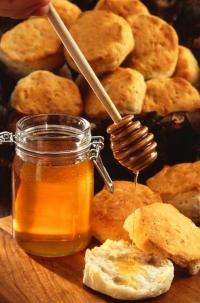
Scientists have developed a test to identify adulterated or impure honey. Credit: U.S. Department of Agriculture

Here's some sweet news for honey lovers: Researchers in France are reporting development of a simple test for distinguishing 100 percent natural honeys from adulterated or impure versions that they say are increasingly being foisted off on consumers. Their study appears in ACS’ Journal of Agricultural and Food Chemistry.

Bernard Herbreteau and colleagues point out that the high price of and its limited supply has led some beekeepers and food processors to fraudulently make and sell impure honey doped with inexpensive sweeteners, such as corn syrup. These knock-offs are almost physically and chemically indistinguishable from the real thing. Scientists need a better way to identify adulterated honey, the researchers say.

Herbreteau and colleagues describe a new, highly sensitive test that uses a special type of chromatography to separate and identify complex sugars (polysaccharides) on their characteristic chemical fingerprints. To test their method, the scientists obtained three different varieties of pure honey from a single beekeeper and then prepared adulterated samples of the honeys by adding 1 percent corn syrup. They showed that the new technique accurately distinguished the impure honeys from the pure versions based on differences in their sugar content.

More information: “Polysaccharides as a Marker for Detection of Corn Sugar Syrup Addition in Honey”,

Provided by American Chemical Society (news : web)


print this article email this article download pdf blog this article bookmark this article     Stumble it Digg this share on Facebook retweet share on Reddit add to delicious
Rate this story - 5 /5 (1 vote)


May 7, 2009 all stories

Comments: 0

5 /5 (1 vote)
  • Stumble this up

  • Digg this

  • share this

  • hide
  • Related Stories


  • hide
  • Relevant PhysicsForums posts

  • Putting every element in a box
    created Nov 25, 2009
  • a question in Lewis structure???
    created Nov 25, 2009
  • Paint Technology
    created Nov 24, 2009
  • About pH, Metallic electrodes
    created Nov 24, 2009
  • More from Physics Forums - Chemistry

Other News

Research sheds light on workings of anti-cancer drug

Chemistry / Analytical Chemistry

created 13 hours ago | popularity not rated yet | comments 0

(PhysOrg.com) -- The copper sequestering drug tetrathiomolybdate (TM) has been shown in studies to be effective in the treatment of Wilson disease, a disease caused by an overload of copper, and certain metastatic cancers. ...


New chemical reaction offers opportunities for drug development

Chemistry / Biochemistry

created 17 hours ago | popularity not rated yet | comments 2

Researchers led by Conway Fellow, Professor Pat Guiry have solved a chemistry problem that has stumped researchers worldwide for more than a decade. The results have earned the group the cover story of the leading scientific ...


Sandia CR5

Machine Converts CO2 into Gasoline, Diesel, and Jet Fuel

Chemistry / Biochemistry

created Nov 23, 2009 | popularity 4.6 / 5 (30) | comments 20

(PhysOrg.com) -- Researchers at Sandia National Laboratories have built a machine that uses the sun's energy to convert carbon dioxide waste from power plants into transportation fuels such as gasoline, diesel, ...


New hydrogen-storage method discovered

New hydrogen-storage method discovered

Chemistry / Materials Science

created Nov 22, 2009 | popularity 4.3 / 5 (42) | comments 15

Scientists at the Carnegie Institution have found for the first time that high pressure can be used to make a unique hydrogen-storage material. The discovery paves the way for an entirely new way to approach ...


New on-off 'switch' triggers and reverses paralysis in animals with a beam of light

New on-off 'switch' triggers and reverses paralysis in animals with a beam of light (w/ Video)

Chemistry / Biochemistry

created Nov 18, 2009 | popularity 4.8 / 5 (5) | comments 4

In an advance with overtones of Star Trek phasers and other sci-fi ray guns, scientists in Canada are reporting development of an internal on-off "switch" that paralyzes animals when exposed to a beam of ultraviolet ...