Former coal mine aids Arctic climate research
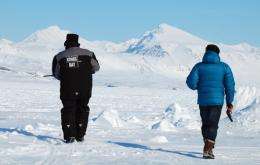
May 8, 2009 by Pierre-Henry Deshayes People with rifle and a flare gun chase a polar bear in the village of Ny-Aalesund

Enlarge

People with rifle and a flare gun chase a polar bear in the village of Ny-Aalesund. The former coal-mining village of Ny-Aalesund, the most northerly village in the world, has become an International Centre of Research on the Norwegian Archipelago of Svalbard (Spitzberg).

Out of place in the snowy, polar landscape, the train that once hauled coal out of the mountain serves as a reminder to scientists at the Ny-Aalesund Arctic research station of the origin of the planet's woes.

Before becoming an international research station where scientists study the effects of global warming, this cluster of coloured buildings in the northwest corner of Norway's Svalbard archipelago was once a mining site for now blamed for .

A firedamp explosion in the coal mine killed 21 men in 1962. The disaster ended the mining era in Ny-Aalesund, which is closer to the North Pole just 1,200 kilometers (745 miles) away than to Oslo, where the tragedy brought down the government.

Scientists in white lab coats have since replaced the black-faced miners, and the remote town -- the northernmost in the world -- has a "broader broadband than London," boasts Kings Bay, the company that runs the site.

There is however no mobile network, and visitors are asked to turn off their cell phones to avoid disturbances to the research station's finely-calibrated measuring instruments.

"It's good to be far away to measure trends" in , Swedish researcher Johan Stroem said from the Zeppelin atmospheric measuring station, located on a peak overlooking Ny-Aalesund.

"When you're in the middle of it, you don't see it. Exactly like when you're in the middle of the forest, you can see a few trees but not the whole thing," he said.

A somewhat erratic cable car brings visitors and researchers up to Zeppelin, which measures, among other things, fine particles from forest fires in North America brought to the Arctic by air currents.

In graphics taped to the walls, all the arrows point upwards, with particularly sharp increases seen in recent decades.

"It's not so much the high level of carbon dioxide in the atmosphere that worries me. Humankind will always adapt and change its lifestyle. We won't go on vacation to the Maldives anymore. But it's the rate at which the concentrations increase which is worrying," Stroem said.

"Over the past 20 years, we've seen a jump of CO2 concentrations at a speed which has never been observed before," he said.

The Svalbard archipelago is on the frontline of global warming. Each year, the volume of its ice cap shrinks by 13 cubic kilometers (3.11 cubic miles) or the equivalent of 5.2 million Olympic-size swimming pools.

And the glaciers around Ny-Aalesund are no exception.

"From one year to the next, I can see them retreat with my own eyes," said Stroem, who has been coming to the research station since 1999.

Jack Kohler, a US glaciologist at the Norwegian Polar Institute, paints a dark picture of the future.

"In 50 to 100 years from now these glaciers will be shadows of themselves. The larger ones will still be here but the smaller ones will be gone," he predicted, expressing concern about the largely overlooked impact the melting of smaller glaciers will have on rising ocean levels.

At the town limits, a docking port for blimps attests to Ny-Aalesund's unique role in the history of polar expeditions.

Norwegian explorer Roald Amundsen, Italy's Umberto Nobile, and Lincoln Ellsworth of the United States left here in 1926 aboard the blimp Norge to become the first team ever to reach the North Pole with certainty.

At the rate at which the sea ice is melting today, the will soon be more easily accessible by boat.

(c) 2009 AFP


print this article email this article download pdf blog this article bookmark this article     Stumble it Digg this share on Facebook retweet share on Reddit add to delicious
Rate this story - 3.7 /5 (7 votes)


May 8, 2009 all stories

Comments: 0

3.7 /5 (7 votes)
  • Stumble this up

  • Digg this

  • share this

  • hide
  • Related Stories

  • Record air pollution above the Arctic
    created May 11, 2006 | popularity not rated yet | comments 0
  • British team trek to North Pole to measure sea ice
    created Mar 01, 2009 | popularity not rated yet | comments 0
  • Briton claims new Svalbard island
    created May 10, 2006 | popularity not rated yet | comments 0
  • Scientists want polar bear protection
    created Jun 20, 2006 | popularity not rated yet | comments 0
  • Scientists expect increased melting of mountain glaciers
    created Jan 20, 2006 | popularity not rated yet | comments 0


  • hide
  • Relevant PhysicsForums posts

  • cycles
    created 11 hours ago
  • The Origin of the term 'fossil' fuels
    created Nov 05, 2009
  • co2
    created Nov 03, 2009
  • Early Earths Sulfidic Ocean Conditions
    created Oct 30, 2009
  • More from Physics Forums - Earth

Other News

Deep creep means milder, more frequent earthquakes along Southern California's San Jacinto fault

Deep creep means milder, more frequent earthquakes along Southern California's San Jacinto fault

Space & Earth / Earth Sciences

created 10 hours ago | popularity 4.7 / 5 (3) | comments 0

With an average of four mini-earthquakes per day, Southern California's San Jacinto fault constantly adjusts to make it a less likely candidate for a major earthquake than its quiet neighbor to the east, the ...


Success in 'space elevator' competition (AP)

Success in 'space elevator' competition (Update 3)

Space & Earth / Space Exploration

created Nov 05, 2009 | popularity 4.3 / 5 (33) | comments 50

(AP) -- A robot powered by a ground-based laser beam climbed a long cable dangling from a helicopter on Wednesday to qualify for prize money in a $2 million competition to test the potential reality of the ...


In a Galaxy Far, Far Away...

In a Galaxy Far, Far Away...

Space & Earth / Astronomy

created Nov 06, 2009 | popularity 4.8 / 5 (5) | comments 15

(PhysOrg.com) -- Astronomers have published the discovery of the farthest known object in the cosmos: a star that exploded when the universe was only 630 million years old -- only 4.6% of its current age. ...


'Dropouts' pinpoint earliest galaxies

'Dropouts' pinpoint earliest galaxies

Space & Earth / Astronomy

created Nov 06, 2009 | popularity 4.2 / 5 (10) | comments 13

Astronomers, conducting the broadest survey to date of galaxies from about 800 million years after the Big Bang, have found 22 early galaxies and confirmed the age of one by its characteristic hydrogen signature ...


Space hotel taking bookings for 2012 opening

Space hotel taking bookings for 2012 opening

Space & Earth / Space Exploration

created Nov 05, 2009 | popularity 4.4 / 5 (21) | comments 11

(PhysOrg.com) -- The first orbiting space hotel is on track to open for its first customers in 2012, but hurry, as bookings are filling fast.