New clues on the link between Heliobacter pylori and stomach cancer
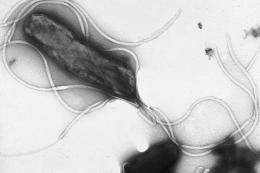
Heliobacter pylori (H. pylori) infection is considered one of the most important risk factors for stomach (or gastric) cancer with as much as 65% of all cases linked back to the bacteria, although exactly how this occurs is not fully clear. But now researchers in Denmark, Portugal and France, publishing in the journal Clinical Cancer Research, show that H. pylori infection contribution to cancer can be linked to at least three independent molecular pathways, which, when disturbed by infection, lead to mutations in the patients’ gastric tissues.
Interestingly, this accumulation of mutations occur only during the initial stages of infection making intervention at this stage crucial if to prevent cancer, a particularly important information when deciding more efficient medical approaches in those areas where antibiotic resistance and re-infection is so widespread that question the relevance of giving treatment against infection.
Despite a drastic reduction in the number of cases, stomach cancer is still the 4th most common cancer and the 2nd cause of cancer death in the world, with about 1 million of people dying every year. That, only in the UK, around 8.000 new cases are diagnosed per year is enough to reveal the magnitude of the problem. The best established risk factor for stomach cancer is Helicobacter pylori infection with a capability to double the risk of disease, although the more virulent H. pylori strains can push this number to as much as 30-fold. This is believed to occur because of the bacteria capacity to lead to acute gastritis, which, if not treated, can becomes chronic and, with time, evolve to more serious disturbances of the gastric wall as result of the chronic inflammation produced by the infection.
Still, although more than half of the world population is infected with H. pylori only a small percentage of these individuals goes to develop cancer proving that other factors are also important. These are known to include the environment - diet and smoking for example - as well as the host genetic predisposition such as a pro-inflammatory genetic profile. But despite these well recognised associations the exact molecular mechanisms behind gastric cancer development - particularly those linked to H. pylori infection - are far from being understood
In this new study researchers Ana Machado, Ceu Figueiredo and Raquel Seruca at IPATIMUP, Eliette Touati from Institute Pasteur and Lene Rasmussen from Roskilde University in Denmark do a through investigation into the problem with the help of three parallel models: human gastric cells growing in laboratory and mice, both infected with a very virulent H. pylori, and cells from biopsies of infected patients with chronic gastritis - trying to understand exactly what happens in H. pylori infected stomachs.
Previous studies have suggested that one of cell systems affected by H. pylori infection was the DNA repair mechanism, mismatch repair (MMR), which - like the name indicates - identifies mismatched pieces of DNA and calls for proteins that cut and insert properly complementary ones. And in fact when Machado, Figueiredo and colleagues looked at H. pylori infected cells their, MMR levels were abnormally reduced, an observation further confirmed in gastric cells of infected mice, although, interestingly, only at 3 months post-infection as normal levels were already restored after 12 months (when the chronic disease is already chronic).
Because problems in MMR are known to result in genomic instability and mutations, the stomachs of infected mice were analysed after 6 months of infection to find, that in fact, they contained an abnormal number of mutations although, again, by 12 months post-infection values were back to normal, in agreement with previously observed MMR variations.
What these results suggested was that H. pylori effect on MMR was temporary, and that by 12 months, when MMR is back to normal and no more mutations are accumulating, the altered cells have also been eliminated probably by a compensatory mechanism such as accelerated cell death and fast cell division. Nevertheless, as we know that one escaped cell at this stage, later progressing to malignancy, is enough to induce cancer this observation of apparent normality at 12 months does not exclude the possibility of cancer appearance later on.
Mutations in mitochondrial DNA (mitochondrion are the cell’s power plants supplying energy for all its functions) have been found in pre-cancerous gastric cells. Not only that but it has been suggested that H. pylori could lead to oxidative stress - a situation where highly reactive oxygen molecules, which are normally the by-product of mitochondria, occur in toxic quantities damaging the DNA. Both these observations suggested that mitochondria’s function could be affected during H. pylori infection and led Machado and Figueiredo to investigate.
And in fact, when the researchers looked into the infected cells’ mitochondrial DNA this again presented abnormally high number of mutations. The relevance of this observation was confirmed when gastric cells from infected patients with chronic gastritis where found to have, not only an abnormal number of mutations, but mutations of the same type and affecting the same areas in the mitochondrial DNA, than those found in the infected cells. Further confirming that these mutations were linked to the H. pylori infection, the more virulent was the strain infecting the patient, the higher was the number of mutations found in their gastric cells. The researchers also found that BER - a DNA repair mechanism linked to oxidative damage in mitochondrial DNA - was also affected during the infection with one of its components not being produced in quantities enough to allow proper DNA repair.
Machado, Figueiredo and colleagues’ work reveal that H. pylori infection seems to affect temporarily the host DNA repair mechanisms resulting in a dangerous accumulation of mutations. These mutations, although apparently eliminated when the infection is chronic, have, nevertheless, the potential to originate cancer as one escaped malignant cell is enough to trigger the whole process. In conclusion, H. pylori-induced carcinogenesis is the combinatorial result of at least three linked mutagenic phenomena resulting from impairments in MMR, mitochondria and BER.
This work has several implications: for a start it helps to establish a definitive link between H. pylori and cancer development, explaining (at least part of) the molecular mechanism behind it, and maybe contributing to the development of better strategies for the prevention of stomach cancer.
In fact, trials to prevent cancer by eradicating the bacteria have had conflicting results, which now might be partially explained by the fact that H. pylori infection only seems to be mutagenic during the early stages of disease, so treatment at later stages of the disease would not be effective preventing cancer. Until now consensus was that the optimum time to eradicate H. pylori was before intestinal metaplasia appeared, but even this seemed to be relevant in only a subset of subjects. On the face of Machado and Figueiredo’s study it will be interesting to see if eradication at a much earlier stage, more in agreement with the results here described, could help to substantially increase the number of those responding to treatment.
Finally, Machado and Figueiredo’s study is also particularly important in those regions where both H. pylori infection and antibiotic resistance are at rift, and where some defend that - due to the high probability of reinfection - treating the disease is not worthwhile, as it shows that, at least among those patients recently infected, treatment can be crucial to prevent cancer.
Stomach cancer is not only incredibly widespread but it also has a very poor prognosis with less than 20% of the patients -15% in the UK - surviving more than 5 years, what makes any new information on the disease with potential to help preventing it, particular important.
More information: Clinical Cancer Research - 15, 2995, May 1, 2009 doi: 10.1158/1078-0432.CCR-08-2686, “Helicobacter pylori Infection Induces Genetic Instability of Nuclear and Mitochondrial DNA in Gastric Cells”
Source: Ciência Viva


