Warning: Sunspot cycle beginning to rise
May 8, 2009 By RANDOLPH E. SCHMID , AP Science Writer
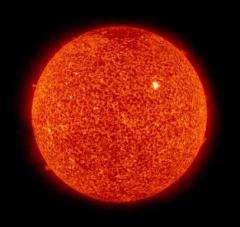
FILE - In this undated image provided by NASA's Solar and Heliospheric Observatory (SOHO) shows a new sunspot, upper right, which after many weeks of a blank sun with no sunspots and very few sunspots this entire year, emerged Sept. 23, 2008. When the sun sneezes it's Earth that gets sick. It's time for the sun to move into a busier period for sunspots, and while forecasters expect a relatively mild outbreak by historical standards, one major solar storm can cause havoc with satellites and electrical systems here. (AP Photo/NASA/ESA, FILE)
(AP) -- When the sun sneezes it's Earth that gets sick. It's time for the sun to move into a busier period for sunspots, and while forecasters expect a relatively mild outbreak by historical standards, one major solar storm can cause havoc with satellites and electrical systems here.
Like hurricanes, a weak cycle refers to the number of storms, but it only takes one powerful storm to create chaos, said scientist Doug Biesecker of the National Oceanic and Atmospheric Administration's space weather prediction center.
A report by the National Academy of Sciences found that if a storm as severe as one in 1859 occurred today, it could cause $1 trillion to $2 trillion in damage the first year and take four to 10 years to recover.
The 1859 storm shorted out telegraph wires, causing fires in North America and Europe, sent readings of Earth's magnetic field soaring, and produced northern lights so bright that people read newspapers by their light.
Today there's a lot more than telegraph lines at stake. Vulnerable electrical grids circle the globe, satellites now vital for all forms of communications can be severely disrupted along with the global positioning system. Indeed, the panel warned that a strong blast of solar wind can threaten national security, transportation, financial services and other essential functions.
The solar prediction center works closely with industry and government agencies to make sure they are prepared with changes in activity and prepared to respond when damage occurs, Biesecker said in a briefing.
While the most extreme events seem unlikely this time, there will probably be smaller scale disruptions to electrical service, airline flights, GPS signals and television, radio and cell phones.
On the plus side, the solar storms promote the colorful auroras, known as the northern and southern lights, high in the sky over polar areas.
An international panel headed by Biesecker said Friday it expects the upcoming solar cycle to be the weakest since 1928.
The prediction calls for the solar cycle to peak in May 2013 with 90 sunspots per day, averaged over a month. If the prediction proves correct it will be the weakest cycle since a peak of 78 daily sunspots in 1928.
Measurement of sunspot cycles began in the 1750s.
The panel described solar storms as eruptions of energy and matter that escape from the sun. At least some of this heads toward the Earth.
Solar cycles of more and fewer sunspots last several years and the cycle currently building up will be number 24 since counting began.
It's only the third time researchers have tried to make such a forecast. In 1989 a panel predicted Cycle 22, which peaked that year. And in 1996 scientists predicted Cycle 23.
Both earlier groups did better at predicting timing than intensity, according to Biesecker.
The last solar minimum occurred in December, the researchers said.
W. Dean Pesnell of the National Aeronautics and Space Administration said the forecasts are based on such indicators as the strength of the sun's magnetic field at the poles and the reaction of the Earth's magnetic field to the sun. Both are weak right now, he said, with only a few sunspots visible since 2007.
A preliminary forecast issued in 2007 was split over the outlook for the upcoming cycle, Biesecker said the researchers have now reached consensus.
---
On the Net:
NOAA: http://www.noaa.gov
NASA: http://www.nasa.gov
Space Weather Center: http://www.spaceweather.gov
©2009 The Associated Press. All rights reserved. This material may not be published, broadcast, rewritten or redistributed.
-
Next solar storm cycle will likely start next March
Apr 27, 2007 |
not rated yet |
0
-
Sunspot is harbinger of new solar cycle, increasing risk for electrical systems
Jan 07, 2008 |
not rated yet |
0
-
The Sun Loses its Spots
Jul 24, 2007 |
not rated yet |
0
-
Is a New Solar Cycle Beginning?
Dec 17, 2007 |
not rated yet |
0
-
Old Solar Cycle Returns
Mar 28, 2008 |
not rated yet |
0
-
Engineers build first sub-10-nm carbon nanotube transistor
Feb 01, 2012 |
4.9 / 5 (33) |
30
-
Something old, something new: Evolution and the structural divergence of duplicate genes
Jan 31, 2012 |
4.6 / 5 (7) |
1
-
The hidden nanoworld of ice crystals: Revealing the dynamic behavior of quasi-liquid layers
Jan 30, 2012 |
5 / 5 (4) |
1
-
Stock market network reveals investor clustering
Jan 27, 2012 |
3.9 / 5 (23) |
8
-
Of microchemistry and molecules: Electronic microfluidic device synthesizes biocompatible probes
Jan 26, 2012 |
5 / 5 (2) |
0
-
Never ending outer space.....
Feb 11, 2012
-
Neutron Star fragments?
Feb 11, 2012
-
stationary or not?
Feb 11, 2012
-
Scale of the Universe
Feb 10, 2012
-
Titan's lack of impact craters
Feb 09, 2012
-
Real pictures of black hole eating a star?
Feb 08, 2012
- More from Physics Forums - General Astronomy
More news stories
Latin America mining boom clashes with conservation
Latin America is experiencing a mining boom as prices rise fuelled by a hike in global demand, but the region is also being hit by a wave of violent protests, strikes and rallies by environmentalists.
20 hours ago |
5 / 5 (1) |
1
Salvage workers begin pumping fuel from Italian shipwreck
Salvage workers Sunday began pumping fuel from the shipwrecked Italian cruise liner Costa Concordia, a day ahead of schedule, officials said.
12 hours ago |
5 / 5 (2) |
0
Political leaders play key role in how worried Americans are by climate change: study
More than extreme weather events and the work of scientists, it is national political leaders who influence how much Americans worry about the threat of climate change, new research finds.
Feb 06, 2012 |
5 / 5 (8) |
75
NASA budget will axe Mars deal with Europe: scientists
US President Barack Obama's budget proposal to be submitted next week for 2013 will cut NASA's budget by 20 percent and eliminate a major partnership with Europe on Mars exploration, scientists said Thursday.
Space & Earth / Space Exploration
Feb 10, 2012 |
5 / 5 (4) |
58
Humans may have helped the decline of African rainforests 3000 years ago
(PhysOrg.com) -- Large areas of rainforests in Central Africa mysteriously disappeared over three thousand years ago, to be replaced by savannas. The prevailing theory has been that the cause was a change ...
Scientists discover molecular secrets of 2,000-year-old Chinese herbal remedy
For roughly two thousand years, Chinese herbalists have treated Malaria using a root extract, commonly known as Chang Shan, from a type of hydrangea that grows in Tibet and Nepal. More recent studies suggest that halofuginone, ...
New method to examine batteries -- MRI from the inside
There is an ever-increasing need for advanced batteries for portable electronics, such as phones, cameras, and music players, but also to power electric vehicles and to facilitate the distribution and storage of energy derived ...
A mitosis mystery solved: How chromosomes align perfectly in a dividing cell
Although the process of mitotic cell division has been studied intensely for more than 50 years, Whitehead Institute researchers have only now solved the mystery of how cells correctly align their chromosomes during symmetric ...
Google might launch Drive for cloud storage soon
(PhysOrg.com) -- Google's next big move, according to the Wall Street Journal, is a cloud storage service called Drive. Hardly first to the plate, Google is simply catching up to introducing its cloud reposi ...
Lab study raises questions over nano-particle impact
Tests involving chickens have raised questions about the impact on health from engineered nano-particles, the ultra-fine grains commonly used in drugs and processed foods, scientists said on Sunday.
Starve a virus, feed a cure? Findings show how some cells protect themselves against HIV
A protein that protects some of our immune cells from the most common and virulent form of HIV works by starving the virus of the molecular building blocks that it needs to replicate, according to research published online ...
May 08, 2009
Rank: 3.4 / 5 (5)
May 08, 2009
Rank: 1.8 / 5 (4)
May 09, 2009
Rank: 4.8 / 5 (4)
May 09, 2009
Rank: 5 / 5 (5)
Anyone else get confused by this run on sentence? If the image is of a new sunspot, why do they mention Sept. 23? It's May 2009.
The rest of the article is just as confusing. Hopping around without a point. Is it a "fear the sun" article? Is it presenting any new information?
Seems like a really half-hearted effort to spew some fear-mongering misinformation.
May 09, 2009
Rank: 5 / 5 (4)
Also apparently a sunspot that appeared a year ago is big news.
May 09, 2009
Rank: 3.3 / 5 (3)
May 09, 2009
Rank: 4 / 5 (3)
May 09, 2009
Rank: 5 / 5 (3)
May 09, 2009
Rank: 5 / 5 (3)
I feel for all the poor radio hams who've had little to no opportunities to send or receive signals over any significant distance.
solarcycle24.com is my personal fave.
And interestingly enough, the cycle was forecast to peak in early 2012, but now they've pushed it back to near the start of 2013. So no, all the new-age parties are still raging.
May 09, 2009
Rank: 4 / 5 (3)
http://sohowww.na..._195.jpg
Soho Magnetogram:
http://sohowww.na...est.html
The NOAA press release this appears to be based on:
http://www.spacew...4sf7hst6
Finally, spaceweather.com's archive for May 8th:
http://www.spacew...p?view=1&day=08&month=05&year=2009