Research suggests children can recover from autism
May 8, 2009 By LINDSEY TANNER , AP Medical Writer Research suggests children can recover from autism (AP)

Enlarge

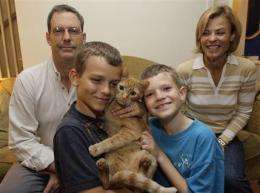
Leo Lytel, second from right, 9, and his family David Lytel, left, Lucas Lytel, 11, and Jayne Lytel pose for a photograph with one of the family cats in their home in Washington Wednesday, May 6, 2009. Leo was diagnosed with autism as a toddler. He was undiagnosed at age 9. Provocative new research suggests that 10 percent of autistic children actually "recover" from the troubling developmental disorder and lose the diagnosis later on in childhood. (AP Photo/Alex Brandon)

(AP) -- Leo Lytel was diagnosed with autism as a toddler. But by age 9 he had overcome the disorder. His progress is part of a growing body of research that suggests at least 10 percent of children with autism can "recover" from it - most of them after undergoing years of intensive behavioral therapy.

Skeptics question the phenomenon, but University of Connecticut psychology professor Deborah Fein is among those convinced it's real.

She presented research this week at an conference in Chicago that included 20 children who, according to rigorous analysis, got a correct diagnosis but years later were no longer considered autistic.

Among them was Leo, a boy in Washington, D.C., who once made no eye contact, who echoed words said to him and often spun around in circles - all classic autism symptoms. Now he is an articulate, social third-grader. His mother, Jayne Lytel, says his teachers call Leo a leader.

The study, funded by the National Institute of Mental Health, involves children ages 9 to 18.

Autism researcher Geraldine Dawson, chief science officer of the advocacy group Autism Speaks, called Fein's research a breakthrough.

"Even though a number of us out in the clinical field have seen kids who appear to recover," it has never been documented as thoroughly as Fein's work, Dawson said.

"We're at a very early stage in terms of understanding" the phenomenon, Dawson said.

Previous studies have suggested between 3 percent and 25 percent of autistic kids recover. Fein says her studies have shown the range is 10 percent to 20 percent.

But even after lots of therapy - often carefully designed educational and social activities with rewards - most autistic children remain autistic.

Recovery is "not a realistic expectation for the majority of kids," but parents should know it can happen, Fein said.

Doubters say "either they really weren't autistic to begin with ... or they're still socially odd and obsessive, but they don't exactly meet criteria" for autism, she said.

Fein said the children in her study "really were" autistic and now they're "really not."

University of Michigan autism expert Catherine Lord said she also has seen autistic patients who recover. Most had parents who spent long hours working with them on behavior improvement.

But, Lord added, "I don't think we can predict who this will happen for." And she does not think it's possible to make it happen.

The children in Fein's study, which is still ongoing, were diagnosed by an autism specialist before age 5 but no longer meet diagnostic criteria for autism. The initial diagnoses were verified through early medical records.

Because the phenomenon is so rare, Fein is still seeking children to help bolster evidence on what traits formerly autistic kids may have in common. Her team is also comparing these children with autistic and non-autistic kids.

So far, the "recovered" kids "are turning out very normal" on neuropsychological exams and verbal and nonverbal tests, she said.

The researchers are also doing imaging tests to see if the recovered kids' brains look more like those of autistic or nonautistic children. Autistic children's brains tend to be slightly larger than normal.

Imaging scans also are being done to examine brain function in formerly autistic kids. Researchers want to know if their "normal" behavior is a result of "normal" brain activity, or if their brains process information in a non-typical way to compensate for any deficits.

Results from those tests are still being analyzed.

Most of the formerly autistic kids got long-term behavior treatment soon after diagnosis, in some cases for 30 or 40 hours weekly.

Many also have above-average IQs and had been diagnosed with relatively mild cases of autism. At age 2, many were within the normal range for motor development, able to walk, climb and hold a pencil.

Significant improvement suggesting recovery was evident by around age 7 in most cases, Fein said.

None of the has shown any sign of relapse. But nearly three-fourths of the formerly autistic kids have had other disorders, including attention-deficit problems, tics and phobias; eight still are affected.

Jayne Lytel says Leo sometimes still gets upset easily but is much more flexible than before.

---

On the Net

National Institute of Mental Health: http://www.nimh.nih.gov

Autism Speaks: http://www.autismspeaks.org

©2009 The Associated Press. All rights reserved. This material may not be published, broadcast, rewritten or redistributed.


print this article email this article download pdf blog this article bookmark this article     Stumble it Digg this share on Facebook retweet share on Reddit add to delicious
Rate this story - 4.7 /5 (6 votes)

Rank Filter

Move the slider to adjust rank threshold, so that you can hide some of the comments.


Display comments: newest first

  • KBK - May 09, 2009
    • Rank: 1 / 5 (2)
    If one gets the shit our of their diets and the corporations with their vaccines and metabolic poisons out of their lives..... well your children too -can recover from autism!
  • Nik_2213 - May 10, 2009
    • Rank: not rated yet
    I am so happy that this child was among the ~10% who find a 'second wind' and become 'late developer / high achiever'.

    Um, IIRC, the UK's recent experience with the MMR scare reducing vaccination uptake showed no reduction in autism cases.

    It did show a lot of kiddies get very, very sick without those vaccinations. And, without their rubella vaccination, a swathe of adolescent girls may yet be blighted with sterility or birth defects...
    ---

    Um, KBK, without vaccines, how do you protect yourself from measles, mumps, rubella, pneumonia, annual flu', smallpox, diptheria, tetanus, several hepatitis, tuberculosis etc etc ??

    For most of those dire ailments, the answer is 'herd immunity': You gotta hope enough sheeple take the contrary view to you. Your best game-plan is not to convince them to abstain...

    For the rest of those diseases, well, good luck-- You'll need it. Then, next time you or your dependent is in ER with a really, really dirty wound and an anti-tet injection is offered, think quickly...

May 8, 2009 all stories

Comments: 2

4.7 /5 (6 votes)
  • Stumble this up

  • Digg this

  • share this

  • hide
  • Related Stories

  • Study: Fever may ease autism for a while
    created Dec 24, 2007 | popularity not rated yet | comments 0
  • Preschool kids do better when they talk to themselves, research shows
    created Mar 28, 2008 | popularity not rated yet | comments 0
  • No link found between autism and celiac disease
    created May 01, 2007 | popularity not rated yet | comments 0
  • Older men risk siring autistic kids
    created Sep 05, 2006 | popularity not rated yet | comments 0
  • Study supports theory that rise in autism is related to changes in diagnosis
    created Apr 09, 2008 | popularity not rated yet | comments 0


  • hide
  • Relevant PhysicsForums posts

Other News

Scientists report first effective medical therapy for rare stomach disorder

Medicine & Health / Cancer

created 56 minutes ago | popularity not rated yet | comments 0

A drug used to treat colorectal cancer also can reverse a rare stomach disorder and should be considered first-line therapy for the disease, researchers at Vanderbilt University Medical Center report this week.


Jail

Preventing Spread of HIV in Jails: Best Window of Opportunity Early in Incarceration

Medicine & Health / HIV & AIDS

created 36 minutes ago | popularity not rated yet | comments 0

(PhysOrg.com) -- With World AIDS Day less than a week away, two new studies from Yale School of Medicine show that jail inmates, one of the highest risk groups for AIDS, are far more likely to be tested for ...


Implant-based cancer vaccine is first to eliminate tumors in mice

Medicine & Health / Cancer

created 1hour ago | popularity 5 / 5 (1) | comments 0

A cancer vaccine carried into the body on a carefully engineered, fingernail-sized implant is the first to successfully eliminate tumors in mammals, scientists report this week in the journal Science Translational Medicine.


CDC: Swine flu vaccine safe; no big problems seen

Medicine & Health / Medications

created 1hour ago | popularity not rated yet | comments 0

(AP) -- U.S. health officials say there's no evidence that the swine flu vaccine is causing any serious side effects.


Feeding the clock

Feeding the clock: Cycles of feeding and fasting drive circadian gene expression in the liver

Medicine & Health / Research

created 4 hours ago | popularity 4 / 5 (1) | comments 0

When you eat may be just as vital to your health as what you eat, found researchers at the Salk Institute for Biological Studies. Their experiments in mice revealed that the daily waxing and waning of thousands ...