Sources: Senators weigh 3 government health plans
May 9, 2009 By RICARDO ALONSO-ZALDIVAR , Associated Press Writer Sources: Senators weigh 3 government health plans (AP)

Enlarge

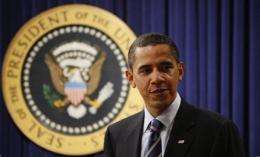
President Barack Obama finishes his remarks during an unannounced visit to a Spanish language town hall meeting on the H1N1 swine flu virus, Friday, May 8, 2009, in the Eisenhower Executive Office building on the White House complex in Washington. (AP Photo/Charles Dharapak)

(AP) -- Senators are considering three different designs for a new government health insurance plan that middle-income Americans could buy into for the first time, congressional officials said Friday. Officials familiar with the proposals said senators plan to debate them in a closed meeting next week. The officials spoke on condition of anonymity because details of the controversial plans have not been released.

Creating a public plan is one of the most contentious ideas in the debate over how to overhaul the nation's to cover the uninsured and try to restrain costs.

President and many Democrats say a government option would serve as a check to keep the private insurance industry honest.

Insurers fear the government would use its power to drive them out of business. And Republicans call a public plan in the legislation a dealbreaker, dashing hopes for bipartisan legislation for overhauling the health insurance system. Employer groups are also opposed.

The three approaches being discussed are:

-Create a plan that resembles Medicare, administered by the Health and Human Services department.

-Adopt a Medicare-like plan, but pick an outside party to run it. That way government officials would not directly control the day-to-day operations.

-Leave it up to individual states to set up a public insurance plan for their residents.

But many key details would still have to be fleshed out.

Among them is whether the public plan would be open to everyone, or be limited to small businesses and individuals purchasing coverage on their own.

Also, would the plan reimburse medical providers at discounted Medicare rates or the higher fees that private insurers pay? And would it be financed by tax dollars, or entirely from premiums?

Senators on the Finance Committee will consider the proposals during a closed-door session scheduled for late next week. Committee leaders want to bring a bill to the Senate floor this summer. It's unclear whether a public plan in any form will emerge from Congress.

Citing surveys that show most seniors are happy with Medicare, Democrats say they believe that a public plan would be a political winner. But Republicans counter that it would be a step toward a government-run system in which medical services sooner or later would be rationed.

The majority of Americans now get through private insurers, about 170 million people in all. Most of them are enrolled in employer-sponsored plans.

A recent report by the Lewin Group, a numbers-crunching firm that serves government and private clients, found that a new government plan could radically alter that landscape - or maybe not.

It depends on the design.

If the public plan were open to all employers and individuals - and if it paid doctors and hospitals the same as Medicare - it would quickly grow to 131 million members, while enrollment in private insurance plans would plummet, the study found.

By paying rates the government plan would be able to set premiums well below what private plans charge. Employers and individuals would rush to sign up.

But the results would be far different if the government plan was limited to small employers, individuals and the self-employed.

In that smaller-scale scenario, the public plan would get from 17 million to 43 million members, the study said. It found that a government plan could be effective in reducing number of uninsured.

Lewin is a subsidiary of UnitedHealthcare, the nation's largest health insurer. The consulting firm says it makes its own judgments, however. Its work is used by groups on all sides of the health care debate, including supporters of a public plan.

©2009 The Associated Press. All rights reserved. This material may not be published, broadcast, rewritten or redistributed.


print this article email this article download pdf blog this article bookmark this article     Stumble it Digg this share on Facebook retweet share on Reddit add to delicious
Rate this story - 2 /5 (5 votes)

Rank Filter

Move the slider to adjust rank threshold, so that you can hide some of the comments.


Display comments: newest first

  • GrayMouser - May 09, 2009
    • Rank: 3 / 5 (2)
    The government has no constitutional mandate allowing them to provide health plans. Given their past performance, and the performance of other governments, and plan will be a bare bones minimum with poor service.
  • SDDuude - May 09, 2009
    • Rank: not rated yet
    Interesting enough, the 3 choices they're looking at include two plans that emulate our failed medicare system which is entirely bankrupt, while the 3rd is to allow states to choose themselves. This tells me that Congress won't come up with new ideas. They're either too lazy or to tired of coming up with failed policies to try anything innovative.
  • Ivan2 - May 10, 2009
    • Rank: not rated yet
    (...)performance of other governments, and plan will be a bare bones minimum with poor service.

    It's a senatorial plan for health insurance for *middle-income Americans*: zzzzzzzzz...

    They couldn't touch the subject when middle-income Americans existed. Their paying lobbies wouldn't let them.

    tells me that Congress won't come up with new ideas. They're either too lazy or to tired(...)

    Maybe their lobbies have been paying less because of the crisis and congress is making this racket because it's trying to press them to release the dough. I am so not impressed.

May 9, 2009 all stories

Comments: 3

2 /5 (5 votes)
  • Stumble this up

  • Digg this

  • share this

  • hide
  • Related Stories


  • hide
  • Relevant PhysicsForums posts

Other News

Why can't chimps speak? Study links evolution of single gene to human capacity for language

Why can't chimps speak? Study links evolution of single gene to human capacity for language

Medicine & Health / Genetics

created 13 hours ago | popularity 4.4 / 5 (9) | comments 0

(PhysOrg.com) -- If humans are genetically related to chimps, why did our brains develop the innate ability for language and speech while theirs did not?


Review: Reporting on Pfizer drug studies fudged

Medicine & Health / Medications

created 9 hours ago | popularity 4.7 / 5 (3) | comments 3

(AP) -- Analysis of a dozen published studies testing possible new uses for a Pfizer Inc. epilepsy drug found that reporting of the results was often fudged, indicating the medicine worked better than internal company documents ...


Microbial menagerie: Junk food binge alters community of microbes in the gut in less than a day

Medicine & Health / Research

created 9 hours ago | popularity 4.5 / 5 (2) | comments 2

(PhysOrg.com) -- Switching from a low-fat, plant-based diet to one high in fat and sugar alters the collection of microbes living in the gut in less than a day, with obesity-linked microbes suddenly thriving, according to ...


Longevity tied to genes that preserve tips of chromosomes

Medicine & Health / Genetics

created 8 hours ago | popularity 5 / 5 (6) | comments 0

A team led by researchers at Albert Einstein College of Medicine of Yeshiva University has found a clear link between living to 100 and inheriting a hyperactive version of an enzyme that rebuilds telomeres - the tip ends ...


Few Americans make end-of-life wishes known (AP)

Few Americans make end-of-life wishes known

Medicine & Health / Health

created 1hour ago | popularity not rated yet | comments 0

(AP) -- Lillian Landry always said she wasn't afraid to die. So when death came last week, the 99-year-old was lying peacefully in a hospice with no needles or tubes. Her final days saw her closest friend ...