More 'Star Trek' than 'Snuggie': Student design to protect lunar outpost from dangerous radiation
May 11, 2009 By Caroline Barnhill More 'Star Trek' than 'Snuggie': Student design to protect lunar outpost from dangerous radiation

Enlarge

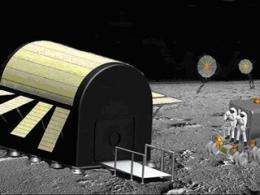
NC State grads Michael Sieber, Ryan Boyle and Anne Tomasevich designed a lunar shield with the ability to protect its inhabitants from radiation.

(PhysOrg.com) -- Alien creatures are the least of NASA's worries when it comes to moon travel. There are several potential threats to future missions - with space radiation at the top of the list. Now, a group of students at North Carolina State University has developed a "blanket" of sorts that covers lunar outposts - the astronauts' living quarters - to provide astronauts protection against radiation while also generating and storing power.

Astronauts who previously traveled to the had little protection against , but were only exposed to it for a short amount of time. NASA's plans to return astronauts to the moon by 2020 - and to potentially keep them there for several months at a time - could be stymied by .

The surface of the moon is exposed to cosmic rays and - making radiation hard to stop with shielding. When these rays hit matter, they produce a dangerous spray of secondary particles which, when penetrating human flesh, can damage DNA, boosting the risk of cancer and other maladies.

Groups all over the globe are trying to determine ways to combat space radiation - including Michael Sieber, Ryan Boyle and Anne Tomasevich, all recent graduates of the textile engineering program at NC State. Their design of a lunar radiation shield with the ability to protect its inhabitants from radiation was reviewed by a panel of industry experts and chosen as one of 10 undergraduate abstract finalists in the Revolutionary Aerospace Systems Concepts Academic Linkage (RASC-AL) competition.

Sponsored by NASA and the National Institute of Aerospace, the RASC-AL competition challenges university students to think about what sorts of conditions astronauts will face when returning to the moon, then design projects that might become part of actual lunar exploration.

"We had many factors to consider in developing this outpost cover - not just being able to protect against radiation," Sieber says. "The product needed to be as lightweight as possible to feasibly fit on the transportation module, and have the ability to be easily erected by a minimum number of astronauts for immediate use once landing on the moon."

"These obstacles are where our knowledge of textile properties will give us an advantage," adds Dr. Warren Jasper, professor of textile engineering and advisor for the project. "This is a competition aimed at aerospace engineering students, but we understand the properties associated with different textile materials, and that gives us unique insight on how to troubleshoot some of these issues."

The "lunar texshield" is made from a lightweight polymer material that has a layer of radiation shielding that deflects or absorbs the radiation so astronauts are only exposed to a safe amount. The outermost surface of the shield includes a layer of solar cells to generate electricity, backed up by layers of radiation-absorbing materials. The advantages of the materials used in the design include flexibility, large surface area, ease of transportation, ease of construction and the ability to have multiple layers of independent functional fabrics.

The students will present their lunar texshield at the 2009 RASC-AL Forum held June 1-3 in Cocoa Beach, Fla. The project will be judged by a steering committee made up of experts from NASA, industry and universities.

"We aren't even sure what the prize is for being named first place - but that wasn't what was important to us," Sieber says. "We used what we've learned throughout our college careers and were able to apply that logic to provide a solution a real-world problem. That is what is cool to us."

Source: North Carolina State University (news : web)


Rate this story - 4.8 /5 (11 votes)

Rank Filter

Move the slider to adjust rank threshold, so that you can hide some of the comments.


Display comments: newest first

  • zevkirsh - May 11, 2009
    • Rank: 1 / 5 (2)
    not only have we known the lunar base would never happen since obama was elected, and since he officially directed nasa away from bushs lunar hopes, but the blanky is a useless idea anyway. a blanky?! the thing would just collect dust (regolith)
  • Azpod - May 11, 2009
    • Rank: not rated yet
    not only have we known the lunar base would never happen since obama was elected, and since he officially directed nasa away from bushs lunar hopes, but the blanky is a useless idea anyway. a blanky?! the thing would just collect dust (regolith)


    In this case, collecting dust may not be a bad thing! It's make the solar power generation side useless, but it'd just provide that much extra protection from radiation.

    The best solution, of course, is to make the astronaut living quarters "underground" by using robotic earth movers (something already being discussed) piling up regolith against a static structure & putting a foot or so on top.

    As for the politics of going to the Moon, I fear that may be a problem. Not just with Obama but with Congress overall. Even the call for shrinking the size of the federal budget go out, NASA is always chosen to be the whipping boy.
  • dirk_bruere - May 11, 2009
    • Rank: 1 / 5 (3)
    It's pointless the US going to the moon fo0r two reasons:
    a) The Chinese will be there first
    b) Burrowing into an asteroid like Ceres, or going to Mars, makes more sense for long term bases.
  • holoman - May 11, 2009
    • Rank: 1 / 5 (1)
    Dirk,

    In contradiction, NASA carried out six manned moon landings between 1969 and 1972.

    China 000000000000=0000000000

    What we need is the old visionary NASA to become
    a Phoenix.
  • Shootist - May 11, 2009
    • Rank: 1 / 5 (2)
    What the US needs is to shut NASA down. Pournelle's Iron Law of Bureaucracy has taken over and rules the Space Agency.


    Pournelle's Iron Law of Bureaucracy states that in any bureaucratic organization there will be two kinds of people: those who work to further the actual goals of the organization, and those who work for the organization itself. The latter group always ends up in control.


    Case in point. The method NASA decided to use to return to the Moon. Re-building the Saturn V would have cost less, taken less time to build and is already Manned certified.


    Built with modern materials; I'd bet the first stage would be capable of SSTO.

    Of course the last thing NASA wants is cheap access to LEO.
  • docknowledge - May 12, 2009
    • Rank: 1 / 5 (1)
    Shootist,

    That thinking isn't wrong, it's just too much TV or pulp science fiction. NASA was always a bureaucracy. The difference in the 1960s (there were still people from then, when I was there) and later is that NASA wasn't being run by Count Von Braun. The man was German nobility, he had a sense of social obligation, and he knew how to rule. The American public -- believing itself -- responded to someone who was a winner.

    Those conditions will not be repeated, and we must live with that. There are plenty of people in NASA who would cheer on any positive step. Our country (and the ESA, and Japan, and any other country, for that matter who wants to help) needs to have a vision.

    That's what's changed. The lack of vision.
  • djp - May 12, 2009
    • Rank: 1 / 5 (1)
    mirrors and curtains to fool the uninitiated.
  • RocketScientist - May 15, 2009
    • Rank: 5 / 5 (1)
    Aside from the NASA quibbling and speculation, I was thinking about this "blankie" idea. Ideally, the use of regolith or Lunar "dirt" would satisfy the need for radiation protection while negating the need to bring any additional payload. However with the study of Regolith, it's a very tricky substance. Having been unsubjected to the erosive effects of wind or water, the particles are spiny, and interlock with each other. Additionally, the presence of boulders or large rocks are scattered through the substrate much like a bread pudding. This makes excavation of the lunar surface very difficult. Some design attempts at lunar excavation include robotic excavation machines (See the CalPoly competition), or using shaped charges to blast holes into the surface. It will be a long time before lunar bases are built below the surface.
    In the meantime, reliable structures that can withstand radiation and micrometeorites have a very good chance of meeting NASA's approval. I would not be surprised to see more public interest in the realm of space structures and composite/radiation materials, especially since Bigelow works toward Space Hotels.
  • Jayofalltrades - May 18, 2009
    • Rank: not rated yet
    Ideally the best way to protect against radiation and micrometeorites would be to build on the side of a crater wall, preferably on a crater wall that faces the trailing side, or rotation, of the moon. Statistically, this would be an ideal place to build whatever structure they use. The problems with piling the regolith are numerous, and to add another to the list, these structures would probably keep their shape using mostly air pressure. Piling dirt on top of such a structure would be... not a good idea. What is needed is one of two things. a) an easy and cheap method of getting finished products to the moon, such as a space elevator or an orbital railgun. b) A foundry on the moon or in orbit. Hey, I have an idea. Why don't we start slinging some space junk at the moon, then use that for raw material? Its already in orbit, all it needs is the proper momentum coupled with some decent timing to get it in the moon's orbit.

May 11, 2009 all stories

Comments: 9

4.8 /5 (11 votes)

  • hide
  • Related Stories

  • How much radiation awaits lunar colonists? A new NASA mission aims to find out
    created Sep 09, 2005 | popularity not rated yet | comments 0
  • Space radiation threats to astronauts addressed in federal research study
    created Oct 25, 2006 | popularity not rated yet | comments 0
  • 'Force Field' to Protect Lunar Astronauts From Space Radiation
    created Jun 27, 2005 | popularity not rated yet | comments 0
  • Lunar Outpost Plans Taking Shape
    created Oct 01, 2007 | popularity not rated yet | comments 0
  • Detecting Radiation on Lunar and Mars Missions
    created Feb 20, 2007 | popularity not rated yet | comments 0


  • hide
  • Relevant PhysicsForums posts

  • Spreading Life in the Universe
    created 11 hours ago
  • Force of Gravity in terms of Density
    created Feb 08, 2010
  • what is the relation between gravity and light?
    created Feb 08, 2010
  • Does the Thermoelectric effect apply in sun?
    created Feb 07, 2010
  • More from Physics Forums - General Astronomy

Other News

Space shuttle Endeavour pulls in at space station (AP)

Space shuttle Endeavour pulls in at space station

Space & Earth / Space Exploration

created 17 minutes ago | popularity not rated yet | comments 0

(AP) -- Shuttle Endeavour arrived to a warm welcome at the International Space Station early Wednesday, delivering a new room and observation deck that will come close to completing construction 200 miles ...


Rho Ophiuchus cloud

Professor: We have a 'moral obligation' to seed universe with life

Space & Earth / Astronomy

created 21 hours ago | popularity 3.1 / 5 (27) | comments 53 | with audio podcast report

(PhysOrg.com) -- Eventually, the day will come when life on Earth ends. Whether that’s tomorrow or five billion years from now, whether by nuclear war, climate change, or the Sun burning up its fuel, the last ...


Climate 'Tipping Points' May Arrive Without Warning, Says Top Forecaster

Space & Earth / Environment

created 10 hours ago | popularity 3 / 5 (8) | comments 8 | with audio podcast

(PhysOrg.com) -- A new University of California, Davis, study by a top ecological forecaster says it is harder than experts thought to predict when sudden shifts in Earth's natural systems will occur -- a worrisome finding ...


38 percent of world's surface in danger of desertification

38 percent of world's surface in danger of desertification

Space & Earth / Environment

created 7 hours ago | popularity 2.3 / 5 (3) | comments 5

A team of Spanish researchers has measured the degradation of the planet's soil using the Life Cycle Assessment (LCA), a scientific methodology that analyses the environmental impact of human activities, and ...


A new 3-D map of the interstellar gas within 300 parsecs from the sun

A new 3D map of the interstellar gas within 300 parsecs from the Sun

Space & Earth / Astronomy

created 13 hours ago | popularity 5 / 5 (5) | comments 0 | with audio podcast

(PhysOrg.com) -- Astronomy & Astrophysics is publishing new 3D maps of the interstellar gas in the local area around our Sun. A French-American team of astronomers presents new absorption measurements toward ...