TRMM satellite captures rainfall from 2 typhoons that soaked Philippines
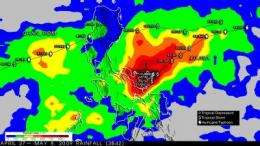
Within a week's time, the northern Philippines were hit by two tropical cyclones that left behind more than 42 inches of rainfall to various areas, and NASA's Tropical Rainfall Measuring Mission satellite captured those measurements from space. Less than a week ago, then Tropical Storm Kujira inundated parts of southern Luzon in the northeast-central Philippines with torrential rains. Recently Typhoon Chan-hom (known locally as "Emong") made landfall on the northwest coast of Luzon, bringing strong winds, heavy rains and yet more flooding to the beleaguered island.
The Tropical Rainfall Measuring Mission satellite (better known as TRMM) can be used to calibrate rainfall estimates from other satellites. The TRMM-based, near-real time Multi-satellite Precipitation Analysis (TMPA) at the NASA Goddard Space Flight Center in Greenbelt, Md. is used to monitor rainfall over the global Tropics. TMPA rainfall totals were calculated and created on an image for the period 27 April to 8 May 2009, which captures the rainfall from both tropical cyclone events.
The most extreme rainfall totals, located over southern Luzon in the northeast-central part of the islands are associated with then Tropical Storm Kujira and are on the order of 900 mm or more (~36 inches, shown by the darker brown). The totals from Chan-hom are considerably less on the order of 150 mm (~6 inches) and are located over the northern part of Luzon (shown in green). The large difference in rainfall between the two storms is due to the difference in their forward motion and not their intensity--Kujira was only a tropical storm at the time while Chan-hom was a typhoon.
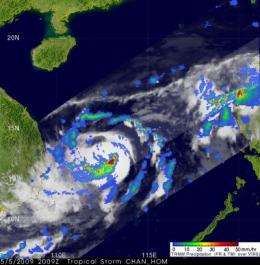
TRMM captured an image of Chan-hom after it formed off of the southeast coast of Vietnam on the evening (local time) of May 3, 2009 as a tropical depression. It was upgraded overnight to a minimal tropical storm as it slowly drifted northward. Chan-hom continued to drift northward on the 4th, paralleling the coast of Vietnam, with a slight increase in intensity. The system continued to gradually intensify on the 5th before turning westward across the central South China Sea in the direction of Luzon in the northern Philippines. TRMM was launched way back in November of 1997 with the objective of measuring rainfall over the Tropics. Armed with a combination of passive microwave and active radar sensors, TRMM has been providing unique images and valuable information on tropical cyclones for over 11 years.
TRMM also captured Tropical Storm Chan-hom as it was heading into the central South China Sea. The image was taken at 20:09 UTC May 5, 2009 (4:09 am May 6 Manila time). It shows the horizontal pattern of rain intensity (top down view) within the storm. Rain rates in the center of the swath are from the TRMM Precipitation Radar (PR), a unique space-borne precipitation radar, while those in the outer swath are from the TRMM Microwave Imager (TMI). The rain rates are overlaid on infrared (IR) data from the TRMM Visible Infrared Scanner (VIRS). At the time of this image, the Chan-hom was a moderate tropical storm with sustained winds estimated at 55 knots (63 mph) by the Joint Typhoon Warning Center.
The center of circulation is located in the middle of the circular cloud shield (circular white area) and just to the north of the heavy rain area (dark red area) in the center of the image. This heavy rain area is actually part of a southern eyewall (a northern eyewall has not yet formed). Although not yet fully developed, the strong curvature in the surrounding rainbands indicates that Chan-hom has a well-developed circulation. The intense rain near the center can be a precursor to strengthening; it indicates that large amounts of heat (known as latent heat) are being released into the core of the system, driving its circulation.
On the night of the 6th, Chan-hom became a typhoon as it continued to march west-northwestward across the South China Sea towards the northern Philippines. By early afternoon on the 7th, it was a category 2 storm with sustained winds estimated at 85 knots (98 mph). Chan-hom made landfall later that day around 7 pm (local time) on Thursday the 7th on the west coast of Luzon near the town of Bolinao at the entrance to the Lingayen Gulf. So far the storm has been blamed for 26 dead with several more still missing. Twelve people were killed in around Bolinao where Chan-hom made landfall and the rest in the mountainous region to the northeast of Bolinao mainly from landslides in the form of large boulders.
On Monday, May 11th, the Joint Typhoon Warning Center issued its final warning on Chan-hom as it has been downgraded into a tropical depression. At 0900 Zulu Time (5 a.m. EDT), Chan-hom's center was about 265 nautical miles south of Okinawa, Japan, near 21.8 north and 126.7 east. It was moving northwestward near 4 knots (5 mph). It is now in waters cooler than the 80F threshold that is needed to keep the storm going, and is expected to dissipate by 5pm EDT today.
Source: NASA's Goddard Space Flight Center (news : web)


