Blue whales re-establishing former migration patterns: research (w/Video)
May 11, 2009 Blue whales re-establishing former migration patterns: research

Enlarge

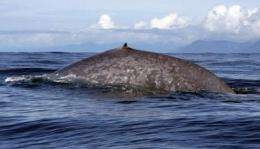
Identification of blue whales was made by pigmentation patterns on the back and shape of the small dorsal fin. Credit: Alexei Calambokidis, Cascadia Research Collective

Scientists have documented the first known migration of blue whales from the coast of California to areas off British Columbia and the Gulf of Alaska since the end of commercial whaling in 1965.

In the scientific journal Marine Mammal Science, researchers from Cascadia Research Collective in Washington state, NOAA's Southwest Fisheries Science Center in California, and Canada's Department of Fisheries and Oceans identified 15 separate cases where blue whales were seen off British Columbia and the Gulf of Alaska. Four of the whales were identified as animals previously observed off the coast of California, suggesting a re-establishment of a historical migration pattern.

FLV player

This blue whale filmed in the Gulf of Alaska has been identified several times off the coast of California. Credit Jay Barlow/NOAA

Researchers made this identification by comparing photographs of blue whales taken in the north Pacific Ocean since 1997 with a library of nearly two thousand photographs of blue whales off the West Coast. A positive match was determined based on pigmentation patterns in skin color and shape of the dorsal fin.

Blue whales were severely depleted during commercial whaling activities during the early 1900's in the north Pacific and along the West Coast as far south as Baja California. Formerly large populations of blue whales in the north Pacific never rebounded after commercial whaling ended while those animals off southern California have apparently fared much better.
NOAA researchers: Blue whales re-establishing former migration patterns
Enlarge

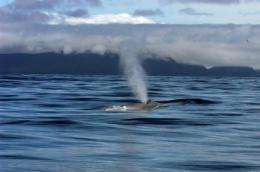
A blue whale spouts off Moresby Island, British Columbia. Credit: John Calambokidis, Cascadia Research Collective

Scientists are still not certain exactly why blue whales are now beginning to migrate from southern California to the north Pacific Ocean although changing may have shifted their primary food source of krill further north.

Blue whales are thought to be the largest animal ever to have existed on earth, reaching lengths of nearly 100 feet. They were nearly hunted to extinction throughout the world and are currently listed as endangered under the U.S. and as endangered on the red list of the International Union for the Conservation of Nature. There are an estimated 5,000 to 12,000 animals remaining today, with the largest population of approximately 2,000 off the U.S. West Coast.

More information: Science article: http://www.cascadiaresearch.org/MMS-AK-BC-BM-09.htm

Source: NOAA National Marine Fisheries Service (news : web)


print this article email this article download pdf blog this article bookmark this article     Stumble it Digg this share on Facebook retweet share on Reddit add to delicious
Rate this story - 3.7 /5 (3 votes)


May 11, 2009 all stories

Comments: 0

3.7 /5 (3 votes)
  • Stumble this up

  • Digg this

  • share this

  • hide
  • Related Stories

  • Iceland to resume commercial whaling
    created Oct 18, 2006 | popularity not rated yet | comments 0
  • Mariners urged to look out for whales
    created Oct 01, 2007 | popularity not rated yet | comments 0
  • Skinny gray whales swim Pacific Coast
    created Jul 06, 2007 | popularity not rated yet | comments 0
  • New study finds most North Pacific humpback whale populations rebounding
    created May 21, 2008 | popularity not rated yet | comments 0
  • Gray whales a fraction of historic levels, genetic research says
    created Sep 10, 2007 | popularity not rated yet | comments 0


  • hide
  • Relevant PhysicsForums posts

Other News

UK starts study on using human DNA in animals

Biology / Biotechnology

created 28 minutes ago | popularity not rated yet | comments 0

(AP) -- British scientists begin a new study on Tuesday to consider how human DNA is used in animal experiments and to determine what the boundaries of such controversial science might be.


Scientists successfully reprogram blood cells

Biology / Cell & Microbiology

created 3 hours ago | popularity 5 / 5 (1) | comments 0

Researchers have transplanted genetically modified hematopoietic stem cells into mice so that their developing red blood cells produce a critical lysosomal enzyme -preventing or reducing organ and central nervous system damage ...


New discovery allows scientists for the first time to experimentally annotate genomes

New discovery allows scientists for the first time to experimentally annotate genomes

Biology / Biotechnology

created 2 hours ago | popularity 5 / 5 (3) | comments 0

Over the last 20 years, the sequencing of the human genome, along with related organisms, has represented one of the largest scientific endeavors in the history of mankind. The information collected from genome ...


Wasp

Well-traveled wasps provide hope for vanishing species

Biology / Plants & Animals

created 3 hours ago | popularity not rated yet | comments 0

They may only be 1.5mm in size, but the tiny wasps that pollinate fig trees can travel over 160km in less than 48 hours, according to research from scientists at the University of Leeds. The fig wasps are transporting ...


Study shows that some malignant tumors can be shut down after all

Biology / Cell & Microbiology

created 7 hours ago | popularity 5 / 5 (3) | comments 1

Oncologists have had their hands tied because more than half of all human cancers have mutations that disable a protein called p53. As a critical anti-cancer watchdog, p53 masterminds several cancer-fighting operations within ...