Planck Satellite ready to measure the Big Bang
May 11, 2009
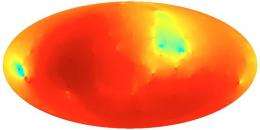
Full sky map of predicted CMB temperature fluctuations due to changing gravitational fields in the local universe, which was computed at MPA. Image: Maturi et al. 2007, Astronomy & Astrophysics 476, 83
(PhysOrg.com) -- The last tests of the Ariane 5 rocket system have been finished and ESA's Planck satellite is sitting ready for launch at the Guiana Space Centre in Kourou. Together with ESA's space telescope Herschel, Planck will lift off into space on 14 May to begin its studies of the cosmic microwave radiation and of the clues it gives about the Big Bang, the earliest phases of the cosmic history, and the structure and composition of the Universe. The Max Planck Institute for Astrophysics (MPA) in Garching has developed important software components for Planck and is getting ready to participate in the analysis and scientific interpretation of the mission data.
According to the standard model of cosmology, our Universe began 13.7 billions years ago in a Big Bang, the origin of space and time. The Cosmic Microwave Background (CMB) is the relic heat from this Big Bang, released 380.000 years after beginning and still travelling freely through space today. At that early time, weak fluctuations of matter density were present, which are seen as variations of temperature in the CMB. By observing these fluctuations, cosmologists can infer how the large-scale structure of today’s Universe - galaxies, galaxy clusters and filaments - was formed.
The Planck satellite will be placed at the second Lagrangian point of the Sun-Earth-Moon system (L2), located about 1.5 million kilometres away from the Earth - four times the distance to the Moon. The satellite will spin around its own axis, always point towards the Sun, with each rotation recording another strip of the sky and mapping the sky’s temperature to an accuracy of about one millionth of a degree. The data are sent to Earth and converted into temperature maps of the sky in data processing centres in France and Italy. What the maps look like depends on certain characteristics of the Universe, for example on the curvature of space. For hypothetic Universes with specified properties, computer simulations using the MPA software generate virtual maps which will be compared with maps of the real sky. "From the comparison we can draw conclusions about the structure of our own Universe, for example how much ordinary matter and dark energy exist in it", explains Torsten Enßlin, head of the Planck group at MPA.
The physics of structure formation and the formation of galaxies will be studied via the so-called Sunyaev Zeldovich effect - the heating of CMB photons by scattering in the atmosphere of galaxy clusters. Due to this effect distant galaxy clusters become visible as "shadows" in front the cosmic microwave background.
However the galaxy clusters are only the densest parts of the cosmic matter distribution. 85 percent of the cosmic matter remains invisible and dark. The composition of this Dark Matter is still not known. From their computer simulations, MPA cosmologists have shown how the CMB is influenced the gravitational field of dark matter. The unseen structures of dark matter can therefore be deduced from temperature variations in the CMB. This requires the scientists to analyse the Planck data with statistical methods, obtaining important information on the structure and future development of the Universe.
Moreover, the mission is expected to detect thousands of distant objects in a frequency range barely studied so far, and so to offer new insights into the physics of galaxies, active galactic nuclei and quasars in the submillimetre domain. These will show Planck scientists energetic processes in the immediate vicinity of massive black holes. Planck may also help us to understand the birth of the first stars in the Universe and the structure of our own galaxy, the Milky Way.
"With the start of the Planck satellite a dream comes true", says Rashid Sunyaev, MPA director and pioneer of CMB research. "Planck will provide the most precise data on the early Universe ever. We have never been so close to the Big Bang." "We will understand the past of our Universe’s past and throw a glance at its future", adds Sunyaev’s colleague Simon White. "Will it keep on expanding for ever or some day collapse back upon itself? What is the nature of the mysterious dark energy causing this expansion? Planck will provide an answer to many important questions of cosmology. The satellite is the most powerful tool ever for studying the Cosmic Microwave Background developed."
Provided by Max Planck Institute
-
ESA's Planck satellite builds on Nobel-prize-winning science
Oct 04, 2006 |
not rated yet |
0
-
Looking Back 13.8 Billion Years: The countdown for Planck satellite has started
Feb 05, 2009 |
not rated yet |
0
-
Planck instruments ready for integration
Nov 16, 2006 |
not rated yet |
0
-
Introducing the 'coolest' spacecraft in the universe
Feb 09, 2007 |
not rated yet |
0
-
Penn astrophysicist outlines a multi-pronged approach in the hunt for dark energy
Feb 18, 2005 |
not rated yet |
0
-
Engineers build first sub-10-nm carbon nanotube transistor
Feb 01, 2012 |
4.9 / 5 (30) |
30
-
Something old, something new: Evolution and the structural divergence of duplicate genes
Jan 31, 2012 |
4.6 / 5 (7) |
1
-
The hidden nanoworld of ice crystals: Revealing the dynamic behavior of quasi-liquid layers
Jan 30, 2012 |
5 / 5 (3) |
1
-
Stock market network reveals investor clustering
Jan 27, 2012 |
3.9 / 5 (23) |
8
-
Of microchemistry and molecules: Electronic microfluidic device synthesizes biocompatible probes
Jan 26, 2012 |
5 / 5 (1) |
0
-
Titan's lack of impact craters
22 hours ago
-
Real pictures of black hole eating a star?
Feb 08, 2012
-
Hypothetical way to travel faster than light, but not technically exceed lightspeed
Feb 06, 2012
-
How do scientists monitor the Sun's activity?
Feb 05, 2012
-
Search patterns in observational studies
Feb 05, 2012
-
Derivation of Pogson's law
Feb 03, 2012
- More from Physics Forums - General Astronomy
More news stories
Clam fields found at deep, low-temperature Mariana vents
(PhysOrg.com) -- Scientists have marveled at the unusual life forms thriving at high temperature hydrothermal vents of the deep ocean.
Space & Earth / Earth Sciences
48 minutes ago |
not rated yet |
0
|
Could Venus be shifting gear?
(PhysOrg.com) -- ESAs Venus Express spacecraft has discovered that our cloud-covered neighbour spins a little slower than previously measured. Peering through the dense atmosphere in the infrared, the ...
Space & Earth / Space Exploration
16 minutes ago |
5 / 5 (1) |
0
|
Streams need trees to withstand climate change
(PhysOrg.com) -- More than twenty years of biological monitoring have confirmed the importance of vegetation for protecting Australia's freshwater streams and rivers against the ravages of drought and climate ...
57 minutes ago |
not rated yet |
0
The turbulent birth of super star clusters in galaxy mergers
By combining two of the most advanced telescopes in the world -- the new Atacama Large Millimeter Array (ALMA) and the Very Large Telescope (VLT) of ESO -- a team of French astronomers from the Institut d'astrophysique ...
39 minutes ago |
not rated yet |
0
What does a nebula sound like?
What do things sound like out in the cosmos? Of course, sound waves cant travel through the vacuum of space; however, electromagnetic waves can. These electromagnetic waves can be recorded by devices called spectrographs ...
Space & Earth / Space Exploration
23 minutes ago |
5 / 5 (1) |
0
Seeing colors in music, tasting flavors in shapes may happen in life's early months
Famed violinist Itzhak Perlman sees a deep forest green whenever he plays a B-flat on his Stradivarius' G string. The A on the E string is red.
Is that sleepiness during pregnancy normal or a sign of sleep apnea?
(Medical Xpress) -- Most pregnant women complain of being tired. Some of them however, could be suffering more than normal fatigue associated with their pregnancy; they may have developed obstructive sleep apnea (OSA), a ...
Engineering images bring life to submerged city
(PhysOrg.com) -- Photo-realistic 3D mapping and digital reconstruction of an ancient underwater city in Greece have earned a team from the University of Sydney's Faculty of Engineering and Information Technologies ...
Numeracy: The educational gift that keeps on giving?
(Medical Xpress) -- Cancer risks. Investment alternatives. Calories. Numbers are everywhere in daily life, and they figure into all sorts of decisions. A new article published in Current Directions in Psychological Science, a journal of the Association for Psychological Science, examin ...
New power source discovered
(PhysOrg.com) -- Researchers at the Massachusetts Institute of Technology (MIT) and RMIT University have made a breakthrough in energy storage and power generation.
Measurements from high-energy collisions lead to better understanding of why meson particles disappear
For several years, physicists at the Relativistic Heavy Ion Collider (RHIC) at Brookhaven National Laboratory (BNL), USA, have studied an unusual state of matter called the quarkgluon plasma, which they ...
May 14, 2009
Rank: 2.3 / 5 (3)