Spiral swimmers may prove micro workhorses (w/Video)
May 11, 2009
Spiral swimmers may prove micro workhorses (w/Video)

Enlarge

Researchers Ambarish Ghosh (left) and Peer Fischer of the Rowland Institute at Harvard have devised a new microscopic swimmer, a corkscrew that rotates in a magnetic field.

(PhysOrg.com) -- Harvard researchers have created a new type of microscopic swimmer: a magnetized spiral that corkscrews through liquids and is able to deliver chemicals and push loads larger than itself.

Though other researchers have created similar devices in the past, Peer Fischer, a junior fellow at the Rowland Institute at Harvard, said the new nano-robot is the only swimmer that can be precisely controlled in solution.

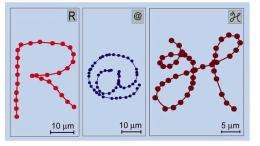
At just two microns long and 200 to 300 wide, the corkscrew swimmer is about the size of a bacterial cell. The work was published online May 4 in the journal . Fischer and Rowland Institute postdoctoral research associate Ambarish Ghosh were able to control the tiny device well enough to use it to write “R @ H” for “Rowland at Harvard” within a space that’s less than the width of a human hair.

This video is not supported by your browser at this time.

Using nano-structured surfaces scientists make micro-robots that can be propelled through liquids with unprecedented control and precision. Each micro-robot is essentially a glass-screw with a screw-pitch that that is less than the wavelength of visible light. The body is made from glass and a magnetic material (cobalt) is added to magnetize and drive these “artificial swimmers” with a magnetic field. Video: Harvard University

Further, they were able to use it to push a 5 micron bead — which had a volume more than 1,000 times that of the swimmer — and were also able to control two of the swimmers simultaneously.

“It really has good control. It’s exactly doing what we want it to do,” Fischer said.

The Rowland Institute was created by legendary Polaroid founder Edwin Land in 1980 as the Rowland Institute for Science, a nonprofit, basic research laboratory. It maintained its scientific mission in 2002, when it merged with Harvard and became the Rowland Institute at Harvard.

Fischer said the strength of his and Ghosh’s work is not just the swimmer’s performance but also its manufacturing method, which allows many swimmers to be created simultaneously.

The devices are made by exposing a silicon wafer to silicon dioxide vapor. The wafer is slowly rotated as the vapor condenses, growing the devices in a corkscrew shape. They are then shaken loose, sprayed with cobalt, and magnetized. Because they are lying on their sides when the cobalt is applied, the process provides a magnetic “handle” to rotate the corkscrews with.

“You can make hundreds of millions in a square centimeter,” Fischer said. “Even if you use only a few percent, that’s still a lot. … You can make a lot of them very quickly.”

Fischer and Ghosh took one last step, which didn’t improve the swimmers’ functionality, but allowed them to be tracked: they coated them with a fluorescent chemical.

Once complete, the researchers surrounded the swimmers with three magnetic coils, allowing them to precisely adjust the magnetic field, and control the tiny devices in three dimensions.

The microscopic world of the nano-swimmer is different from the one we experience when going for a swim, Fischer said. Because it operates at such a tiny scale, water that we move through relatively easily — thin and runny - appears thicker to the nano-swimmers, more like honey. The swimmers meet a considerable amount of resistance to their forward motion so that they really need to drill their way forward, he said.

The devices move at about the speed of bacteria, 40 micrometers — one micrometer is a millionth of a meter — per second.

Though applications in drug delivery, microsurgery, and other aspects of medicine seem apparent, Fischer said it’s too early to speak about those realistically.

However, Fischer said the artificial swimmers can be used to test some of these ideas and could have almost immediate applications in research, being used to shuttle chemicals in and out of cells or testing the strength and properties of membranes, for example.

More information: http://pubs.acs.or … 21/nl900186w

Provided by Harvard University (news : web)

4.8 /5 (10 votes)  

Rank 4.8 /5 (10 votes)
Related Stories
Relevant PhysicsForums posts
  • gas leaks in space
    created3 hours ago
  • Weight required to balance a boom stand?
    created5 hours ago
  • Questions about Equivalence principle & Einstein Elevator?
    created6 hours ago
  • Kinetic energy of gas
    created8 hours ago
  • Understanding induced emfs
    created10 hours ago
  • What is the precise definition of a year?
    created11 hours ago
  • More from Physics Forums - General Physics

More news stories

New kind of solar cell could capture significantly more energy than current cells

New solar cells could increase the maximum efficiency of solar panels by over 25%, according to scientists from the University of Cambridge.

Nanotechnology / Nanophysics

created Feb 08, 2012 | popularity 4.5 / 5 (12) | comments 14 | with audio podcast

Nanoshell whispering galleries improve thin solar panels

Visitors to Statuary Hall in the U.S. Capitol Building may have experienced a curious acoustic feature that allows a person to whisper softly at one side of the cavernous, half-domed room and for another on ...

Nanotechnology / Nanomaterials

created Feb 07, 2012 | popularity 4.3 / 5 (6) | comments 6 | with audio podcast

'Dark plasmons' transmit energy

Microscopic channels of gold nanoparticles have the ability to transmit electromagnetic energy that starts as light and propagates via "dark plasmons," according to researchers at Rice University.

Nanotechnology / Nanophysics

created Feb 09, 2012 | popularity 4.8 / 5 (9) | comments 1 | with audio podcast

Revealing how a battery material works

Since its discovery 15 years ago, lithium iron phosphate (LiFePO4) has become one of the most promising materials for rechargeable batteries because of its stability, durability, safety and ability to deliver ...

Nanotechnology / Nanomaterials

created Feb 08, 2012 | popularity 5 / 5 (5) | comments 0 | with audio podcast

Nanotube therapy takes aim at breast cancer stem cells

Wake Forest Baptist Medical Center researchers have again proven that injecting multiwalled carbon nanotubes (MWCNTs) into tumors and heating them with a quick, 30-second laser treatment can kill them.

Nanotechnology / Bio & Medicine

created Feb 09, 2012 | popularity 5 / 5 (1) | comments 0 | with audio podcast


Google might launch Drive for cloud storage soon

(PhysOrg.com) -- Google's next big move, according to the Wall Street Journal, is a cloud storage service called Drive. Hardly first to the plate, Google is simply catching up to introducing its cloud reposi ...

Latin America mining boom clashes with conservation

Latin America is experiencing a mining boom as prices rise fuelled by a hike in global demand, but the region is also being hit by a wave of violent protests, strikes and rallies by environmentalists.

Love a click away in Indonesia's Twitter Republic

He was a geeky kid from Yogyakarta, she a glamorous city girl in Jakarta. In a country with one of the world's most vibrant social networking scenes they fell in love on Twitter.

Walney offshore wind farm is world's biggest (for now)

(PhysOrg.com) -- The Walney wind farm on the Irish Sea--characterized by high tides, waves and windy weather--officially opened this week. The farm is treated in the press as a very big deal as the Walney ...

GPS court ruling leaves US phone tracking unclear

A US Supreme Court decision requiring a warrant to place a GPS device on the car of a criminal suspect leaves unresolved the bigger issue of police tracking using mobile phones, legal experts say.

Europeans protest controversial Internet pact

Tens of thousands of people marched in protests in more than a dozen European cities Saturday against a controversial anti-online piracy pact that critics say could curtail Internet freedom.