Hubble Photographs a Planetary Nebula to Commemorate Decommissioning of Super Camera
May 11, 2009 Hubble Photographs a Planetary Nebula to Commemorate Decommissioning of Super Camera

Enlarge

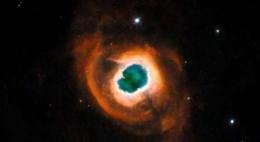
The Wide Field and Planetary Camera 2's final "pretty picture" is the planetary nebula known as Kohoutek 4-55 (or K 4-55). Image credit: NASA/ESA/JPL

(PhysOrg.com) -- The Hubble community bids farewell to the soon-to-be decommissioned Wide Field and Planetary Camera 2 onboard NASA's Hubble Space Telescope. In tribute to Hubble's longest-running optical camera, which was developed and built by NASA's Jet Propulsion Laboratory, Pasadena, Calif., a planetary nebula has been imaged as the camera's final "pretty picture."

This planetary nebula is known as Kohoutek 4-55 (or K 4-55). It is one of a series of planetary nebulae that were named after their discoverer, Czech astronomer Lubos Kohoutek. A planetary nebula contains the outer layers of a red giant star that were expelled into interstellar space when the star was in the late stages of its life. emitted from the remaining hot core of the star ionizes the ejected gas shells, causing them to glow.

In the specific case of K 4-55, a bright inner ring is surrounded by a bipolar structure. The entire system is then surrounded by a faint red halo, seen in the emission by nitrogen gas. This multi-shell structure is fairly uncommon in planetary nebulae.

This Hubble image was taken by the Wide Field and Planetary Camera 2 on May 4, 2009. The colors represent the makeup of the various emission clouds in the nebula: red represents nitrogen, green represents hydrogen, and blue represents oxygen. K 4-55 is nearly 4,600 light-years away in the constellation Cygnus.

The Wide Field and Planetary Camera 2 instrument, which was installed in 1993 to replace the original Wide Field/Planetary Camera, will be removed to make room for Wide Field Camera 3 during the upcoming Hubble Servicing Mission.

During the camera's amazing, nearly 16-year run, the Wide Field and Planetary Camera 2 provided outstanding science and spectacular images of the cosmos. Some of its best-remembered images are of the Eagle Nebula pillars, Comet P/Shoemaker-Levy 9's impacts on Jupiter's atmosphere, and the 1995 Hubble Deep Field - the longest and deepest Hubble optical image of its time.

The scientific and inspirational legacy of the camera will be felt by astronomers and the public alike, for as long as the story of the is told.

For images and more information about planetary nebula K 4-55, visit: http://hubblesite.org/news/2009/21 . For more information about the Wide Field and Planetary Camera 2, visit: http://www.jpl.nasa.gov/wfpc2/

Provided by JPL/NASA (news : web)


print this article email this article download pdf blog this article bookmark this article     Stumble it Digg this share on Facebook retweet share on Reddit add to delicious
Rate this story - 4.8 /5 (4 votes)


May 11, 2009 all stories

Comments: 0

4.8 /5 (4 votes)
  • Stumble this up

  • Digg this

  • share this

  • hide
  • Related Stories

  • The Last Confessions of a Dying Star
    created Mar 04, 2008 | popularity not rated yet | comments 0
  • Hubble Captures Stars Going Out in Style
    created Sep 11, 2007 | popularity not rated yet | comments 0
  • The Colorful Demise of a Sun-Like Star
    created Feb 13, 2007 | popularity not rated yet | comments 0
  • Hubble's Celestial Landscape
    created Oct 02, 2008 | popularity not rated yet | comments 0
  • Dying star creates fantasy-like sculpture of gas and dust
    created Sep 09, 2004 | popularity not rated yet | comments 0


  • hide
  • Relevant PhysicsForums posts

  • Redshift as a distance indicator
    created 7 hours ago
  • Question about 2-body gravity
    created Nov 24, 2009
  • life on Mars
    created Nov 24, 2009
  • Semi-major axis from cartesian co-ordinates
    created Nov 23, 2009
  • More from Physics Forums - General Astronomy

Other News

Past regional cold and warm periods linked to natural climate drivers

Space & Earth / Earth Sciences

created 4 hours ago | popularity 5 / 5 (4) | comments 6

Intervals of regional warmth and cold in the past are linked to the El Niņo phenomenon and the so-called "North Atlantic Oscillation" in the Northern hemisphere's jet stream, according to a team of climate scientists. These ...


Russia: no space for space tourists (AP)

Russia: no space for space tourists

Space & Earth / Space Exploration

created 12 hours ago | popularity 2.7 / 5 (3) | comments 2

(AP) -- A top Russian space official says there is no space for tourists wishing to fly to the International Space Station.


Astronauts surprised by holiday turkey dinners (AP)

Astronauts surprised by holiday turkey dinners

Space & Earth / Space Exploration

created 7 hours ago | popularity not rated yet | comments 0

(AP) -- Space shuttle Atlantis' astronauts thought they were going to give thanks with pantry leftovers Thursday as their mission drew to a close, but found turkey dinners awaiting them.


Gullies and Flow Features on Crater Wall

Gullies and Flow Features on Crater Wall

Space & Earth / Space Exploration

created 8 hours ago | popularity not rated yet | comments 0

(PhysOrg.com) -- This image from the High Resolution Imaging Science Experiment (HiRISE) camera on NASA's Mars Reconnaissance Orbiter shows a sample of the variety and complexity of processes that may occur ...


Burning coal worse for climate than clearing rain forests

Space & Earth / Environment

created 6 hours ago | popularity 3 / 5 (4) | comments 0

Deforestation has had a big influence on the increase of carbon dioxide (CO2) emissions in the past three centuries, but its impact is tapering off relatively. Nowadays, the burning of fossil fuels is a more crucial factor. ...