Dogs, maybe not, but old genes can learn new tricks
May 11, 2009 Dogs, maybe not, but old genes can learn new tricks

Enlarge

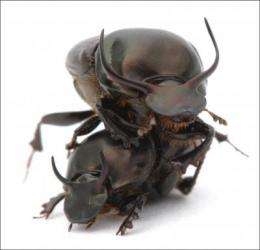
Two Onthophagus taurus males. Armin Moczek and Debra Rose's study suggests several genes involved in making legs and antennae were co-opted to make the beetles' horns. Horns are a novel trait that is unique to horned beetles. Credit: Alex Wild (http://www.myrmecos.net)

A popular view among evolutionary biologists that fundamental genes do not acquire new functions was challenged this week by a new study in the Proceedings of the National Academy of Sciences.

Indiana University Bloomington biologist Armin Moczek and research associate Debra Rose report that two ancient were "co-opted" to help build a new trait in -- the fancy antlers that give horned beetles their name. The genes, Distal-less and homothorax, touch most aspects of insect larval development, and have therefore been considered off-limits to the evolution of new traits.

In the two horned beetle species Moczek and Rose studied, the genetic sequences of Distal-less and homothorax were hardly different, suggesting the two genes have retained their unique identities because of selective pressures not to change. What changed was not the genes themselves, but when and where they are turned on.

"Evolutionary biologists have a good idea of what it takes to change the shape of a wing, the length of a leg, or the anatomy of an eye," Moczek said. "What we have struggled with, though, is how these traits originate in the first place. How do you evolve that first wing, limb or from a flightless, limbless and blind ancestor?"

To investigate these questions, Moczek and Rose examined three that are so old, all insects have them: Distal-less, homothorax and a third, dachshund. The genes were first characterized in , and are categorized as "upstream" regulatory genes because they influence a wide variety of genetic processes in insect cells, such as the development of legs, antennae and wings. Moczek said that in horned beetles, each of the three genes is likely to have hundreds to thousands of downstream targets.

A tenuous consensus among evolutionary biologists was that such genes -- upon which so many different and important processes depend -- could not be easily modified, because any modification would affect countless aspects of the insect's development, any one of which could be bad for the individual insect, reducing its fitness relative to its peers.

Moczek and Rose's PNAS paper confirms one aspect of this idea. All three genes were sequenced and found to be highly conserved, or unchanged, not only among the individuals of each beetle species they examined, but also between the two species, Onthophagus taurus (Italy) and Onthophagus binodis (South Africa), whose lineages diverged about 24 million years ago. But that isn't the whole story.

To understand the effects of the three genes on horned beetle development, Moczek and Rose employed a new and promising technique, RNA interference, which disables the action of specific genes without compromising other genetic processes. Humans are only mimicking nature here; RNA interference is also a natural method of gene regulation in eukaryotes.

Moczek and Rose divided beetle larvae of both species into three treatment groups: no injection, buffer injection with nonsense RNA and buffer injection with RNA interference transcripts designed to disrupt one of three crucial developmental genes.

Moczek and Rose learned that two of the three genes, Distal-less and homothorax, are used by both O. taurus and O. binodis in the development of beetle horns. While Distal-less was found to affect both the development of thorax horns (which form just behind the head) and head horns, homothorax was only found to influence thorax horn development. The gene dachshund appears to have no effect whatsoever on horn development in either species.

"The evolution of novel features does not require the evolution of novel genes," Moczek said. "A lot of innovation can grow from within the organism's genetic toolbox."

More importantly, Moczek and Rose learned all developmental genes are candidates for such recruitment, not just the genes whose development functions are considered non-essential or limited in their effects.

Moczek also says the PNAS paper may compel to revisit pleiotropy, the foundational concept of one gene influencing many traits.

"It may be that our understanding of pleiotropy is too simplistic," Moczek said. "Now that we know fundamental development genes can acquire new and diverse functions with relative ease, pleiotropy may not be nearly as constraining as we have thought."

Source: Indiana University (news : web)


print this article email this article download pdf blog this article bookmark this article     Stumble it Digg this share on Facebook retweet share on Reddit add to delicious
Rate this story - 5 /5 (8 votes)

Rank Filter

Move the slider to adjust rank threshold, so that you can hide some of the comments.


Display comments: newest first

  • E_L_Earnhardt - May 12, 2009
    • Rank: not rated yet
    Marvelous! Trying to get a "picture" of something that is unlikely to reflect light and can not be bisected! Atoms express themselves by charatoristics of outer orbital ELECTRONS! Very sensitive OSCILLASCOPES are your only hope!
  • HenisDov - Aug 01, 2009
    • Rank: not rated yet
    Old Genes Can Learn New Tricks
    Psalms 115,5-6


    A. "Dogs, maybe not, but old genes can learn new tricks"
    http://www.physor...793.html

    B. "They have eyes, but they can not see, They have ears, but they cannot hear"
    (Psalms 115,5-6)

    Exasperating. "Scientists" keep ruminating again and again stale verbiage about genes with determination not to see that genes are organisms.

    C. About time for life sciences to assimilate, to internalize, the lifehood of genes,

    starting with search-surfing "on the lifehood of genes" or "on the pavlovian behaviour of genes".


    Suggesting,

    Dov Henis
    (Comments From The 22nd Century)
    Origin Of Origins
    http://www.the-sc...age#2753

May 11, 2009 all stories

Comments: 2

5 /5 (8 votes)
  • Stumble this up

  • Digg this

  • share this

  • hide
  • Related Stories

  • Vanishing beetle horns have surprise function
    created Dec 04, 2006 | popularity not rated yet | comments 0
  • How 'secondary' sex characters can drive the origin of species
    created Aug 25, 2008 | popularity not rated yet | comments 0
  • Why do males and females of some species look so different?
    created Dec 04, 2006 | popularity not rated yet | comments 0
  • Researchers Study Gene Regulation In Insects
    created Apr 27, 2006 | popularity not rated yet | comments 0
  • Scientists identify how development of different species uses same genes with distinct features
    created Mar 30, 2007 | popularity not rated yet | comments 0


  • hide
  • Relevant PhysicsForums posts

  • Cornea and Sclera
    created 8 hours ago
  • This is a long shot...
    created 21 hours ago
  • How do I get an A in Bio AP if I know nothing about Biology?
    created Nov 10, 2009
  • Mutation
    created Nov 10, 2009
  • Incorrupt Bodies
    created Nov 09, 2009
  • What was your favorite intro to biology textbook?
    created Nov 08, 2009
  • More from Physics Forums - Biology

Other News

Africa's rarest monkey had an intriguing sexual past, DNA study confirms

Africa's rarest monkey had an intriguing sexual past, DNA study confirms

Biology / Plants & Animals

created 10 hours ago | popularity 4.7 / 5 (3) | comments 0

The most extensive DNA study to-date of Africa's rarest monkey reveals that the species had an intriguing sexual past. Of the last two remaining populations of the recently discovered kipunji, one population ...


Antarctic lake

Antarctic lake home to diverse community of viruses

Biology / Cell & Microbiology

created 12 hours ago | popularity 5 / 5 (8) | comments 0

(PhysOrg.com) -- A study of the genetic structure of viruses in an Antarctic lake has revealed an astonishing genetic richness in the large number of viral families discovered.


Warm-blooded dinosaurs worked up a sweat

Warm-blooded dinosaurs worked up a sweat

Biology / Plants & Animals

created 17 hours ago | popularity 5 / 5 (3) | comments 0

(PhysOrg.com) -- Were dinosaurs endothermic (warm-blooded) like present-day mammals and birds or ectothermic (cold-blooded) like present-day lizards? The implications of this simple-sounding question go beyond ...


Can a plant be altruistic?

Biology / Plants & Animals

created 12 hours ago | popularity 5 / 5 (1) | comments 0

The concept of altruism has long been debated in philosophical circles, and more recently, evolutionary biologists have joined the debate. From the perspective of natural selection, altruism may have evolved because any ...


Gov't says brown pelicans are endangered no longer (AP)

Gov't says brown pelicans are endangered no longer

Biology / Ecology

created 6 hours ago | popularity not rated yet | comments 0

(AP) -- Much like its death-defying dives for fish, the brown pelican has resurfaced after plummeting to the brink of extinction.