A 'light bulb' moment for people with dementia (w/Video)
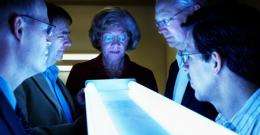
(PhysOrg.com) -- Change the lighting; improve your health. It's a strategy researchers from Case Western Reserve University's Frances Payne Bolton School of Nursing and the School of Medicine, the Geriatric Research Education and Clinical Center at the Louis Stokes Cleveland Veterans Affairs Medical Center (GRECC), Rensselaer Polytechnic Institute's Lighting Research Center and GE Consumer & Industrial have begun to test in a long-term care facility where daylight, which has proven health benefits, is not readily available.
The researchers removed some standard fluorescent lighting and installed new blue-white lamp prototypes developed by GE scientists at the company's Nela Park campus.
Research team members hypothesize that periods of blue light, like daylight, can help regulate the sleep-wake rhythm, which is a behavioral pattern linked to the 24-hour biochemical circadian cycle of the hormone melatonin. Depending on the level of the hormone, people are awake or sleepy.
The researchers want to regulate the sleep-wake cycle by regulating the amount of exposure to blue-white (wakefulness) and yellow-white (sleepiness) light. By increasing exposure to blue-white light during the day and yellow-white light in the evening, researchers hope to help patients regulate their sleep-wake cycles so that they are more awake during the day and more asleep at night.
Patricia Higgins, associate professor at the Bolton School of Nursing and one of the lead investigators, says the project may prove to be especially beneficial for people suffering from dementia.
In a recently conducted pilot study with five male patients, each suffering from dementia and living in a long-term care facility, researchers installed the blue-white lights in an activities room where most residents gathered for meals and daytime activities.
"We wanted to see whether lighting could affect the participants' sleep-wake rhythms," says Higgins. "While the group was small, the results show promise in raising activity levels during daytime hours and increasing sleep at nighttime."
The researchers plan a larger study with residents with dementia at two Northeast Ohio long-term care facilities. The study will include men and women to see if light impacts the genders differently.
An unexpected side effect of the lighting is that once adjusted to the blue-white light, most employees reported that they liked the new lighting conditions.
For a number of decades it has been known that light affects how people feel. Those particularly sensitive to changes in light have benefited from a boost in the brightness of light sources. The new lighting used in the test changes the color without overpowering individuals with brightness, according to the researchers.
"Why waste light if you can tune it to the right color and maximize the amount of useful light," says Mariana Figueiro, assistant professor at Rensselaer and program director at Rensselaer's Lighting Research Center."Light is a good stimulus for the circadian system, which regulates your sleep-wake cycles," says Thomas Hornick, associate director at the GRECC at the Veterans Administration Hospital and associate professor at the Case Western Reserve University School of Medicine. He says it is known that certain drugs do better when given at the appropriate time in the circadian cycle.
As a safe, non-pharmacological intervention, researchers also hope to apply information from the study to changing the lighting in hospitals where patients may have a speedier recovery or improved quality of life with a good night's rest.
"We're innovators at heart," says Mark Duffy, engineering and technology systems manager, GE Consumer & Industrial. "Our goal entering this collaboration was to apply the passion and inventiveness, which we bring to every customer need or application, to a project that has implications for society at large. We're proud to be part of this effort."
If changing the lighting works to improve health, the researchers plan to take what would be a natural next step: trying to influence public policy to include new lighting standards for healthcare facilities.
More information: Visit www.case.edu/think/breakingnews/Lightbulb.html for further information.
Source: Case Western Reserve University (news : web)


