Electricity more efficient than ethanol as energy pathway from biomass
May 12, 2009 by David Hecht Biofuels

Enlarge

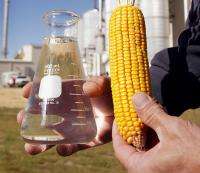
(PhysOrg.com) -- Electricity or ethanol, which is the better use of our nation's biomass crops when it comes to powering vehicles? Our government seems to have chosen ethanol, recently announcing nearly $800 million of research money devoted towards biofuels, far more than they have committed towards bioelectricity. However, a recent study published in the journal Science seems to suggest that they, like me at the Kentucky Derby, may be backing the wrong horse. The team, led by researchers at UC Merced and Stanford, have found that bioelectricity outperforms ethanol across a wide range of input parameters, in terms of transportation efficiency as well as emissions.


is radiated to earth from the sun and stored by crops in molecular bonds. To harness and use that energy, we need to break those molecular bonds, typically by burning the crops. This method for harnessing energy has probably been mankind's longest, ever since man discovered that one can burn wood to produce heat. In fact, until the 1860's the U.S. used in the form of wood for nearly 91% of all energy consumption. The biomass from crops such as corn can also be distilled into ethanol , which we can burn to produce energy. This research addressed two alternative energy pathways for biomass: Converting biomass into ethanol to power internal combustion vehicles or converting biomass into electricity to power battery . The technology to convert biomass into electricity already exists, and can be implemented using biomass boilers or integrated gasification combined cycle power plants (http://www.aesenergy.net/).

There is a limited amount of land available to devote towards growing crops for biofuels before the sacrificing of land for foodcrops begins to inflate commodity prices. Therefore, the efficiency of such technology is of utmost importance. The study finds that bioelectricity outperforms ethanol in both transportation kilometers per area of crops per year, and emissions. A small SUV driving on the highway can travel 56% farther in an electric vehicle powered by bioelectricity than in a gas engine powered by ethanol. A similar calculation was performed over a range of vehicle classes (small car up to full size SUV) and for both city and highway driving. Bioelectricity powered vehicles went on average 81% further than vehicles powered by ethanol. Greenhouse gas emissions were also lower for the case of bioelectricity. Furthermore, for the case of bioelectricity, CO2 gas can be sequestered at the power plant, resulting in a net removal of CO2 from the air.

The study concludes that a given area of bio cropland would deliver more transportation and less using a bioelectricity energy pathway rather than ethanol. Also, bioelectricity would further encourage electric transportation which is compatible with other green energy sources such as wind and solar. The researchers plan to continue this study, and factor in excluded criteria such as impacts on water resources, battery toxicity and recycling, air pollution, and economic constraints. Economically speaking, it is important to remember that the competiveness of ethanol depends on the price of petroleum, while the competiveness of bioelectricity depends on the cost of wind, coal, solar, and nuclear. Overall, the paper clearly shows that more research needs to be done before the country chooses over bioelectricity as the energy pathway of choice from biomass.

More information can be found at Science, May 7, 2009, 10.1126/science.1168885.

© 2009 PhysOrg.com


print this article email this article download pdf blog this article bookmark this article     Stumble it Digg this share on Facebook retweet share on Reddit add to delicious
Rate this story - 4 /5 (11 votes)

Rank Filter

Move the slider to adjust rank threshold, so that you can hide some of the comments.


Display comments: newest first

  • GrayMouser - May 12, 2009
    • Rank: 1 / 5 (2)
    Converting ethanol to electricity and then storing the electricity in a battery is more efficient than using the ethanol directly?
    Since when? Every step in the conversion entails loss and the fewer steps the less loss. I know this is a simplification but it appears that those people doing the calculations have left out some simple engineering principles.
  • dhecht - May 12, 2009
    • Rank: 5 / 5 (1)
    Converting biomass (i.e., crops) directly into electricity (via burning the crops and producing steam that can power turbines) is more efficient than converting the biomass into ethanol by distillation, and than burning the ethanol in a combustion engine.
  • HODuser - May 12, 2009
    • Rank: not rated yet
    Ethanol from corn as fuel is a fraud. Sugar cane is 3x more productive. But we would have to plant a lot of the Everglades to get enough. A better, but temporary solution is build yourself a Hydrogen On Demand add on for your car. You use either a rechargeable battery pack or your alternator as the power supply. Simple electrolysis makes hydrogen and oxygen which is then entered into the air intake. The resulting HHO gas makes your engine burn fuel better. It is not replacing gasoline. Don't buy one, build it yourself and learn how it works. Look at my video at You Tube under the user: cyberphan. Of course, be skeptical, but do some research before you build one or discount backyard mechanics.
  • dajobe - May 13, 2009
    • Rank: not rated yet
    The government's funding of ethanol as an alternative fuel is for the benifit of the government. It will be blended with current fuels, distributed and marketed via existing networks and thus taxed seamlessly without any loss of revenues accruing to the participating government entities. This one consideration is probably the biggest single obstacle to any cheap alternative energy discovery making it to the general public. Government and industry have to make their money (and maintain their control) first!
  • kirkamr - May 13, 2009
    • Rank: not rated yet
    I wonder if the calculations for growing include the land necessary to account for crop rotation and non-renewable fertilizers? If not, it seems we're borrowing from Peter to pay Paul.

May 12, 2009 all stories

Comments: 5

4 /5 (11 votes)
  • Stumble this up

  • Digg this

  • share this

  • hide
  • Related Stories


  • hide
  • Relevant PhysicsForums posts

  • Zinc Oxide reduction
    created 3 hours ago
  • depolymerization of HDPE
    created 19 hours ago
  • Question, whats the best chemistry software for a college student?
    created Nov 08, 2009
  • Why only opposite spin electrons in an orbital ?
    created Nov 08, 2009
  • More from Physics Forums - Chemistry

Other News

Toward home-brewed electricity with 'personalized solar energy'

Toward home-brewed electricity with 'personalized solar energy'

Chemistry / Materials Science

created Nov 04, 2009 | popularity 3.4 / 5 (9) | comments 4

New scientific discoveries are moving society toward the era of "personalized solar energy," in which the focus of electricity production shifts from huge central generating stations to individuals in their ...


Scientists Reproduce a Building Block of Life in Laboratory

Scientists Reproduce a Building Block of Life in Laboratory

Chemistry / Biochemistry

created Nov 06, 2009 | popularity 4.8 / 5 (23) | comments 0

(PhysOrg.com) -- NASA scientists studying the origin of life have reproduced uracil, a key component of our hereditary material, in the laboratory.


Newly Discovered Fat Molecule: An Undersea Killer with an Upside

Newly Discovered Fat Molecule: An Undersea Killer with an Upside

Chemistry / Biochemistry

created Nov 05, 2009 | popularity 4.8 / 5 (10) | comments 0

(PhysOrg.com) -- A chemical culprit responsible for the rapid, mysterious death of phytoplankton in the North Atlantic Ocean has been found by collaborating scientists at Rutgers University and the Woods Hole ...


CU-Boulder map of human bacterial diversity shows wide interpersonal differences

Map of Human Bacterial Diversity Shows Wide Interpersonal Differences

Chemistry / Biochemistry

created Nov 05, 2009 | popularity 4.7 / 5 (11) | comments 0

(PhysOrg.com) -- A University of Colorado at Boulder team has developed the first atlas of bacterial diversity across the human body, charting wide variations in microbe populations that live in different ...


Mimicking nature, scientists can now extend redox potentials

Mimicking nature, scientists can now extend redox potentials

Chemistry / Biochemistry

created Nov 04, 2009 | popularity 4.8 / 5 (5) | comments 0

(PhysOrg.com) -- New insight into how nature handles some fundamental processes is guiding researchers in the design of tailor-made proteins for applications such as artificial photosynthetic centers, long-range ...