Intel hit with $1.45B fine in Europe
May 13, 2009 By AOIFE WHITE , AP Business Writer
Intel hit with $1.45B fine in Europe (AP)

Enlarge

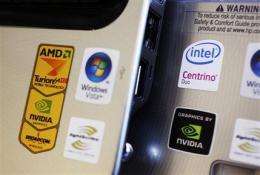
A Hewlett-Packard laptop running on AMD technology is shown on top of a laptop running on Intel technology at HP headquarters in Palo Alto, Calif., Wednesday, May 13, 2009. The European Union fined Intel Corp. a record €1.06 billion ($1.45 billion) on Wednesday and ordered the world's biggest maker of computer chips to stop illegal sales tactics that shut out Silicon Valley rival AMD. (AP Photo/Paul Sakuma)

(AP) -- Intel Corp. was fined a record $1.45 billion by the European Union on Wednesday for using strong-arm sales tactics in the computer chip market - a penalty that could turn up the pressure on U.S. regulators to go after the company, too.

The fine against the world's biggest chip maker represents a huge victory for Intel's rival, Inc., or AMD, the No. 2 supplier of microprocessors to PC makers.

AMD has sued Intel and lobbied regulators around the world for the past five years, complaining that Intel was penalizing PC makers in the U.S. and abroad for doing business with AMD.

Although the U.S. Federal Trade Commission is also investigating, AMD seems to have found its most sympathetic ear in Europe.

EU Competition Commissioner Neelie Kroes said Intel has harmed millions of European consumers by "deliberately acting to keep competitors out of the market."

"Intel did not compete fairly, frustrating innovation and reducing consumer welfare in the process," she said.

The commission told Intel to immediately stop some sales practices in Europe, though it wouldn't say what those were. Intel said it was "mystified" about what it was supposed to change but would comply while it appeals the fine.

The Santa Clara, Calif., company also defended its sales practices - which include rebates to big Intel customers - as legitimate.

"This is really just a matter of competition at work, which is something I think we all want to see, versus something nefarious," Intel CEO Paul Otellini said in a conference call with reporters.

AMD Chief Executive Dirk Meyer said the decision was "an important step toward establishing a truly competitive market."

"We are looking forward to the move from a world in which Intel ruled, to one which is ruled by customers," Meyer said in a statement.

The biggest previous fine levied by the European Union for anticompetitive behavior was $1.3 billion, brought against Microsoft Corp. last year.

Whether Intel could face punishment in the U.S. remains to be seen. But the EU's fine against Intel could push the issue to the forefront for the Obama administration.

"If there was ever a time not to appear to be a large firm behaving badly, this would be it, as the financial collapse has the U.S. and EU competing for which government is the most proactively protecting consumer rights," warned Rob Enderle, a technology industry analyst. "This judgment makes Intel the ball in what is likely an international game of one-upmanship."

The Obama administration signaled this week that antitrust enforcement would be pursued more vigorously than in the Bush administration, whose Justice Department filed only three anti-monopoly cases, all involving mergers. Yet the Justice Department has been silent on whether it is investigating Intel.

The Federal Trade Commission investigation of Intel could result in the agency asking a court to order Intel to alter its practices. A spokeswoman for the FTC declined to comment.

Stephen Kinsella, a lawyer specializing on European antitrust law, cautioned that Europe is known for its aggressive antitrust enforcement and that a case brought against Intel in the U.S. or elsewhere might be milder.

The EU fine is "hugely significant because it's Intel, and the amounts at stake are enormous," he said. But "it is known that the commission takes a very hard line on this type of behavior."

The Intel-vs.-AMD fight exposes an ugly part of the business for microprocessors, which essentially are the brains of personal computers.

Unlike other parts of the PC industry that have lots of competitors, microprocessors come from only two sources. Intel has about 80 percent of the market, and AMD - headquartered a few miles away in Sunnyvale - has the rest. That means a victory for one is a defeat for the other.

The process of getting a chip into a computer and onto the shelves has two main steps, and AMD has cried foul about Intel's behavior at both stages.

First, a has to agree to buy the chips. In that stage, AMD has alleged, Intel has illegally used its dominant position by offering huge rebates to PC makers that promise to buy lots of Intel's chips. AMD argues that the discounts can effectively make some chip orders free, and that it would have to lose money on sales in order to keep up.

The case before the European Commission alleges that Intel illegally undermined AMD with computer makers Acer, Dell, Hewlett-Packard, Lenovo and NEC.

In AMD's U.S. lawsuit against Intel, set to go to trial next year in Delaware, executives from Gateway complained that Intel's threats of retaliation for working with AMD beat them "into guacamole." The lawsuit also quotes Toshiba officials saying Intel's financial incentives amounted to "cocaine."

Second, chip makers help persuade stores to carry PCs with their processors inside, and pay the retailers to help promote the machines. In the case before the EU, regulators said Intel paid Germany's biggest electronics retailer to stock only Intel-based computers at its MediaMarkt superstores - even in Dresden, where many AMD chips are made.

Kinsella, the specialist on European antitrust law, said "loyalty rebate" programs are common, but become a problem when dominant companies use them. In a similar European case, tire maker Michelin was fined in 2001 over its rebate program in France.

Kinsella said the accusation that Intel paid companies specifically not to use AMD's products would set this case apart from others.

"If that's true," he said, "that would be pretty far out there in terms of examples of abuse."

Investors were expecting the Intel fine and seemed unfazed. stock lost 8 cents to close at $15.13. AMD was up 3 cents at $4.38.

---

AP Business Writers Aoife White in Brussels and Christopher S. Rugaber in Washington contributed to this report.
©2009 The Associated Press. All rights reserved. This material may not be published, broadcast, rewritten or redistributed.

3.7 /5 (3 votes)  

Filter


Move the slider to adjust rank threshold, so that you can hide some of the comments.


Display comments: newest first

Damon_Hastings
May 13, 2009

Rank: 5 / 5 (1)
There is a fine line separating healthy capitalism from illegal behavior, and Intel pretty clearly crossed that line when they essentially extorted their own customers into secret deals forbidding them to buy AMD chips. Now they act all surprised, like they didn't know that was illegal. If they didn't know, then why the concealment? Don't make me laugh, Intel.

This issue isn't about capitalism vs liberalism -- it's about the law. I'm a small business owner myself, and I depend on capitalism for my income. But you don't extort your customers to kill your competitors. It's illegal, it's wrong, and it erodes the health of a capitalist economy.

The sad thing is that this will make no difference. Such a small fine -- less than 1% of Intel's revenue over the 5 years covered by the investigation -- is little more than a slap on the wrist. Intel's strategists will simply regard it as a small tax on shadiness. And that tax is far outweighed by the profit produced by that shadiness.
VOR
May 13, 2009

Rank: not rated yet
The pigs on CNBC defended Intel with moronic statements like 'but AMD recently gained market share', or 'processors prices have continued to decline while speed has increased' and most moronic of all, one guy said 'but a salesman in a store recently recommended an AMD computer to me'.

How can they be so stupid? -As if we would swallow the idea that monopolistic behavior is always, or even ever, totally effective. If they are really thinking that way they are lacking in rational thought ability. I suspect they often know what they are saying, and its part of a pro-business-corruption agenda. That group puts profits and power over wisdom and fairness everytime.
Rank 3.7 /5 (3 votes)
Related Stories
Relevant PhysicsForums posts
  • Need help reading 3-D
    created18 hours ago
  • A way to send and receive wireless data
    createdFeb 11, 2012
  • Calling function with no input argument
    createdFeb 10, 2012
  • Force free body diagram problem on gym equipment
    createdFeb 10, 2012
  • Empirical data regarding shower heads and water
    createdFeb 10, 2012
  • feed hold button on CNC lathe
    createdFeb 09, 2012
  • More from Physics Forums - General Engineering

More news stories

Iran blocks email, restricts net access: reports

Iran has further restricted access to the Internet and blocked popular email services for the past few days, in a move a top lawmaker said could "cost the regime dearly," media reports said on Sunday.

Technology / Internet

created 1 minute ago | popularity not rated yet | comments 0

Google might launch Drive for cloud storage soon

(PhysOrg.com) -- Google's next big move, according to the Wall Street Journal, is a cloud storage service called Drive. Hardly first to the plate, Google is simply catching up to introducing its cloud reposi ...

Technology / Internet

created 7 hours ago | popularity 4.7 / 5 (3) | comments 3 | with audio podcast report

Love a click away in Indonesia's Twitter Republic

He was a geeky kid from Yogyakarta, she a glamorous city girl in Jakarta. In a country with one of the world's most vibrant social networking scenes they fell in love on Twitter.

Technology / Internet

created 8 hours ago | popularity 4 / 5 (1) | comments 0

Europeans protest controversial Internet pact

Tens of thousands of people marched in protests in more than a dozen European cities Saturday against a controversial anti-online piracy pact that critics say could curtail Internet freedom.

Technology / Internet

created 23 hours ago | popularity 4.6 / 5 (10) | comments 2

Walney offshore wind farm is world's biggest (for now)

(PhysOrg.com) -- The Walney wind farm on the Irish Sea--characterized by high tides, waves and windy weather--officially opened this week. The farm is treated in the press as a very big deal as the Walney ...

Technology / Energy & Green Tech

created Feb 11, 2012 | popularity 4 / 5 (11) | comments 35 | with audio podcast weblog


Scientists discover molecular secrets of 2,000-year-old Chinese herbal remedy

For roughly two thousand years, Chinese herbalists have treated Malaria using a root extract, commonly known as Chang Shan, from a type of hydrangea that grows in Tibet and Nepal. More recent studies suggest that halofuginone, ...

New method to examine batteries -- MRI from the inside

There is an ever-increasing need for advanced batteries for portable electronics, such as phones, cameras, and music players, but also to power electric vehicles and to facilitate the distribution and storage of energy derived ...

A mitosis mystery solved: How chromosomes align perfectly in a dividing cell

Although the process of mitotic cell division has been studied intensely for more than 50 years, Whitehead Institute researchers have only now solved the mystery of how cells correctly align their chromosomes during symmetric ...

Starve a virus, feed a cure? Findings show how some cells protect themselves against HIV

A protein that protects some of our immune cells from the most common and virulent form of HIV works by starving the virus of the molecular building blocks that it needs to replicate, according to research published online ...

Researchers find extensive RNA editing in human transcriptome

In a new study published online in Nature Biotechnology, researchers from BGI, the world's largest genomics organization, reported the evidence of extensive RNA editing in a human cell line by analysis of RNA-seq data, demons ...

The proteins ensuring genome protection

Researchers from the University of Geneva (UNIGE), Switzerland, have discovered the crucial role of two proteins in developing a cell 'anti-enzyme shield'. This protection system, which operates at the level of molecular ...