Embryo's heartbeat drives blood stem cell formation
May 13, 2009
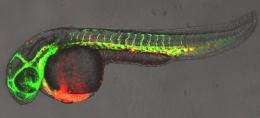
In this fluorescent image of a zebrafish embryo, endothelial cells (blood vessels) are labeled green and erythrocytes (red blood cells) are labeled red and imaged by confocal microscopy. This embryo was exposed to SNAP, which enhanced NO production, increased blood flow and elevated blood stem cell formation. In the picture, the red "lines" are red blood cells flowing through the large vessels (like the aorta where the stem cells are formed) and heart in a live embryo. Image courtesy of Wolfram Goessling and Trista North
(PhysOrg.com) -- Biologists have long wondered why the embryonic heart begins beating so early, before the tissues actually need to be infused with blood. Two groups of researchers from Children's Hospital Boston, Brigham and Women's Hospital, and the Harvard Stem Cell Institute (HSCI) -- presenting multiple lines of evidence from zebrafish, mice and mouse embryonic stem cells -- provide an intriguing answer: A beating heart and blood flow are necessary for development of the blood system, which relies on mechanical stresses to cue its formation.
Their studies, published online by the journals Cell and Nature, respectively, on May 13, together offer clues that may help in treating blood diseases such as leukemia, immune deficiency and sickle cell anemia, suggesting new ways scientists can make the types of blood cells a patient needs. This would help patients who require marrow or cord blood transplants, who do not have a perfect donor match.
One team, led by Leonard Zon, MD, of the Division of Hematology/Oncology at Children's and Director of its Stem Cell research program, used zebrafish, whose transparent embryos allow direct observation of embryonic development. Publishing in Cell, Zon and colleagues discovered that compounds that modulate blood flow had a potent impact on the expression of a master regulator of blood formation, known as Runx1, which is also a recognized marker for the blood stem cells that give rise to all the cell types in the blood system.
Confirming this observation, a strain of mutant embryos that lacked a heartbeat and blood circulation exhibited severely reduced numbers of blood stem cells. Further work showed that nitric oxide, whose production is increased in the presence of blood flow, is the key biochemical regulator: Increasing nitric oxide production restored blood stem cell production in the mutant fish embryos, while inhibiting nitric oxide production led to reduced stem cell number.
Zon and colleagues went on to demonstrate that nitric oxide production was coupled to the initiation of blood stem cell formation across vertebrate species. Suppression of nitric oxide production in mice, by either genetic or chemical means, similarly reduced the number of functional Runx1-expressing blood stem cells.
"Nitric oxide appears to be a critical signal to start the process of blood stem cell production," says Zon, who is also affiliated with the HSCI. "This finding connects the change in blood flow with the production of new blood cells."
The second team, publishing in Nature, was led by George Q. Daley, MD, PhD, director of the Stem Cell Transplantation Program at Children's Hospital Boston, and Guillermo García-Cardeņa, director of the Laboratory for Systems Biology of the Center for Excellence in Vascular Biology at Brigham and Women's Hospital, along with scientists from the Indiana University School of Medicine. Intrigued by the appearance of blood progenitors in the wall of the developing aorta soon after the heart starts beating, they investigated the effects of mechanical stimulation on blood formation in cultured mouse embryonic stem cells.
They showed that shear stress -- the frictional force of fluid flow on the surface of cells lining the embryonic aorta -- increases the expression of master regulators of blood formation, including Runx1, and of genetic markers found in blood stem cells. Shear stress also increased formation of colonies of progenitor cells that give rise to specific lineages of blood cells (red cells, lymphocytes, etc.). These findings demonstrate that biomechanical forces promote blood formation.
Daley, García-Cardeņa and colleagues also studied mouse embryos with a mutation that prevented initiation of the heartbeat. These embryos had a sharp reduction in progenitor blood cell colonies, along with reduced expression of genetic markers of blood stem cells. When specific cells from the mutant embryos were exposed in vitro to shear stress, markers of blood stem cells and numbers of blood cell colonies were restored.
Finally, the team showed that when nitric oxide production was inhibited, in both cell cultures and live mouse embryos, the effects of shear stress on blood progenitor colony formation were reduced.
"In learning how the heartbeat stimulates blood formation in embryos, we've taken a leap forward in understanding how to direct blood formation from embryonic stem cells in the petri dish," says Daley, who is also affiliated with the HSCI.
"These observations reveal an unexpected role for biomechanical forces in embryonic development," adds García-Cardeņa. "Our work highlights a critical link between the formation of the cardiovascular and hematopoietic systems."
The authors of the two papers speculate that drugs that mimic the effects of embryonic blood flow on blood precursor cells, or molecules involved in nitric oxide signaling, might be therapeutically beneficial for patients with blood diseases. For example, nitric oxide could be used to grow and expand blood stem cells either in the culture dish or in patients after transplantation.
-
A faster way to recover from chemotherapy and marrow transplant
Jun 20, 2007 |
not rated yet |
0
-
Molecule dictates how stem cells travel
Jan 14, 2006 |
not rated yet |
0
-
Stem cell scientists share research
Aug 25, 2005 |
not rated yet |
0
-
Researchers identify granddaddy of human blood cells
Dec 12, 2007 |
not rated yet |
0
-
From stem cells to organs: The bioengineering challenge
Feb 16, 2008 |
not rated yet |
0
-
Engineers build first sub-10-nm carbon nanotube transistor
Feb 01, 2012 |
4.9 / 5 (33) |
30
-
Something old, something new: Evolution and the structural divergence of duplicate genes
Jan 31, 2012 |
4.6 / 5 (7) |
1
-
The hidden nanoworld of ice crystals: Revealing the dynamic behavior of quasi-liquid layers
Jan 30, 2012 |
5 / 5 (4) |
1
-
Stock market network reveals investor clustering
Jan 27, 2012 |
3.9 / 5 (23) |
8
-
Of microchemistry and molecules: Electronic microfluidic device synthesizes biocompatible probes
Jan 26, 2012 |
5 / 5 (2) |
0
-
Is Everyday Technology Killing Us?
Feb 08, 2012
-
Exercise and weight loss
Feb 08, 2012
-
Why do we have head aches? Our brains can't feel anything.
Feb 07, 2012
-
"The end of diseases" by David Agus, interview from Daily Show with Jon Stewart
Feb 04, 2012
-
Oncolytic adenovirus
Feb 04, 2012
-
Nutrition label stuffs and diets
Feb 02, 2012
- More from Physics Forums - Medical Sciences
More news stories
Starve a virus, feed a cure? Findings show how some cells protect themselves against HIV
A protein that protects some of our immune cells from the most common and virulent form of HIV works by starving the virus of the molecular building blocks that it needs to replicate, according to research published online ...
13 hours ago |
5 / 5 (3) |
0
|
Overeating may double risk of memory loss
New research suggests that consuming between 2,100 and 6,000 calories per day may double the risk of memory loss, or mild cognitive impairment (MCI), among people age 70 and older. The study was released today and will be ...
Medicine & Health / Neuroscience
9 hours ago |
5 / 5 (2) |
0
|
Declining health-care productivity in England: Who says so?
Reports that the National Health Service in England has been declining in productivity in the last decade appear to have been accepted as fact. However, a Viewpoint published Online First by The Lancet disputes this. The Vi ...
7 hours ago |
1 / 5 (1) |
1
Injured boomers beware: Know when to see doctor
(AP) -- It happened to nurse Jane Byron years after an in-line skating fall, business owner Haralee Weintraub while doing "men's" push-ups, and avid cyclist Gene Wilberg while lifting a heavy box.
14 hours ago |
5 / 5 (1) |
0
FDA-approved drug rapidly clears amyloid from the brain, reverses Alzheimer's symptoms in mice
Neuroscientists at Case Western Reserve University School of Medicine have made a dramatic breakthrough in their efforts to find a cure for Alzheimer's disease. The researchers' findings, published in the journal Science, show t ...
Medicine & Health / Neuroscience
Feb 09, 2012 |
4.9 / 5 (58) |
17
|
Scientists discover molecular secrets of 2,000-year-old Chinese herbal remedy
For roughly two thousand years, Chinese herbalists have treated Malaria using a root extract, commonly known as Chang Shan, from a type of hydrangea that grows in Tibet and Nepal. More recent studies suggest that halofuginone, ...
New method to examine batteries -- MRI from the inside
There is an ever-increasing need for advanced batteries for portable electronics, such as phones, cameras, and music players, but also to power electric vehicles and to facilitate the distribution and storage of energy derived ...
A mitosis mystery solved: How chromosomes align perfectly in a dividing cell
Although the process of mitotic cell division has been studied intensely for more than 50 years, Whitehead Institute researchers have only now solved the mystery of how cells correctly align their chromosomes during symmetric ...
Google might launch Drive for cloud storage soon
(PhysOrg.com) -- Google's next big move, according to the Wall Street Journal, is a cloud storage service called Drive. Hardly first to the plate, Google is simply catching up to introducing its cloud reposi ...
Lab study raises questions over nano-particle impact
Tests involving chickens have raised questions about the impact on health from engineered nano-particles, the ultra-fine grains commonly used in drugs and processed foods, scientists said on Sunday.
Researchers find extensive RNA editing in human transcriptome
In a new study published online in Nature Biotechnology, researchers from BGI, the world's largest genomics organization, reported the evidence of extensive RNA editing in a human cell line by analysis of RNA-seq data, demons ...