Astronauts grab Hubble, prepare for tough repairs
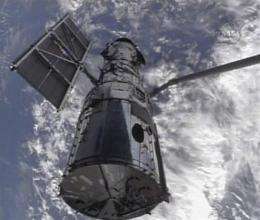
(AP) -- Atlantis' astronauts grabbed the Hubble Space Telescope on Wednesday, then quickly set their sights on the difficult, dangerous and unprecedented spacewalking repairs they will attempt over the next five days.
Hubble and Atlantis are flying in a 350-mile-high orbit littered with space junk. The shuttle already has an ugly stretch of nicks from Monday's launch, but the damage is considered minor and poses no safety threat. NASA continued to prep another shuttle, though, just in case Atlantis is hit by orbital debris and the crew needs to be rescued.
After seven years of orbital solitude, Hubble looked surprisingly well. Flight controllers gasped when the telescope first came into view.
"It's an unbelievably beautiful sight," reported John Grunsfeld, the telescope's chief repairman. "Amazingly, the exterior of Hubble, an old man of 19 years in space, still looks in fantastic shape."
NASA hopes to get another five to 10 years of dazzling views of the cosmos from Hubble, with all the planned upgrades, which should leave the observatory more powerful than ever.
Shuttle robot arm operator Megan McArthur used the 50-foot boom to seize the school bus-sized telescope as the two spacecraft sailed 350 miles above Australia. Then she lowered the observatory into Atlantis' payload bay, where cameras checked it out.
Going into the mission, Hubble scientists and managers warned that Hubble might look a little ragged because it hasn't had a tuneup since 2002. But initial observations showed nothing major.
"Everybody's very excited up here, I can tell you," said Grunsfeld, who will venture out Thursday with Andrew Feustel. They will replace an old Hubble camera that's the size of a baby grand piano, as well as a science data-handling unit that failed in September and delayed Atlantis' flight by seven months.
This is the fifth time astronauts have called upon Hubble. The previous overhauls went well, but those repairs were straightforward, with spacewalkers pulling equipment in and out. This time, Grunsfeld and his team will venture into the guts of broken instruments.
"Don't hold us to too high a standard," NASA space operations chief Ed Weiler warned before Monday's launch. "We're trying to do two things that we've never done before, take apart instruments that aren't designed to be taken apart in space and operated on by gloved astronauts, and fix them after pulling out 110 or 111 screws.
"That's one heck of a challenge."
Two teams of spacewalking astronauts - two men per team - will take turns stepping outside. Besides swapping out the old camera and science data unit, they will replace Hubble's batteries, gyroscopes and a pointing mechanism. They also will install fresh thermal covers on the telescope, along with a docking ring so a future spacecraft can guide the telescope into the Pacific Ocean sometime in the early 2020s.
And in the toughest challenge, they will open up the two broken science instruments to replace fried electronics.
No one will visit Hubble after the Atlantis astronauts leave next week, so NASA crammed as much as it could into the five spacewalks and poured more than $1 billion into the mission. Managers also chose two experienced spacewalkers who have been to Hubble before, Michael Massimino and Grunsfeld, who is making a record third visit.
Atlantis is loaded with 180 tools; 116 were designed for this 11-day mission.
"We've set the bar extraordinarily high for ourselves," said senior project scientist David Leckrone, "and nobody should consider this mission a failure or any of the crew a failure if for some reason we don't get all things done to the 100 percent level."
The mission almost didn't happen.
A year after the 2003 Columbia tragedy, NASA canceled the repair effort, saying it was too dangerous. The astronauts would not have anywhere to seek shelter because the international space station is in a different, inaccessible orbit.
But a new NASA regime reinstated the flight in 2006 after shuttle repair techniques were developed and tested in orbit. A plan also was put in place to have a shuttle on the launch pad to blast off within days for a rescue. Since then, Hubble's unusually high orbit has become dirtier as a result of satellite smashups; even a small piece could pierce the shuttle or the suit of a spacewalker.
Shuttle Endeavour will remain on standby until Atlantis and its crew of seven head back to Earth at the end of next week.
---
On the Net:
NASA: http://www.nasa.gov/mission-pages/hubble/main/index.html
©2009 The Associated Press. All rights reserved. This material may not be published, broadcast, rewritten or redistributed.


