James Webb Space Telescope unfolds by animation (w/Video)
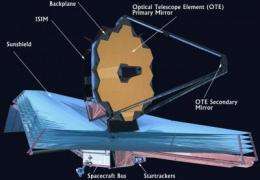
Although engineers, scientists and manufacturers are still in the process of building all of the instruments that will fly aboard NASA's James Webb Space Telescope, they had to figure out long ago, how it was going to "unfold" in space. That's because the Webb Telescope is so big that it has to be folded up for launch. Now, animators have made that "unfolding" come to life in two new videos.
A brand new animation of how NASA's massive next-generation space telescope will open up in space once it achieves orbit, was created by the Image center at Northrop Grumman Aerospace Systems, Redondo Beach, Calif. The Webb Telescope is roughly 65 feet (21 meters) from end to end and about 3 stories high.
"Animation helps designers and their colleagues to fully visualize and explain the complex motions required to deploy this observatory," said Mike Herriage, Webb Telescope Deputy Program Manager at Northrop Grumman. "And while it's a visual tool, producing accurate animation is a technical challenge as well."
The James Webb Space Telescope is a large, infrared space telescope. It will find the first galaxies that formed in the early Universe, connecting the Big Bang to our own Milky Way Galaxy. It will peer through dusty clouds to see stars forming planetary systems, connecting the Milky Way to our own Solar System.
The Webb Telescope is extremely large and cannot fit in a rocket unless it is folded. It has a sunshield the size of a tennis court and an 18-segment mirror that looks like a honeycomb. Because of its large size, the telescope needs to be folded up to fit in the rocket. The sunshield will be compactly folded, much like a parachute, around the front and back of the telescope. The mirror segments are mounted on the "spine" or backplane of the telescope and the segments on the left and right sides of the honeycomb shape are folded in the rocket.
Once the Webb telescope is on its way to its final orbit, approximately 1 million miles from the Earth, engineers at Northrop Grumman will issue commands to the Webb Telescope to unfold it. "Think of the sunshield as five candy wrappers the size of a tennis court," said Mark Clampin, Webb Telescope Observatory Project Scientist at NASA's Goddard Space Flight Center, Greenbelt, Md.
The animation shows the first part of the telescope to unfold is the solar panel, followed by the communications antenna. Next, the five layers of sunshield will drop into place from the front and back, spread out into a kite shape. The "secondary mirror support structure," an arm-like feature holding the secondary mirror assembly will then drop down from its folded center perch, and finally, the side mirror segments will be moved forward to form the complete "honeycomb."
"There are videos showing a simple deployment and a version that includes detailed views of key points in the sequence," Clampin said. "There are 2 and 4 megabyte versions of each video and they are high definition."
Source: NASA/Goddard Space Flight Center


