Ancient trading raft sails anew
May 13, 2009 David Chandler Ancient trading raft sails anew

Enlarge

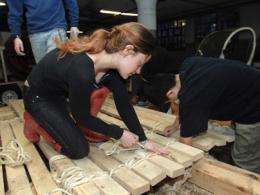
Students from Professor of Archeology and Ancient Technology Dorothy Hosler's class work on making the full-size authentic replica of a pre-Columbian South American balsa oceangoing raft on the Charles river. Here Leslie Dewan and Feng Wu work. Photo / Donna Coveney

(PhysOrg.com) -- For the first time in nearly 500 years, a full-size balsa-wood raft just like those used in pre-Columbian Pacific trade took to the water on Sunday, May 10. Only this time, instead of the Pacific coast between Mexico and Chile where such rafts carried goods between the great civilizations of the Andes and Mesoamerica as long as a millennium ago, the replica raft was floated in the Charles River basin.

The faithful reproduction of the ancient sailing craft, built from eight balsa logs brought from Ecuador for the project, was created in less than six weeks by 30 students in the Ancient Materials class taught by Professor of Archeology and Ancient Technology Dorothy Hosler of the department of Materials Science and Engineering. The replica was based on an analysis carried out by Hosler and her former student Leslie Dewan '06, which was published last year in the Journal of Anthropological Research.

Based on drawings and descriptions recorded by Spanish, Portuguese and Dutch explorers, Dewan and Hosler figured out the dimensions and construction methods that most likely were used for the ancient craft, and reproduced these as accurately as possible. While some other attempts have been made to reproduce the ancient craft, including a one-third scale version built by Dewan and other students five years ago, none had previously copied the ancient designs and materials so precisely. No modern materials were used in the construction.

The full-size replica was built to confirm the of the craft's size, capacity and construction, and to prove that such a vessel really is seaworthy and could have made the voyages of thousands of miles indicated by Hosler's research on similarities in the metalwork design and manufacture between the Andean and Mesoamerican cultures. The reproduction was financed through a donation from Alcan-Beltec Corp.

The raft will undergo a series of tests over the summer, but so far performed very well, Hosler says. Although there were high winds that caused problems for many sailboats on the Charles on Sunday, the raft with nine students aboard remained very stable, she said.

Provided by Massachusetts Institute of Technology (news : web)


print this article email this article download pdf blog this article bookmark this article     Stumble it Digg this share on Facebook retweet share on Reddit add to delicious
Rate this story - 4 /5 (1 vote)

Rank Filter

Move the slider to adjust rank threshold, so that you can hide some of the comments.


Display comments: newest first

  • IAmMe - May 13, 2009
    • Rank: 5 / 5 (1)
    I suggest they read "Kon-Tiki" by Thor Heyerdahl. I think he did this in 1947, but with out the computer modeling bit.
  • jerryd - Jun 06, 2009
    • Rank: not rated yet

    I doubt they had 2x4's back then and would have had notches for the ties. Instead they would have flattened the tops or more likely split the tree into wider planks. Too bad there are not better pics.

May 13, 2009 all stories

Comments: 2

4 /5 (1 vote)
  • Stumble this up

  • Digg this

  • share this

  • hide
  • Related Stories


  • hide
  • Relevant PhysicsForums posts

  • Mutation
    created 3 hours ago
  • Incorrupt Bodies
    created Nov 09, 2009
  • What was your favorite intro to biology textbook?
    created Nov 08, 2009
  • What does sustainable harvest mean to you?
    created Nov 08, 2009
  • More from Physics Forums - Biology

Other News

New fossil plant discovery links Patagonia to New Guinea in a warmer past

New fossil plant discovery links Patagonia to New Guinea in a warmer past

Other Sciences / Archaeology & Fossils

created 3 hours ago | popularity not rated yet | comments 0

Fossil plants are windows to the past, providing us with clues as to what our planet looked like millions of years ago. Not only do fossils tell us which species were present before human-recorded history, ...


Research shows avatars can negatively affect users

Other Sciences / Social Sciences

created 2 hours ago | popularity not rated yet | comments 0

(PhysOrg.com) -- Although often seen as an inconsequential feature of digital technologies, one's self-representation, or avatar, in a virtual environment can affect the user's thoughts, according to research by a University ...


Golden State: Yes, No or Maybe?

Golden State: Yes, No or Maybe?

Other Sciences / Other

created 2 hours ago | popularity 3 / 5 (1) | comments 0

(PhysOrg.com) -- Dan Schnur, director of the College's Jesse M. Unruh Institute of Politics, analyzes the findings from the first of six USC College of Letters, Arts & Sciences/Los Angeles Times statewide ...


Gender-based pay gaps among US faculty

Other Sciences / Social Sciences

created 8 hours ago | popularity 1 / 5 (1) | comments 0

Before the Equal Pay Act of 1963 was signed into law by President Kennedy, women earned about fifty percent less than men. Nationally, women still earn an average of thirty percent less than men regardless of education, choice ...


School textbooks have political purpose, finds study

School textbooks have political purpose, finds study

Other Sciences / Social Sciences

created 2 hours ago | popularity 2 / 5 (2) | comments 0

(PhysOrg.com) -- The simple school textbook is used by states to mould loyal citizens, according to a new study.