A 'cloaking device' -- it's all done with mirrors
May 13, 2009 By Bill Steele
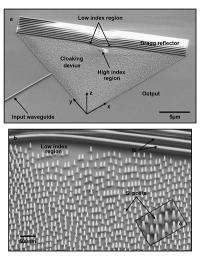
Scanning electron microscope images of the cloaking device. Top: Light passes through silicon posts as it bounces off a deformed reflector. Varying density of the silicon posts bends light to compensate for the distortion in the reflector. Bottom: a close-up of the array of silicon posts, each about 50 billionths of a meter in diameter. Image: Nanophotonics Group
(PhysOrg.com) -- Somewhat the way Harry Potter can cover himself with a cloak and become invisible, Cornell researchers have developed a device that can make it seem that a bump in a carpet -- or, indeed, any flat surface -- isn't there.
So far the illusion works only at the nanoscale, but the researchers suggest that the basic principle might eventually be scaled up for military and communications applications, or perhaps used in reverse to concentrate solar energy.
Devices that bend microwaves around small objects have previously been demonstrated, but this is the first cloaking device to work at optical frequencies, the researchers said.
The experimental device was built by Michal Lipson, associate professor of electrical and computer engineering, and colleagues in her Nanophotonics Research Group, based on a design by British physicists. It bends light bouncing off a reflective surface in a way that corrects for the distortion caused by a bump in the surface. Imagine controlling the light in front of a funhouse mirror so that reflections look perfectly normal, and the mirror looks flat.
A similar device has been reported by University of California-Berkeley researchers.
On a silicon wafer, Lipson's group made a tiny reflector about 30 microns (millionths of a meter) long with a 5-micron-wide bump in the middle, then placed an array of vertical silicon posts, each 50 nanometers (billionths of a meter) in diameter, in front of it. Because the posts are much smaller than the wavelength of the light, the light behaves as if it were passing through a solid whose density varies with the density of the posts. As light passes between regions of high and low density it is refracted, or bent, in the same way light is refracted as it passes from air to glass. By designing smooth transitions of the density of posts, the researchers could control the path of the light to compensate for the distortion caused by the bump.
As a result, an observer looking at light reflected from the mirror sees a flat mirror, with no sign of the bump. The device is expected to work over a range of wavelengths from infrared into visible red light, the researchers said
Of course it's still a long way to cloaking tanks on a battlefield. For starters, the thing being hidden has to hide behind a mirror, and the presence of a mirror would be a giveaway. A practical cloaking device also would have to adjust in real time to changing configurations of the object behind it.
A variation of the method might be used to bend light around an object, the researchers suggested, and a light-bending device could be made much larger by using technology that stamps or molds nanoscale patterns onto a surface.
Such refraction control might also be used in reverse, they added, to concentrate light in a small area to efficiently collect solar energy.
"At the core is the fact that we're manipulating light, telling it where to go and how to behave," said Carl Poitras, a research associate on the Cornell team.
The device was manufactured at the Cornell Nanoscale Facility, which is supported by the National Science Foundation.
-
Negative Refraction of Visible Light Demonstrated; Could Lead to Cloaking Devices
Mar 23, 2007 |
not rated yet |
0
-
Next generation cloaking device demonstrated
Jan 15, 2009 |
not rated yet |
0
-
A Broadband Light Amplifier on a Photonic Chip
Jul 06, 2006 |
not rated yet |
0
-
Engineers create 'optical cloaking' design for invisibility
Apr 02, 2007 |
not rated yet |
0
-
A New Reflection in the Mirror
Jan 10, 2007 |
not rated yet |
0
-
Engineers build first sub-10-nm carbon nanotube transistor
Feb 01, 2012 |
4.9 / 5 (31) |
30
-
Something old, something new: Evolution and the structural divergence of duplicate genes
Jan 31, 2012 |
4.6 / 5 (7) |
1
-
The hidden nanoworld of ice crystals: Revealing the dynamic behavior of quasi-liquid layers
Jan 30, 2012 |
5 / 5 (3) |
1
-
Stock market network reveals investor clustering
Jan 27, 2012 |
3.9 / 5 (23) |
8
-
Of microchemistry and molecules: Electronic microfluidic device synthesizes biocompatible probes
Jan 26, 2012 |
5 / 5 (1) |
0
-
Strength of induced magnetic field inside an inductor
2 hours ago
-
Physical laws .... are they material?!!
2 hours ago
-
increasing time of daylight
3 hours ago
-
Light & Sight
3 hours ago
-
Wind Turbine Power
6 hours ago
-
Steam Table issues
8 hours ago
- More from Physics Forums - General Physics
More news stories
Putting the squeeze on planets outside our solar system
(PhysOrg.com) -- Using high-powered lasers, scientists at Lawrence Livermore National Laboratory and collaborators discovered that molten magnesium silicate undergoes a phase change in the liquid state, abruptly ...
2 hours ago |
5 / 5 (1) |
0
|
Hovering not hard if you're top-heavy, researchers find
Top-heavy structures are more likely to maintain their balance while hovering in the air than are those that bear a lower center of gravity, researchers at New York University's Courant Institute of Mathematical Sciences ...
3 hours ago |
5 / 5 (1) |
1
|
SLAC, Stanford team focuses on high-energy electrons to treat cancer
Accelerator physicists at SLAC and cancer specialists from Stanford are working on a new technology that could dramatically reduce the time needed for cancer radiation treatments. The team ran an initial experiment ...
6 hours ago |
5 / 5 (1) |
0
Measurements from high-energy collisions lead to better understanding of why meson particles disappear
For several years, physicists at the Relativistic Heavy Ion Collider (RHIC) at Brookhaven National Laboratory (BNL), USA, have studied an unusual state of matter called the quarkgluon plasma, which they ...
7 hours ago |
5 / 5 (1) |
0
Quantum physicist explains $100K offer for proof scaled-up quantum computing is impossible
(PhysOrg.com) -- MIT researcher Scott Aaronson has certainly riled the physics community with his offer this past Friday, of $100,000 to anyone who can prove that scaled-up quantum computing is impossible. ...
Complex wiring of the nervous system may rely on a just a handful of genes and proteins
Researchers at the Salk Institute have discovered a startling feature of early brain development that helps to explain how complex neuron wiring patterns are programmed using just a handful of critical genes. ...
CIA website offline, Anonymous takes credit
The website of the Central Intelligence Agency was unresponsive on Friday after the hacker group Anonymous claimed to have knocked it offline.
Q&A: Obama and the birth control controversy
(AP) -- What birth control debate? A half-century after the introduction of the pill, acceptance of birth control by American women is virtually universal.
The power of estrogen -- male snakes attract other males
A new study has shown that boosting the estrogen levels of male garter snakes causes them to secrete the same pheromones that females use to attract suitors, and turned the males into just about the sexiest ...
New error-correcting codes guarantee the fastest possible rate of data transmission
Error-correcting codes are one of the triumphs of the digital age. Theyre a way of encoding information so that it can be transmitted across a communication channel such as an optical fiber o ...
Human cognitive performance suffers following natural disasters, researchers find
Not surprisingly, victims of a natural disaster can experience stress and anxiety, but a new study indicates that it might also cause them to make more errors - some serious - in their daily lives. In their upcoming Human Fa ...
May 13, 2009
Rank: 5 / 5 (3)
be the future of many applications.
Whom ever comes up with a method to program the geometry structure of nano-molecules with light, electrostatics, and electromagnetics will
have the holy grail of materials science.
May 13, 2009
Rank: 1 / 5 (6)
May 14, 2009
Rank: 1 / 5 (6)
They already walk among us! The are called women, with there own lives, families, goals, and dreams. They already posess a sense of self and want to make the best possible life for themselves and theirs. Your description of a lifeless, no willed, machine to serve as your perverted, limitles sexual plaything is nothing short of sociopathic.
Wanting a relationship with a lifeless, sex machine is truly disturbing.
May 14, 2009
Rank: 3.3 / 5 (4)
Does the same go for all the females out thier with vibrators then? I think your speaking crap without even thinking about what your saying. You interpret "FULLY functional" as "a lifeless, no willed, machine to serve as your perverted, limitles sexual plaything", what if he was only meaning for it to have reproductive organs so he could start a family or even have "there own lives, families, goals, and dreams" to find a connection with?
Ofc, QubitTamer may well be the pervert you assume he is, in that case please accept my appologies lol.
May 14, 2009
Rank: 3 / 5 (2)
QT..you need to get out more!
ok..back to the article...didn't we see a similar story recently? so far we can only hide tiny things..oh..i meant to get back to the story...
Jul 29, 2009
Rank: not rated yet