Let the Planet Hunt Begin
May 13, 2009 Let the Planet Hunt Begin

Enlarge

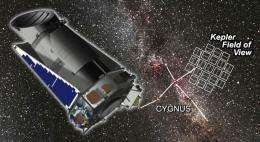
Artist concept of Kepler in space. Image credit: NASA/JPL

(PhysOrg.com) -- NASA's Kepler spacecraft has begun its search for other Earth-like worlds. The mission, which launched from Cape Canaveral, Fla., on March 6, will spend the next three-and-a-half years staring at more than 100,000 stars for telltale signs of planets. Kepler has the unique ability to find planets as small as Earth that orbit sun-like stars at distances where temperatures are right for possible lakes and oceans.

"Now the fun begins," said William Borucki, Kepler science principal investigator at NASA's Ames Research Center, Moffett Field, Calif. "We are all really excited to start sorting through the data and discovering the ."

Scientists and engineers have spent the last two months checking out and calibrating the Kepler spacecraft. Data have been collected to characterize the imaging performance as well as the noise level in the measurement electronics. The scientists have constructed the list of targets for the start of the planet search, and this information has been loaded onto the spacecraft.

"If Kepler got into a staring contest, it would win," said James Fanson, Kepler project manager at NASA's Jet Propulsion Laboratory, Pasadena, Calif. "The spacecraft is ready to stare intently at the same for several years so that it can precisely measure the slightest changes in their brightness caused by planets." Kepler will hunt for planets by looking for periodic dips in the brightness of stars -- events that occur when orbiting planets cross in front of their stars and partially block the light.

The mission's first finds are expected to be large, gas planets situated close to their stars. Such discoveries could be announced as early as next year.

Kepler is a NASA Discovery mission. NASA Ames Research Center, Moffett Field, Calif., is the home organization of the science principal investigator, and is responsible for the ground system development, mission operations and science data analysis. JPL manages the development. Ball Aerospace & Technologies Corp. of Boulder, Colo., is responsible for developing the Kepler flight system and supporting mission operations.

Provided by Jet Propulsion Laboratory (news : web)


print this article email this article download pdf blog this article bookmark this article     Stumble it Digg this share on Facebook retweet share on Reddit add to delicious
Rate this story - 4.7 /5 (6 votes)


May 13, 2009 all stories

Comments: 0

4.7 /5 (6 votes)
  • Stumble this up

  • Digg this

  • share this

  • hide
  • Related Stories


  • hide
  • Relevant PhysicsForums posts

  • Some help with a X-Ray astronomy question please!
    created 9 hours ago
  • Help with Images and Optical Instrument Question..
    created 20 hours ago
  • Redshift as a distance indicator
    created Nov 26, 2009
  • Question about 2-body gravity
    created Nov 24, 2009
  • More from Physics Forums - General Astronomy

Other News

The Energy Sources of Ultraluminous Galaxies

The Energy Sources of Ultraluminous Galaxies

Space & Earth / Astronomy

created 3 hours ago | popularity 5 / 5 (1) | comments 0

(PhysOrg.com) -- Ultraluminous infrared galaxies ((ULIRGs) are galaxies whose luminosity exceeds that of a trillion suns; for comparison, the Milky Way galaxy has a typical (and much more modest) luminosity ...


Fermi Telescope Peers Deep into Microquasar

Fermi Telescope Peers Deep into Microquasar (w/ Video)

Space & Earth / Astronomy

created 2 hours ago | popularity 5 / 5 (1) | comments 0

(PhysOrg.com) -- NASA's Fermi Gamma-ray Space Telescope has made the first unambiguous detection of high-energy gamma-rays from an enigmatic binary system known as Cygnus X-3. The system pairs a hot, massive ...


Space shuttle Atlantis, 7 astronauts back on Earth (AP)

Space shuttle Atlantis, 7 astronauts back on Earth

Space & Earth / Space Exploration

created 4 hours ago | popularity not rated yet | comments 0

(AP) -- Space shuttle Atlantis and its seven astronauts returned to Earth with a smooth touchdown Friday to end an 11-day flight that resupplied the International Space Station.


Herschel takes a peek at the ingredients of the galaxies

Herschel takes a peek at the ingredients of the galaxies

Space & Earth / Astronomy

created 1hour ago | popularity not rated yet | comments 0

(PhysOrg.com) -- The European Space Agency has today released spectacular new observations from the Herschel Space Observatory, including the UK-led SPIRE instrument. Spectrometers on board all three Hershel ...


China is set to launch its second moon orbiter next October, state media have reported

China to launch second lunar probe: state media

Space & Earth / Space Exploration

created 8 hours ago | popularity 5 / 5 (3) | comments 0

China will launch its second moon orbiter next October, state media reported Friday, as it powers ahead with a space programme that has sparked concerns abroad.