Spitzer Catches Star Cooking Up Comet Crystals (w/Animation)
May 13, 2009 Spitzer Catches Star Cooking Up Comet Crystals

Enlarge

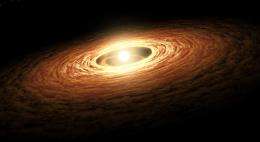
The image shows a young sun-like star encircled by its planet-forming disk of gas and dust. The silicate that makes up most of the dust would have begun as non-crystallized, amorphous particles. Image credit: NASA/JPL-Caltech

(PhysOrg.com) -- Scientists have long wondered how tiny silicate crystals, which need sizzling high temperatures to form, have found their way into frozen comets, born in the deep freeze of the solar system's outer edges. The crystals would have begun as non-crystallized silicate particles, part of the mix of gas and dust from which the solar system developed.

A team of astronomers believes they have found a new explanation for both where and how these crystals may have been created, by using NASA's to observe the growing pains of a young, sun-like star. Their study results, which appear in the May 14 issue of Nature, provide new insight into the formation of planets and comets.

The researchers from Germany, Hungary and the Netherlands found that silicate appears to have been transformed into crystalline form by an outburst from a star. They detected the infrared signature of silicate crystals on the disk of dust and gas surrounding the star EX Lupi during one of its frequent flare-ups, or outbursts, seen by Spitzer in April 2008. These crystals were not present in Spitzer's previous observations of the star's disk during one of its quiet periods.

FLV player

This artist's animation illustrates how silicate crystals like those found in comets can be created by an outburst from a growing star. It first shows a young sun-like star encircled by its planet-forming disk of gas and dust. The silicate that makes up most of the dust would have begun as non-crystallized, amorphous particles. Then, material from the disk spirals onto the star increasing its mass and causing the star to brighten and heat up dramatically. The outburst causes temperatures to rise in the star's surrounding disk. Next, the animation zooms into the disk to show close-ups of silicate particles. When the disk warms from the star's outburst, the amorphous particles of silicate melt. As they cool off, they transform into forsterite, a type of silicate crystal often found in comets in our solar system. In April 2008, NASA's Spitzer Space Telescope detected evidence of this process taking place on the disk of a young sun-like star called EX Lupi. Image credit: NASA/JPL-Caltech

"We believe that we have observed, for the first time, ongoing crystal formation," said one of the paper's authors, Attila Juhasz of the Max-Planck Institute for Astronomy in Heidelberg, Germany. "We think that the crystals were formed by thermal annealing of small particles on the surface layer of the star's inner disk by heat from the outburst. This is a completely new scenario about how this material could be created."

Annealing is a process in which a material is heated to a certain temperature at which some of its bonds break and then re-form, changing the material's physical properties. It is one way that silicate dust can be transformed into crystalline form.

Scientists previously had considered two different possible scenarios in which annealing could create the silicate crystals found in comets and young stars' disks. In one scenario, long exposure to heat from an infant star might anneal some of the silicate dust inside the disk's center. In the other, shock waves induced by a large body within the disk might heat dust grains suddenly to the right temperature to crystallize them, after which the crystals would cool nearly as quickly.

What Juhasz and his colleagues found at EX Lupi didn't fit either of the earlier theories. "We concluded that this is a third way in which silicate crystals may be formed with annealing, one not considered before," said the paper's lead author, Peter Abraham of the Hungarian Academy of Sciences' Konkoly Observatory, Budapest, Hungary.

EX Lupi is a young star, possibly similar to our sun four or five billion years ago. Every few years, it experiences outbursts, or eruptions, that astronomers think are the result of the star gathering up mass that has accumulated in its surrounding disk. These flare-ups vary in intensity, with really big eruptions occurring every 50 years or so.

The researchers observed EX Lupi with Spitzer's infrared spectrograph in April 2008. Although the star was beginning to fade from the peak of a major outburst detected in January, it was still 30 times brighter than when it was quiet. When they compared this new view of the erupting star with Spitzer measurements made in 2005 before the eruption began, they found significant changes.

In 2005, the silicate on the surface of the star's disk appeared to be in the form of amorphous grains of dust. In 2008, the spectrum showed the presence of crystalline silicate on top of amorphous dust. The crystals appear to be forsterite, a material often found in comets and in protoplanetary disks. The crystals also appear hot, evidence that they were created in a high-temperature process, but not by shock heating. If that were the case, they would already be cool.

"At outburst, EX Lupi became about 100 times more luminous," said Juhasz. "Crystals formed in the surface layer of the disk but just at the distance from the star where the temperature was high enough to anneal the silicate--about 1,000 Kelvin (1,340 degrees Fahrenheit)--but still lower than 1,500 Kelvin (2,240 degrees Fahrenheit). Above that, the dust grains will evaporate." The radius of this crystal formation zone, the researchers note, is comparable to that of the terrestrial-planet region in the solar system.

"These observations show, for the first time, the actual production of crystalline silicates like those found in comets and meteorites in our own ," said Spitzer Project Scientist Michael Werner of NASA's Jet Propulsion Laboratory, Pasadena, Calif. "So what we see in comets today may have been produced by repeated bursts of energy when the sun was young."

Provided by JPL/NASA (news : web)


print this article email this article download pdf blog this article bookmark this article     Stumble it Digg this share on Facebook retweet share on Reddit add to delicious
Rate this story - 4.8 /5 (6 votes)

Rank Filter

Move the slider to adjust rank threshold, so that you can hide some of the comments.


Display comments: newest first

  • flashgordon - May 13, 2009
    • Rank: not rated yet
    ahh . . . this is a real picture?(like any picture isn't processed at some level these days! Of course, even the human eye processes the input signals . . . ;still, I can't believe this is a real picture! This is almost certainly the picture of the year!)
  • cybrbeast - May 13, 2009
    • Rank: 5 / 5 (1)
    I wish it was a real picture, but PhysOrg failed to mention it as an artists concept:
    http://www.nasa.g...age.html
  • brant - May 14, 2009
    • Rank: not rated yet
    I wonder if that out burst could be considered plasma?

  • Ethelred - May 14, 2009
    • Rank: 5 / 5 (1)
    [qThis artist's animation illustrates how silicate crystals like those found in comets can be created by an outburst from a growing star

    Read the large caption below the animation. Physorg clearly mentioned it since I just copied it with control C control V.

    Physorg has enough real silliness. Don't blame them for peoples failure to read.

    Ethelred
  • cybrbeast - May 14, 2009
    • Rank: 3 / 5 (2)
    An animation and an image are two different things
  • earls - May 14, 2009
    • Rank: 5 / 5 (1)
    Sorry brant, only "gas" and "dust" are allowed in this model. Something you have to understand is that the Universe is electrically neutral. Until you grasp this simple concept, you'll never understand cosmology.
  • holoman - May 14, 2009
    • Rank: 1 / 5 (3)
    earls,

    quite a statement?

    http://www.thunde...rces.htm


  • Ethelred - May 16, 2009
    • Rank: not rated yet
    A true statement. There is one electron for every proton. That makes the Universe neutral. Any claim to the contrary would require extraordinary evidence as support. Crank sites do not count as extraordinary. Not even ordinary.

    The main alleged support of this nonsense is a single paper written a long time ago that they misquote. They ALWAYS claim experiments showed intergalactic plasma flow. Read the ORIGINAL paper that they even link to in some cases and what do you find?

    The alleged experimental evidence turns out to be a highly speculative set of calculations that IF CORRECT would indeed produce the results of the nonexistent experiment. Such an experiment is IMPOSSIBLE without faster than light travel. The claim was INTERGALACTIC currents. There is no way to tell if they exist except by actually going there and measuring.

    So why do they claim actual evidence instead of a set equations. Because they are cranks seems the most likely explanation. Wishful thinking from people that don't read the stuff they claim is their support.

    Ethelred
  • earls - May 17, 2009
    • Rank: not rated yet
    Ethelred, in addition, matter/anti-matter appear throughout the Universe in equivalence, solidifying the concept electrical neutrality.
  • Ethelred - May 18, 2009
    • Rank: not rated yet
    I don't get that one. What do you mean by matter/anti-matter appear in equivalence? Anti-matter seems to be in seriously short supply outside of science fiction.

    Ethelred

May 13, 2009 all stories

Comments: 10

4.8 /5 (6 votes)
  • Stumble this up

  • Digg this

  • share this

  • hide
  • Related Stories

  • Dusty Shock Waves Generate Planet Ingredients
    created Nov 11, 2008 | popularity not rated yet | comments 0
  • Signs Of Alien Asteroid Belt
    created Apr 20, 2005 | popularity not rated yet | comments 0
  • Spitzer Finds Failed Stars May Succeed in Planet Business
    created Oct 21, 2005 | popularity not rated yet | comments 0
  • Spitzer Finds Violent Galaxies Smothered in 'Crushed Glass'
    created Feb 16, 2006 | popularity not rated yet | comments 0
  • Spitzer Team Says Debris Disk Could Be Forming Infant Terrestrial Planets
    created Dec 14, 2005 | popularity not rated yet | comments 0


  • hide
  • Relevant PhysicsForums posts

  • Sideral question
    created 13 hours ago
  • Doppler shifted blackbody spectrum
    created 16 hours ago
  • Earth v. Moon
    created 18 hours ago
  • help me with coordinates and orbits
    created 18 hours ago
  • basic 'our universe' question..
    created Nov 20, 2009
  • deriving keplers law
    created Nov 19, 2009
  • More from Physics Forums - General Astronomy

Other News

Astronauts finish another spacewalk, still no baby (AP)

Astronauts finish another spacewalk, still no baby

Space & Earth / Space Exploration

created 4 hours ago | popularity 3 / 5 (2) | comments 0

(AP) -- A spacewalking astronaut put aside the impending birth of his daughter and blazed through his first-ever venture outside the International Space Station on Saturday.


Unseasonably hot and dry weather combined with strong winds to fan scores of blazes in the country's southeastern states

Australia issues 'catastrophic' alerts as fires rage

Space & Earth / Environment

created 11 hours ago | popularity 4.5 / 5 (2) | comments 0

Australia has issued "catastrophic" alerts after record-breaking temperatures and wild lightning storms sparked more than 100 fires across the country, officials said Saturday.


Commuters wait on the platform shrouded by fog in London

Climate change not man-made, say majority of Britons: poll

Space & Earth / Environment

created Nov 15, 2009 | popularity 3.3 / 5 (15) | comments 45

Less than half of Britons believes that human activity is to blame for global warming, according to a poll carried out for The Times newspaper and published on Saturday.


Mysteriously warm times in Antarctica

Mysteriously warm times in Antarctica

Space & Earth / Earth Sciences

created Nov 18, 2009 | popularity 4.2 / 5 (21) | comments 28

(PhysOrg.com) -- A new study of Antarctica's past climate reveals that temperatures during the warm periods between ice ages (interglacials) may have been higher than previously thought. The latest analysis ...


UN: Fight climate change with free condoms (AP)

UN: Fight climate change with free condoms

Space & Earth / Environment

created Nov 18, 2009 | popularity 3.1 / 5 (11) | comments 22

(AP) -- The battle against global warming could be helped if the world slowed population growth by making free condoms and family planning advice more widely available, the U.N. Population Fund said Wednesday.