Europium discovery: New element found to be a superconductor
May 13, 2009 By Melissae Stuart
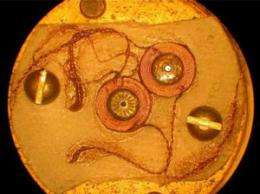
Inside of the diamond cell: In the middle is the coil system around the diamond anvil, which picks up the shielding signal from the superconducting sample.
(PhysOrg.com) -- Of the 92 naturally occurring elements, add another to the list of those that are superconductors. James S. Schilling, Ph.D., professor of physics in Arts & Sciences at Washington University in St. Louis, and Mathew Debessai — his doctoral student at the time — discovered that europium becomes superconducting at 1.8 K (-456 °F) and 80 GPa (790,000 atmospheres) of pressure, making it the 53rd known elemental superconductor and the 23rd at high pressure.
Debessai, who receives his doctorate in physics at Washington University's Commencement May 15, 2009, is now a postdoctoral research associate at Washington State University.
"It has been seven years since someone discovered a new elemental superconductor," Schilling said. "It gets harder and harder because there are fewer elements left in the periodic table."
This discovery adds data to help improve scientists' theoretical understanding of superconductivity, which could lead to the design of room-temperature superconductors that could be used for efficient energy transport and storage.
The results are published in the May 15, 2009, issue of Physical Review Letters in an article titled "Pressure-induced Superconducting State of Europium Metal at Low Temperatures."
Schilling's research is supported by a four-year $500,000 grant from the National Science Foundation, Division of Materials Research.
Europium belongs to a group of elements called the rare earth elements. These elements are magnetic; therefore, they are not superconductors.
"Superconductivity and magnetism hate each other. To get superconductivity, you have to kill the magnetism," Schilling explained.
Of the rare earths, europium is most likely to lose its magnetism under high pressures due to its electronic structure. In an elemental solid almost all rare earths are trivalent, which means that each atom releases three electrons to conduct electricity.
"However, when europium atoms condense to form a solid, only two electrons per atom are released and europium remains magnetic. Applying sufficient pressure squeezes a third electron out and europium metal becomes trivalent. Trivalent europium is nonmagnetic, thus opening the possibility for it to become superconducting under the right conditions," Schilling said.
Schilling uses a diamond anvil cell to generate such high pressures on a sample. A circular metal gasket separates two opposing 0.17-carat diamond anvils with faces (culets) 0.18 mm in diameter. The sample is placed in a small hole in the gasket, flanked by the faces of the diamond anvils.
Pressure is applied to the sample space by inflating a doughnut-like bellow with helium gas. Much like a woman in stilettos exerts more pressure on the ground than an elephant does because the woman's force is spread over a smaller area, a small amount of helium gas pressure (60 atmospheres) creates a large force (1.5 tons) on the tiny sample space, thus generating extremely high pressures on the sample.
Unique electrical, magnetic properties
Superconducting materials have unique electrical and magnetic properties. They have no electrical resistance, so current will flow through them forever, and they are diamagnetic, meaning that a magnet held above them will levitate.
These properties can be exploited to create powerful magnets for medical imaging, make power lines that transport electricity efficiently or make efficient power generators.
However, there are no known materials that are superconductors at room temperature and pressure. All known superconducting materials have to be cooled to extreme temperatures and/or compressed at high pressure.
"At ambient pressure, the highest temperature at which a material becomes superconducting is 134 K (-218 °F). This material is complex because it is a mixture of five different elements. We do not understand why it is such a good superconductor," Schilling said.
Scientists do not have enough theoretical understanding to be able to design a combination of elements that will be superconductors at room temperature and pressure. Schilling's result provides more data to help refine current theoretical models of superconductivity.
"Theoretically, the elemental solids are relatively easy to understand because they only contain one kind of atom," Schilling said. "By applying pressure, however, we can bring the elemental solids into new regimes, where theory has difficulty understanding things.
"When we understand the element's behavior in these new regimes, we might be able to duplicate it by combining the elements into different compounds that superconduct at higher temperatures."
Schilling will present his findings at the 22nd biennial International Conference on High Pressure Science and Technology in July 2009 in Tokyo, Japan.
-
Advance hastens practicality of superconductivity
Mar 02, 2006 |
not rated yet |
0
-
Superconductors get a boost from pressure
May 19, 2008 |
not rated yet |
0
-
One Mystery of High-Tc Superconductivity Resolved
Nov 16, 2006 |
not rated yet |
0
-
Scientists See New Mechanism for Superconductivity
Nov 21, 2008 |
not rated yet |
0
-
Putting the Pressure on Iron-Based Superconductors
Mar 05, 2009 |
not rated yet |
0
-
Fast photon control brings quantum photonic technologies closer
1 hour ago |
5 / 5 (2) |
0
-
Engineers build first sub-10-nm carbon nanotube transistor
Feb 01, 2012 |
4.9 / 5 (33) |
30
-
Something old, something new: Evolution and the structural divergence of duplicate genes
Jan 31, 2012 |
4.6 / 5 (7) |
1
-
The hidden nanoworld of ice crystals: Revealing the dynamic behavior of quasi-liquid layers
Jan 30, 2012 |
5 / 5 (5) |
1
-
Stock market network reveals investor clustering
Jan 27, 2012 |
3.9 / 5 (23) |
8
-
Help with snow Crystals
12 hours ago
-
Doubts about surface plasmons
Feb 11, 2012
-
excited U-236 decay time in the U235 fission chain
Feb 09, 2012
-
Polar catastrophe?
Feb 09, 2012
-
Large scale field sonication
Feb 09, 2012
-
states and energy of paired electrons in BCS
Feb 08, 2012
- More from Physics Forums - Atomic, Solid State, Comp. Physics
More news stories
Fast photon control brings quantum photonic technologies closer
(PhysOrg.com) -- Using photons instead of electrons to transmit information could lead to faster and more secure ways to communicate, among other advantages. Now a team of physicists has taken another step toward realizing ...
Rapunzel, Leonardo and the physics of the ponytail
(PhysOrg.com) -- New research provides the first mathematical understanding of the shape of a ponytail and could have implications for the textile industry, computer animation and personal care products.
6 hours ago |
4.8 / 5 (5) |
0
|
Researchers make better heat sensor based on butterfly wings
(PhysOrg.com) -- Scientists have long known that butterfly wings produce their iridescent colors by bouncing light around and between tiny ridges in structures made of chitin. More recently they’ve discovered ...
Explained: Sigma
It's a question that arises with virtually every major new finding in science or medicine: What makes a result reliable enough to be taken seriously? The answer has to do with statistical significance -- but ...
Feb 09, 2012 |
5 / 5 (21) |
88
Quantum physicist explains $100K offer for proof scaled-up quantum computing is impossible
(PhysOrg.com) -- MIT researcher Scott Aaronson has certainly riled the physics community with his offer this past Friday, of $100,000 to anyone who can prove that scaled-up quantum computing is impossible. ...
Slowing ocean current caused Earth to spin faster
(PhysOrg.com) -- Most people probably didn’t notice it, but back in 2009, the Earth spun around on its axis a tiny bit faster than usual, making for some slightly shorter days. It only happened for a ...
What we mean when we ask for the milk
New research into the different ways that English and Polish people use language in everyday family situations can help members of each community to understand each other better and avoid cultural misunderstandings.
Nerve sparing helps most prostate cancer patients to have same orgasms as before surgery
The vast majority of men who have a prostate cancer operation can retain their ability to orgasm if the surgery is carried out without removing the nerves that surround the prostate gland like a hammock, according to a study ...
Larger belly linked to memory problems in people with HIV
A larger waistline may be linked to an increased risk of decreased mental functioning in people infected with the AIDS virus HIV, according to research published in the February 14, 2012, print issue of Neurology, the me ...
Lens produces hours of scientific work in seconds
A new form of microscope which can produce results in seconds rather than hours dramatically speeding up the process of drug development - is being developed by researchers at the University of Strathclyde ...
Planck mission steps closer to the cosmic blueprint
(PhysOrg.com) -- ESA's Planck mission has revealed that our Galaxy contains previously undiscovered islands of cold gas and a mysterious haze of microwaves. These results give scientists new treasure to mine ...
May 14, 2009
Rank: 5 / 5 (1)
Hard to believe considering it was discovered almost a century ago. I don't get it, but hopefully this will enable progress. I consider superconductors to be one of the most important resources we have available. Room temperature superconductors will revolutionize EVERYTHING. Everything you have now that is electric will be thrown away a replaced. I can't wait, myself.
Assembling the puzzle of superconducting elements: A Review
http://arxiv.org/...0302.pdf
May 27, 2009
Rank: not rated yet