These shoes are made for talking ... to your phone
May 13, 2009 By PETER SVENSSON , AP Technology Writer
These shoes are made for talking ... to your phone (AP)

Enlarge

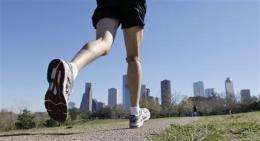
In this Jan. 12, 2009 file photo, a jogger runs near downtown Houston. ESoles Inc., a startup in Scottsdale, Ariz. which makes custom insoles for athletic shoes, has created prototype insoles with pressure sensors that relay their information wirelessly to a nearby cell phone. (AP Photo/David J. Phillip)

(AP) -- A startup is working on a product that can tell you exactly what it's like to walk a mile in someone else's shoes - because the insoles record every touch of pressure.

ESoles Inc., which makes custom insoles for athletic shoes, has created prototype insoles with pressure sensors that relay their information wirelessly to a nearby . Then an application on the phone can tell the wearer how much pressure he or she is applying in 11 different zones of each sole.

The system has been used to analyze the technique of the U.S. Olympic BMX team, helping them figure out how to apply maximum power to the bicycle pedals out of the gate, said Glen Hinshaw, founder of in Scottsdale, Ariz.-based eSoles and a former professional cyclist.

The system can also analyze a golf swing or skiing posture, Hinshaw said.

Sports aren't the only application - the insoles can work in games. ESoles is trying a jump rope game, in which the phone screen shows a swinging rope, and users have to time their jumps to it.

"If you leave one leg on the ground and you're only lifting the other foot, the jump rope stops, because it's not clearing your foot," Hinshaw said.

Nintendo Co. makes a balance board accessory for its Wii game console that senses the force from the user's feet. ESoles' sensing insoles would essentially do the same thing, but without tying the user to an immobile board.

Hinshaw also envisions medical uses - perhaps for warning diabetes patients who have lost feeling in their feet that they risk injury from too much .

Hinshaw said the company plans to make the insoles available in a limited trial version in July, then take them fully commercial late this year. The initial price for the sensors would be about $300, but he hopes to bring the price under $50.

©2009 The Associated Press. All rights reserved. This material may not be published, broadcast, rewritten or redistributed.


Rank not rated yet
Related Stories
Relevant PhysicsForums posts
  • How to calculate total compressibility in liquid porous solid system
    created3 hours ago
  • Need help reading 3-D
    created23 hours ago
  • A way to send and receive wireless data
    createdFeb 11, 2012
  • Calling function with no input argument
    createdFeb 10, 2012
  • Force free body diagram problem on gym equipment
    createdFeb 10, 2012
  • Empirical data regarding shower heads and water
    createdFeb 10, 2012
  • More from Physics Forums - General Engineering

More news stories

Japan scientist makes 'Avatar' robot

A Japanese-developed robot that mimics the movements of its human controller is bringing the Hollywood blockbuster "Avatar" one step closer to reality.

Electronics / Robotics

created Feb 10, 2012 | popularity 5 / 5 (8) | comments 12

Intel packs performance and reliability into its latest SSD 520 series

Intel Corporation announced today its fastest, most robust client/consumer solid-state drive (SSD) to date, the Intel Solid-State Drive 520 Series (Intel SSD 520), a 6 gigabit-per-second (gbps) SATA III SSD ...

Electronics / Hardware

created Feb 07, 2012 | popularity 5 / 5 (1) | comments 4

Google rumored to have built Heads-Up-Display glasses prototype

(PhysOrg.com) -- 9to5Google is reporting that they have received a tip from someone they believe to be a reliable source saying that Google is working on a Heads-Up-Display (HUD) pair of eye-glasses. The per ...

Electronics / Consumer & Gadgets

created Feb 08, 2012 | popularity 4.3 / 5 (9) | comments 2 | with audio podcast weblog

New Kindle Touch is an impressive e-reader

When it comes to reading digital books, tablets are all the rage. But there's a lot to like about simple e-readers, which over the past year have become both a lot cheaper and a lot less clunky.

Electronics / Consumer & Gadgets

created Feb 09, 2012 | popularity 5 / 5 (4) | comments 1

Apple to debut 'iPad 3' in March: report

Apple will unveil a new version of its market-ruling iPad table computer in March, according to a report in Dow Jones-owned technology blog All Things D.

Electronics / Consumer & Gadgets

created Feb 09, 2012 | popularity 1.9 / 5 (21) | comments 0


Scientists discover molecular secrets of 2,000-year-old Chinese herbal remedy

For roughly two thousand years, Chinese herbalists have treated Malaria using a root extract, commonly known as Chang Shan, from a type of hydrangea that grows in Tibet and Nepal. More recent studies suggest that halofuginone, ...

Overeating may double risk of memory loss

New research suggests that consuming between 2,100 and 6,000 calories per day may double the risk of memory loss, or mild cognitive impairment (MCI), among people age 70 and older. The study was released today and will be ...

New method to examine batteries -- MRI from the inside

There is an ever-increasing need for advanced batteries for portable electronics, such as phones, cameras, and music players, but also to power electric vehicles and to facilitate the distribution and storage of energy derived ...

A mitosis mystery solved: How chromosomes align perfectly in a dividing cell

Although the process of mitotic cell division has been studied intensely for more than 50 years, Whitehead Institute researchers have only now solved the mystery of how cells correctly align their chromosomes during symmetric ...

Lab study raises questions over nano-particle impact

Tests involving chickens have raised questions about the impact on health from engineered nano-particles, the ultra-fine grains commonly used in drugs and processed foods, scientists said on Sunday.

Starve a virus, feed a cure? Findings show how some cells protect themselves against HIV

A protein that protects some of our immune cells from the most common and virulent form of HIV works by starving the virus of the molecular building blocks that it needs to replicate, according to research published online ...