How an enzyme tells stem cells which way to divide
May 14, 2009 How an enzyme tells stem cells which way to divide

Enlarge

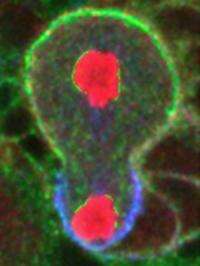
aPKC is shown in green at the top half of a fruit fly neuroblast. Miranda, in blue, has been driven away to the opposite side. Upon division, the top half will remain a stem cell, while the bottom will become a differentiated cell. Credit: Courtesy of Kenneth Prehoda

Driving Miranda, a protein in fruit flies crucial to switch a stem cell's fate, is not as complex as biologists thought, according to University of Oregon biochemists. They've found that one enzyme (aPKC) stands alone and acts as a traffic cop that directs which roads daughter cells will take.

"Wherever aPKC is at on a cell's cortex or membrane, Miranda isn't," says Kenneth E. Prehoda, a professor in the chemistry department and member of the UO's Institute of Molecular Biology. When a stem cell duplicates into , the side, or cortical domain, containing aPKC (atypical protein kinase C) continues as a stem cell, while the other domain with Miranda becomes a differentiated cell such as a neuron that forms the .

Prehoda and co-author Scott X. Atwood, who studied in Prehoda's lab and recently earned his doctorate, describe how the mechanism works in the May 12 issue of the journal Current Biology.

Instead of a complex cascade of protein deactivation steps that many biologists have theorized, Prehoda said, aPKC strips phosphate off an energy-transfer known as ATP and then attaches it to Miranda. This process forces Miranda away from aPKC and helps determine the fates of subsequent daughter cells.

"This process is pretty simple," he said, when viewed from a biochemical perspective. "What happens is that Miranda gets phosphorylated by aPKC, turning it into an inactivated substrate and pushing it into another location in the cell."

Much of the paper in is devoted to why the more complex scenarios are not accurate. "There have been a lot of ideas on how this works, and most seemed to be really complicated and difficult to explain. We have found it's a much simpler mechanism," Prehoda said, adding that the mechanism likely is similar in many other types of cells, not just .

"It's a basic-research question. How does this polarity occur? In order to develop stem cell-specific therapeutics based on a rational methodology you have to understand the mechanism," he said.

If Miranda is improperly isolated into other regions by aPKC, the stem cell divides symmetrically, with both daughter cells adopting the same fate, In turn, Prehoda said, these cells can become tumorous as they continue to rapidly divide without proper .

Source: University of Oregon (news : web)


print this article email this article download pdf blog this article bookmark this article     Stumble it Digg this share on Facebook retweet share on Reddit add to delicious
Rate this story - 5 /5 (4 votes)


May 14, 2009 all stories

Comments: 0

5 /5 (4 votes)
  • Stumble this up

  • Digg this

  • share this

  • hide
  • Related Stories


  • hide
  • Relevant PhysicsForums posts

  • Is there a gay gene?
    created 15 hours ago
  • Super quick question about Starling forces?
    created Nov 22, 2009
  • Questions about diffusion
    created Nov 22, 2009
  • Human Leukocyte Antigen (HLA) typing
    created Nov 21, 2009
  • More from Physics Forums - Biology

Other News

Computational microscope peers into the working ribosome

Computational microscope peers into the working ribosome (w/ Video)

Biology / Cell & Microbiology

created 10 hours ago | popularity 4.8 / 5 (5) | comments 0

Two new studies reveal in unprecedented detail how the ribosome interacts with other molecules to assemble new proteins and guide them toward their destination in biological cells. The studies used molecular ...


Spider secrets decoded in world-first database

Biology / Plants & Animals

created 4 hours ago | popularity not rated yet | comments 0

(PhysOrg.com) -- Queensland scientists have developed a world-first database that catalogues the venom components from hundreds of spiders.


Bioengineers succeed in producing plastic without the use of fossil fuels

Biology / Biotechnology

created 18 hours ago | popularity 4.8 / 5 (11) | comments 0

A team of pioneering South Korean scientists have succeeded in producing the polymers used for everyday plastics through bioengineering, rather than through the use of fossil fuel based chemicals. This groundbreaking research, ...


New chameleon species discovered in East Africa

New chameleon species discovered in East Africa (w/ Podcast)

Biology / Plants & Animals

created 12 hours ago | popularity 5 / 5 (1) | comments 0

A new species of chameleon has been discovered in Tanzania by a team of scientists.


A year after discovery, Congo's 'mother lode' of gorillas remains vulnerable

A year after discovery, Congo's 'mother lode' of gorillas remains vulnerable

Biology / Plants & Animals

created 8 hours ago | popularity not rated yet | comments 0

A new study by the Wildlife Conservation Society says that western lowland gorillas living in a large swamp in the Republic of Congo—part of the "mother lode" of more than 125,000 gorillas discovered last ...