Let there be light: Camera hooked up for Hubble
May 14, 2009 By MARCIA DUNN , AP Aerospace Writer Astronauts hook up new camera for Hubble (AP)

Enlarge

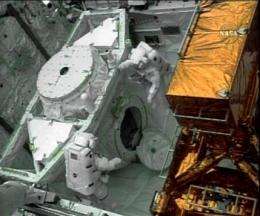
In this image from NASA TV astronauts John Grunsfeld, left, and Drew Feustel leave the shuttle Atlantis airlock to upgrade the Hubble Space Telescope during a spacewalk, Thursday, May 14, 2009. (AP Photo/NASA TV)

(AP) -- A pair of spacewalking astronauts overpowered a stubborn bolt and successfully installed a new piano-sized camera in the Hubble Space Telescope on Thursday, the first step to making the observatory better than ever.

"Let there be light," spacewalker John Grunsfeld said as ground controllers checked the power hookups.

Grunsfeld and Andrew Feustel also completed other major chores, replacing a science data-handling unit that broke last fall and hooking up a docking ring so a robotic craft can guide Hubble into the Pacific years from now.

The repair job - all the more dangerous because of the high, debris-ridden orbit - got off to a slow and rocky start.

John Grunsfeld and Andrew Feustel had trouble removing the old camera from the telescope because a bolt was stuck. They fetched extra tools, but none seemed to work.

Finally, Mission Control urged the astronauts to use as much force as possible, even though there was a risk the bolt might break. If that had happened, the old camera would be stuck inside, leaving no room for its souped-up replacement.

"OK, here we go," Feustel said. "I think I've got it. It turned. It definitely turned." And then: "Woo-hoo, it's moving out!"

The extra effort paid off but put the astronauts a little behind schedule in their first spacewalk of shuttle Atlantis' mission. In all, five high-risk spacewalks are planned to fix Hubble's broken parts and plug in higher-tech science instruments.

Atlantis and its crew are traveling in an especially high orbit, 350 miles above Earth, that is littered with pieces of smashed satellites. A 4-inch piece of passed within a couple miles of the shuttle Wednesday night, just hours after the shuttle grabbed Hubble. Even something that small could cause big damage.

For the first time, another shuttle is on standby in case it needs to rush to the rescue.

Once the sticky bolt was freed, Feustel pulled out the old camera, the size of a baby grand piano.

"This has been in there for 16 years, Drew," said Grunsfeld, "and it didn't want to come out."

The spacewalkers followed up with the installation of the replacement camera. From inside Atlantis, spacewalk overseer Michael Massimino congratulated Grunsfeld and Feustel for "adjusting to the curve ball that was thrown at you."

The newly inserted wide-field and planetary camera - worth $132 million - will allow astronomers to peer deeper into the universe, to within 500 million to 600 million years of creation.

The old one was installed in December 1993 during the first Hubble repair mission, to remedy the telescope's blurred vision. It had corrective lenses already in place and, because of the astounding images it captured, quickly became known as the camera that saved Hubble. It's also been dubbed the people's telescope because its cosmic pictures seem to turn up everywhere.

The camera - which has taken more than 135,000 observations - is destined for the Smithsonian Institution.

Massimino was corrected when he said it was awesome to get the new wide-field camera in "to unlock the secrets of the universe."

"More of the secrets," responded Grunsfeld, an astrophysicist.

Grunsfeld, the chief repairman with two previous Hubble missions under his work belt, took the lead on the and data-handling device replacements. He sounded awe-struck as ever. "Ah, this is fantastic," he said as he floated outside, the bus-size telescope looming overhead.

Hubble's original data handler, which was launched with the telescope 19 years ago, failed in September, just two weeks before Atlantis was supposed to take off on this fifth and final servicing mission. The breakdown caused all picture-taking to cease and prompted NASA to postpone the shuttle flight.

Flight controllers managed to get the telescope working again, but NASA decided to replace the faulty computer unit. The goal is to keep Hubble running for another five to 10 years.

Another two-man team will venture out Friday for the second .

---

On the Net:

NASA: http://www.nasa.gov/mission-pages/hubble/main/index.html

©2009 The Associated Press. All rights reserved. This material may not be published, broadcast, rewritten or redistributed.


print this article email this article download pdf blog this article bookmark this article     Stumble it Digg this share on Facebook retweet share on Reddit add to delicious
Rate this story - 5 /5 (9 votes)

Rank Filter

Move the slider to adjust rank threshold, so that you can hide some of the comments.


Display comments: newest first

  • Thadieus - May 14, 2009
    • Rank: 5 / 5 (3)
    NICE WORK!!!
  • E_L_Earnhardt - May 14, 2009
    • Rank: 2.5 / 5 (2)
    The most valuable thing up there is the PEOPLE!Fix it and get back home!
  • gwrede - May 14, 2009
    • Rank: 4.5 / 5 (2)
    The repair job - all the more dangerous because of the high, debris-ridden orbit - got off to a slow and rocky start.


    I fail to understand how this orbit can be life threatening to the astronauts, while NASA seems to have kept, and intends to keep Hubble in the same orbit for the next (up to) 10 years.

    If there is any chance of a single astronaut being hit in the few hours it takes, then what would the chances be for a bus sized object spending thousands of times as long in the same orbit?

  • Arikin - May 14, 2009
    • Rank: 3 / 5 (2)
    They are planing to boost it up a bit before they leave but that is only to help it stay in the same orbit for 10 more years. They do the same for the station each time.

    All objects big enough for a threat are tracked... Hopefully, that means the current orbit is still safe? Maybe because of the shuttle's size it makes a bigger target for the debris??
  • Bob_Kob - May 15, 2009
    • Rank: not rated yet
    I don't get it, i thought they were supposed to retire hubble years ago..
  • vlam67 - May 15, 2009
    • Rank: not rated yet
    Excellent work in the hazards of space!
  • showme - May 15, 2009
    • Rank: not rated yet
    I don't get it, i thought they were supposed to retire hubble years ago..

    I'm not complaining, as the replacement won't be up for several more years. Go Hubble!

May 14, 2009 all stories

Comments: 7

5 /5 (9 votes)
  • Stumble this up

  • Digg this

  • share this

  • hide
  • Related Stories


  • hide
  • Relevant PhysicsForums posts

  • Question about 2-body gravity
    created Nov 24, 2009
  • life on Mars
    created Nov 24, 2009
  • Semi-major axis from cartesian co-ordinates
    created Nov 23, 2009
  • Primary Mirror grinding
    created Nov 23, 2009
  • dark energy can escape black holes.
    created Nov 23, 2009
  • Are there green, purple and pink stars?
    created Nov 22, 2009
  • More from Physics Forums - General Astronomy

Other News

Russia: no space for space tourists (AP)

Russia: no space for space tourists

Space & Earth / Space Exploration

created 31 minutes ago | popularity not rated yet | comments 0

(AP) -- A top Russian space official says there is no space for tourists wishing to fly to the International Space Station.


Monster Waves on the Sun are Real

Monster Waves on the Sun are Real (w/ Video)

Space & Earth / Astronomy

created 12 hours ago | popularity 4.8 / 5 (12) | comments 1

Sometimes you really can believe your eyes. That's what NASA's STEREO (Solar Terrestrial Relations Observatory) spacecraft are telling researchers about a controversial phenomenon on the sun known as the "solar ...


Cosmic 'dig' reveals vestiges of the Milky Way's building blocks

Cosmic 'Dig' Reveals Vestiges of the Milky Way's Building Blocks

Space & Earth / Astronomy

created 17 hours ago | popularity 4.9 / 5 (15) | comments 1

(PhysOrg.com) -- Peering through the thick dust clouds of our galaxy's "bulge" (the myriads of stars surrounding its center), a team of astronomers has unveiled an unusual mix of stars in the stellar grouping ...


Climate experts debate strategies for reducing atmospheric carbon and future warming

Climate experts debate strategies for reducing atmospheric carbon and future warming

Space & Earth / Environment

created 13 hours ago | popularity 2.6 / 5 (7) | comments 10

(PhysOrg.com) -- Reducing carbon dioxide to safe levels may require extracting carbon from the air, says Cornell climate researcher.


No Wheel Stall in Diagnostic Drive

Spirit Mars Rover: No Wheel Stall in Diagnostic Drive

Space & Earth / Space Exploration

created 12 hours ago | popularity 4 / 5 (4) | comments 1

(PhysOrg.com) -- On Sol 2095 (Tuesday, Nov. 24), Spirit performed a set of diagnostic actions related to a stall of the right-rear wheel on the previous drive, three days earlier.