Going platinum: New catalyst could boost cleaner fuel use
May 14, 2009 By Tony Fitzpatrick
Going platinum: New catalyst could boost cleaner fuel use

Enlarge

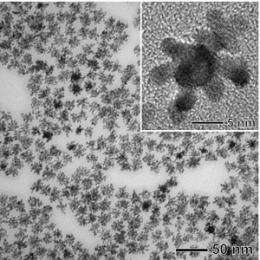
A new catalyst based on dendritic platinum arms grown on palladium nanocrystals has been developed by WUSTL's Younan Xia and his collaborators. Tests have shown that the "bimetallic" catalyst outperforms commercial catalysts, which could enable a cost effective fuel cell technology and ultimately provide cleaner fuels worldwide. Image credit: Younan Xia, WUSTL

(PhysOrg.com) -- Material scientists at Washington University in St. Louis have developed a technique for a bimetallic fuel cell catalyst that is efficient, robust and two to five times more effective than commercial catalysts. The novel technique eventually will enable a cost effective fuel cell technology, which has been waiting in the wings for decades, and should give a boost for cleaner use of fuels worldwide.

Younan Xia, Ph.D., the James M. McKelvey Professor of Biomedical Engineering at Washington University led a team of scientists at Washington University and the Brookhaven National Laboratory in developing a bimetallic catalyst comprised of a palladium core or "seed" that supports dendritic branches, or arms, that are fixed on the nanostructure, consisting of a nine nanometer core and seven nanometer platinum arms. They synthesized the catalysts by sequentially reducing precursor compounds to palladium and platinum with L-ascorbic acid (that is, Vitamin C) in an aqueous solution. The catalysts have a high surface area, invaluable for a number of applications besides in fuel cells, and are robust and stable.

Xia and his team tested how the catalysts performed in the oxygen reduction reaction process in a fuel cell, which determines how large a current will be generated in an electrochemical system similar to the cathode of a fuel cell. They found that their bimetallic nanodendrites, at room temperature, were two-and-a-half times more effective per platinum mass for this process than the state-of-the-art commercial platinum catalyst and five times more active than the other popular commercial catalyst. At 60 C(the typical operation temperature of a fuel cell), the performance almost meets the targets set by the U.S. Department of Energy.

The Department of Energy has estimated for widespread commercial success the "loading" of platinum catalysts in a should be reduced by four times in order to slash the costs. The Washington University technique is expected to substantially reduce the loading of platinum, making a more robust catalyst that won't have to be replaced often, and making better use of a very limited and very expensive supply of platinum in the world.

The study was published in Science on-line on May 14.

"There are two ways to make a more effective catalyst," Xia says. "One is to control the size, making it smaller, which gives the catalyst a higher specific surface area on a mass basis. Another is to change the arrangement of atoms on the surface. We did both. You can have a square or hexagonal arrangement for the surface atoms. We chose the hexagonal lattice because people have found that it's twice as good as the square one for the oxygen reduction reaction.

"We're excited by the technique, specifically with the performance of the new ."

Xia says seeded growth has emerged recently as a good technique for precisely controlling the shape and composition of metallic nanostructures prepared in solutions. And it's the only technique that allowed Xia and his collaborators to come up with their unconventional shape.

"When you have something this small, the atoms tend to aggregate and that can reduce the ,' Xia says. "A key reason our technique works is the ability to keep the platinum arms fixed. They don't move around. This adds to their stability. We also make sure of the arrangement of atoms on each arm, so we increase the activity."

Xia and his collaborators are exploring the possibility of adding other noble metals such as gold to the bimetallic catalysts, making them trimetallic. Gold has been shown to oxidize carbon monoxide, making for even more robust catalysts that can resist the poisoning by carbon monoxide - a reduction byproduct of some fuels.

"Gold should make the catalysts more stable, durable and robust, giving yet another level of control," Xia says.

Source: Washington University in St. Louis (news : web)

4.1 /5 (24 votes)  

Filter


Move the slider to adjust rank threshold, so that you can hide some of the comments.


Display comments: newest first

paulo
May 14, 2009

Rank: 4.5 / 5 (2)
ridiculous. when will this hydrogen economy rubbish die? oh, it already has.
Nartoon
May 15, 2009

Rank: 3 / 5 (2)
palladium, platinum and gold -- thank God they didn't need to use any expensive or rare elements. NOT!
Birger
May 15, 2009

Rank: not rated yet
I would like to see some numbers, how much cheaper than current platinum catalysts is this stuff?
jaggspb
May 15, 2009

Rank: not rated yet
am I going crazy or will carbon nanotubes provide a more cost effective solution in the future? I thought I read an article about cnans used in such a manner.
nick7201969
May 17, 2009

Rank: not rated yet
This should be no problem. There are plenty of gold growing on trees.
Rank 4.1 /5 (24 votes)
Related Stories
Relevant PhysicsForums posts
  • polymer nanocomposites
    created12 hours ago
  • Corrosion Tests on Magnesium
    createdFeb 09, 2012
  • polyethylene copper nanocomposite
    createdFeb 09, 2012
  • Output of xrd analysis
    createdFeb 08, 2012
  • Transport phenomena problem based on problems 18.B11 and 19B.6 from Bird, stewart, lw
    createdFeb 06, 2012
  • Help with material selection - Car Piston
    createdFeb 05, 2012
  • More from Physics Forums - Materials & Chemical Engineering

More news stories

What lies beneath: Mapping hidden nanostructures

The ability to diagnose and predict the properties of materials is vital, particularly in the expanding field of nanotechnology. Electron and atom-probe microscopy can categorize atoms in thin sheets of material, ...

Nanotechnology / Nanophysics

created 4 hours ago | popularity 5 / 5 (1) | comments 1

'Dark plasmons' transmit energy

Microscopic channels of gold nanoparticles have the ability to transmit electromagnetic energy that starts as light and propagates via "dark plasmons," according to researchers at Rice University.

Nanotechnology / Nanophysics

created 21 hours ago | popularity 5 / 5 (6) | comments 1 | with audio podcast

New kind of solar cell could capture significantly more energy than current cells

New solar cells could increase the maximum efficiency of solar panels by over 25%, according to scientists from the University of Cambridge.

Nanotechnology / Nanophysics

created Feb 08, 2012 | popularity 4.5 / 5 (12) | comments 14 | with audio podcast

Nanoshell whispering galleries improve thin solar panels

Visitors to Statuary Hall in the U.S. Capitol Building may have experienced a curious acoustic feature that allows a person to whisper softly at one side of the cavernous, half-domed room and for another on ...

Nanotechnology / Nanomaterials

created Feb 07, 2012 | popularity 4.3 / 5 (6) | comments 6 | with audio podcast

Nanotube therapy takes aim at breast cancer stem cells

Wake Forest Baptist Medical Center researchers have again proven that injecting multiwalled carbon nanotubes (MWCNTs) into tumors and heating them with a quick, 30-second laser treatment can kill them.

Nanotechnology / Bio & Medicine

created Feb 09, 2012 | popularity 5 / 5 (1) | comments 0 | with audio podcast


Putting the squeeze on planets outside our solar system

(PhysOrg.com) -- Using high-powered lasers, scientists at Lawrence Livermore National Laboratory and collaborators discovered that molten magnesium silicate undergoes a phase change in the liquid state, abruptly ...

Employers feel no love for unscrupulous practice of 'service sweethearting'

A new study led by two Florida State University marketing professors finds that some frontline service employees who are rewarded for hikes in customer loyalty and satisfaction also may engage in "service ...

US issues guidelines to avoid heparin contamination

Four years after US drug-maker Baxter International's blood thinner heparin was contaminated in China, causing dozens of deaths, US regulators on Friday issued draft guidelines for safe production.

Expat French get Internet vote for first time

French citizens will for the first time this year be able to vote in a parliamentary election over the Internet, an experiment that could be extended to other elections if successful.

"Twisted Metal" gamers get shot at real gunplay

Fans of "Twisted Metal" will get to welcome a long-awaited sequel of the car-battle videogame with a real-world bang by blasting an ice cream truck to bits with a machine gun.

The power of estrogen -- male snakes attract other males

A new study has shown that boosting the estrogen levels of male garter snakes causes them to secrete the same pheromones that females use to attract suitors, and turned the males into just about the sexiest ...