British explorers cut short trek to North Pole
May 14, 2009 By CHARMAINE NORONHA , Associated Press Writer
British explorers cut short trek to North Pole (AP)

Enlarge

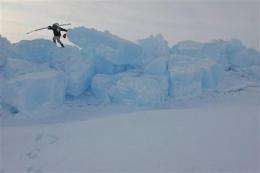
This recent but undated photo provided by Catlin Arctic Survey shows an unidentified British polar explorer walks across a ice ridge with a hand-drill on High Arctic sea ice. Three British polar explorers have ended their sojourn on High Arctic sea ice on Wednesday May 13, 2009 after 73 days of hard travel and skin-freezing temperatures. The trio had been collecting data that will give scientists a rare first-hand look at the ice's declining thickness. (AP Photo/Catlin Arctic Survey via the Canadian Press, Martin Hartley)

(AP) -- British explorers in northern Canada to measure the thickness of floating Arctic sea ice ended their expedition short of reaching the North Pole due to an early summer ice melt, the team said Thursday.

Explorers Pen Hadow, Ann Daniel and photographer Martin Hartley had planned a three-month journey to the North Pole, but ended their arduous trek Wednesday, approximately 304 miles (490 kilometers) from their destination, said Hadow.

The trio stopped after 73 days, during which they measured the thickness of floating sea ice to provide data to scientists studying the impact of global warming in the region.

"This year, the summer melt came a little early," Hadow said during a Webcast conference from Resolute Bay in northern Canada. "We would have rather reached the Pole if we could have, but we've always regarded (getting there) as the cherry on the cake."

Information the team gathers could contribute to a better understanding of global warming, which is believed to be the main culprit in the rapidly melting polar ice cap that is freeing up new sea routes and untapped mineral resources on the bottom.

Hadow said the group's goal was to cover as much distance as possible and gather as much information as possible.

"Along the way we realized (getting to) the Pole was not achievable so we sacrificed it very easily," he said.

The data will be used to help scientists further understand by getting a better picture of when sea ice in the will melt completely and not refreeze seasonally.

The trekkers said they captured 16,000 observations and took 1,500 measurements of the thickness and density of the ice and snow by drilling into the striking blue ice.

The group discovered the average thickness of the was 5 feet (1.5 meters).

"This seems to suggest it was almost all first-year ice. Our science advisers had told us to expect thicker, older ice on at least part of the route, so it is something of a mystery where that older ice has gone. It'll be interesting to see what scientists think about this," said Hadow.

He also said there was little snow cover.

Peter Wadhams, a professor of Ocean Physics at the University of Cambridge, said that "the data already sent back shows the team have been traveling on first-year ice and provided an insight into its rate of growth this year."

Wadhams also heads the Polar Ocean Physics Group in the Department of Applied Mathematics and Theoretical Physics at Cambridge.

Hadow said the findings would be presented at a conference on climate change in December in Copenhagen, where alternatives to the Kyoto Protocol environmental treaty.

But for now, the group is happy to be on solid ground after trekking amid treacherous snow conditions and temperatures dropping below minus 94 degrees Fahrenheit (minus 70 degrees Celsius) with a wind chill.

"It's delightful to be back (on the ground)," said Daniel. "I had the window wide open last night because I got so used to the cold. But I woke up quite often in the night feeling just luxuriated in a bed. And its absolutely wonderful to eat on a plate, with a fork and knife, while sitting on a chair."

---

On the Net:

http://www.catlinarcticsurvey.com/

©2009 The Associated Press. All rights reserved. This material may not be published, broadcast, rewritten or redistributed.

2.2 /5 (11 votes)  

Filter


Move the slider to adjust rank threshold, so that you can hide some of the comments.


Display comments: newest first

GrayMouser
May 14, 2009

Rank: 5 / 5 (1)
The sea ice thickness doesn't match that of the recent German survey. Of course the German's equipment worked in the unusually cold temperatures that caused the British to cut their trip short...
mikiwud
May 15, 2009

Rank: 5 / 5 (1)
"This year, the summer melt came a little early,"


They reached or passed the latest safe date to be removed. The ice cover is close to the 30yr average.
The group discovered the average thickness of the sea ice was 5 feet (1.5 meters).


"This seems to suggest it was almost all first-year ice. Our science advisers had told us to expect thicker, older ice on at least part of the route, so it is something of a mystery where that older ice has gone. It'll be interesting to see what scientists think about this," said Hadow.


They planned their route on known first year ice because it would be flatter. Also they got nowhere near the pole.
mikiwud
May 17, 2009

Rank: not rated yet
This one is worth reading at
http://wattsupwit...ore-7904
The Catlin crew was picked up this week, after completing less than 50% of their planned journey to the North Pole and coming up about 500km short. Immediately upon their return, The Guardian reported :
After 73 days, the Catlin Arctic Survey has come to an end. Pen Hadow%u2019s team of British Arctic explorers have battled to the North Pole through freezing conditions collecting data about the ice en route.

This reminds me of the legend of %u201Cbringing the mountain to Mohammed.%u201D

and
Expedition Leader Pen Hadow revealed that initial Survey results show the average ice thickness in the region to be 1.774m.

1.774m is fairly thick for first year ice (and requires a very accurate tape measure.) They started their expedition in March on ice which NSIDC had already identified in February as first year ice %u2013 so why were they surprised to find first year ice?
Rank 2.2 /5 (11 votes)
Related Stories
Relevant PhysicsForums posts
  • Do some geologists actually act a lot like Randy Marsh?
    createdFeb 11, 2012
  • Discrepancy between oxygen and carbon-dioxide levels
    createdFeb 09, 2012
  • where gems are found in the world
    createdFeb 09, 2012
  • Wind Waves in Reservoir ~ Wind run-up and Wind set-up
    createdFeb 08, 2012
  • Balance of oxygen in the atmosphere
    createdFeb 01, 2012
  • The case for a methanol-based economy
    createdJan 30, 2012
  • More from Physics Forums - Earth

More news stories

Salvage workers begin pumping fuel from Italian shipwreck

Salvage workers Sunday began pumping fuel from the shipwrecked Italian cruise liner Costa Concordia, a day ahead of schedule, officials said.

Space & Earth / Environment

created 7 hours ago | popularity 5 / 5 (1) | comments 0

Latin America mining boom clashes with conservation

Latin America is experiencing a mining boom as prices rise fuelled by a hike in global demand, but the region is also being hit by a wave of violent protests, strikes and rallies by environmentalists.

Space & Earth / Environment

created 15 hours ago | popularity 5 / 5 (1) | comments 1

Political leaders play key role in how worried Americans are by climate change: study

More than extreme weather events and the work of scientists, it is national political leaders who influence how much Americans worry about the threat of climate change, new research finds.

Space & Earth / Environment

created Feb 06, 2012 | popularity 5 / 5 (7) | comments 73

NASA budget will axe Mars deal with Europe: scientists

US President Barack Obama's budget proposal to be submitted next week for 2013 will cut NASA's budget by 20 percent and eliminate a major partnership with Europe on Mars exploration, scientists said Thursday.

Space & Earth / Space Exploration

created Feb 10, 2012 | popularity 5 / 5 (3) | comments 58

Humans may have helped the decline of African rainforests 3000 years ago

(PhysOrg.com) -- Large areas of rainforests in Central Africa mysteriously disappeared over three thousand years ago, to be replaced by savannas. The prevailing theory has been that the cause was a change ...

Space & Earth / Environment

created Feb 10, 2012 | popularity 4.1 / 5 (14) | comments 21 | with audio podcast report


Scientists discover molecular secrets of 2,000-year-old Chinese herbal remedy

For roughly two thousand years, Chinese herbalists have treated Malaria using a root extract, commonly known as Chang Shan, from a type of hydrangea that grows in Tibet and Nepal. More recent studies suggest that halofuginone, ...

New method to examine batteries -- MRI from the inside

There is an ever-increasing need for advanced batteries for portable electronics, such as phones, cameras, and music players, but also to power electric vehicles and to facilitate the distribution and storage of energy derived ...

A mitosis mystery solved: How chromosomes align perfectly in a dividing cell

Although the process of mitotic cell division has been studied intensely for more than 50 years, Whitehead Institute researchers have only now solved the mystery of how cells correctly align their chromosomes during symmetric ...

Google might launch Drive for cloud storage soon

(PhysOrg.com) -- Google's next big move, according to the Wall Street Journal, is a cloud storage service called Drive. Hardly first to the plate, Google is simply catching up to introducing its cloud reposi ...

Lab study raises questions over nano-particle impact

Tests involving chickens have raised questions about the impact on health from engineered nano-particles, the ultra-fine grains commonly used in drugs and processed foods, scientists said on Sunday.

Overeating may double risk of memory loss

New research suggests that consuming between 2,100 and 6,000 calories per day may double the risk of memory loss, or mild cognitive impairment (MCI), among people age 70 and older. The study was released today and will be ...