Brain's organization switches as children become adults
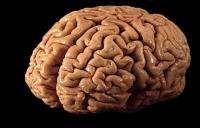
Any child confronting an outraged parent demanding to know "What were you thinking?" now has a new response: "Scientists have discovered that my brain is organized differently than yours."
But all is not well for errant kids. The same new study also provides parents with a rejoinder: While the overarching organization scheme differs, one of the most important core principals of adult brain organization is present in the brains of children as young as 7.
"Regardless of how tempting it might be to assume otherwise, a normal child's brain is not inherently disorganized or chaotic," says senior author Steven E. Petersen, Ph.D., the James McDonnell Professor of Cognitive Neuroscience at Washington University School of Medicine in St. Louis. "It's differently organized but at least as capable as an adult brain."
The findings are published online in PLoS Computational Biology by researchers at Washington University and Oregon Health and Science University.
Petersen and his colleagues study normal brain organization and development to learn more about how developmental disorders and brain injury can impair mental capabilities. They plan to apply what they learn to develop new treatments for such disorders.
The researchers use resting-state functional connectivity MRI to identify and study brain networks. Instead of recording mental activity when volunteers work on a cognitive task, resting-state connectivity scans the spontaneous activity that takes place in their brains while they do nothing. When this brain activity rises and falls at the same time in different brain regions, researchers conclude that those areas likely work together.
Through such studies, scientists previously revealed four brain networks with varying responsibilities in the adult brain. Two of those networks, for example, appear to be co-captains in charge of most voluntary brain function (see mednews.wustl.edu/news/page/normal/9639.html). The networks typically involve tight links between several brain regions that are physically distant from each other.
In the new study, this is where the organizational contrast arises: Instead of having networks made of brain regions that are distant from each other but functionally linked, most of the tightest connections in a child's brain are between brain regions that are physically close to each other.
The study was led by Damien A. Fair, Ph.D., a former Washington University graduate student now at Oregon Health and Science University, and Alexander L. Cohen, a current Washington University graduate student. They directed analysis of data from 210 subjects ranging from 7 to 31 years old.
"We took a group of the youngest subjects, analyzed their results, then dropped data from the youngest and added data from the next-oldest and redid the analysis until we had worked our way through all subjects," Fair says. "The result was a detailed movie of how the organizational transition from a child's brain to an adult's brain takes place. It clearly shows a switch from localized networks based on physical proximity to long-distance networks centered on functionality."
Researchers also checked children's brains for "small-world" organization, another organizational quality present in adult brains. In less formal contexts, this is sometimes called "Kevin Bacon" organization after the trivia game known as "six degrees of Kevin Bacon." The game highlights how easy it is to connect any actor or actress to Kevin Bacon in six movies or less through links among various co-stars.
"It's the idea of a large network that lets you connect one node with another in a relatively short number of steps via special nodes," Fair says. "Like Kevin Bacon, these special nodes have many connections to other nodes, allowing them to help shorten the amount of steps that have to be taken when connecting nodes."
Scientists already knew that children had many fewer long-distance links among brain regions than adults, but when they looked more closely they found there were enough of these links and nodes with multiple connections to establish small-world organization.
Researchers set the lower limit for study subjects at 7 years of age because the brain is approximately 95 percent of its adult size at this age, but they are currently examining ways to adapt the study to the changing physical geography of younger brains. They have also begun looking at the same phenomena in subjects with brain injuries and developmental disorders.
More information: Fair DA, Cohen AL, Power JD, Dosenbach NUF, Church JA, Miezin FM, Schlaggar BL, Petersen SE. Functional brain networks develop from a "local to distributed" organization. PLoS: Computational Biology, May 1, 2008.
Source: Washington University School of Medicine (news : web)


