QUIET team to deploy new gravity-wave probe in June
May 15, 2009
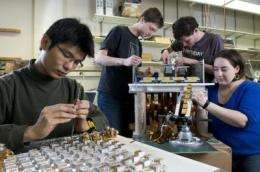
University of Chicago members of the QUIET collaboration at work (l-r): postdoctoral fellow Akito Kusaka and physics graduate students Colin Bischoff, Immanuel Buder and Alison Brizius. These components will enhance the sensitivity of the QUIET experiment, which began operating in Chile's Atacama Desert last October. Credit: Lloyd DeGrane
A tiny fraction of a second following the big bang, the universe allegedly experienced the most inflationary period it has ever known.
During this inflationary era, space expanded faster than the speed of light. It sounds crazy, but it fits a variety of cosmological observations made in recent years, said University of Chicago physicist Bruce Winstein.
"Theorists take it to be true, but we have to prove it," said Winstein, the Samuel K. Allison Distinguished Service Professor in Physics at the University of Chicago. "It needs a real test, and that test is whether or not gravity waves were created."
Winstein and his Chicago associates are part of the international QUIET (Q/U Imaging ExperimenT; the Q and U stand for radiation parameters called Stokes parameters) collaboration that has devised such a test.
QUIET's goal: detect remnants of the radiation emitted at the earliest moments of the universe, when gravity waves rippled through the very fabric of space-time itself.
The intensive gravitational fields that existed at these earliest moments, according to Einstein, produced gravity waves that alternatively compressed and expanded space, first in one direction, then another. The cosmic microwave background (CMB) radiation—the afterglow of the big bang—may still carry a faint signature of those gravitational waves, nearly 14 billion years after their creation.
Seeking ethereal quarry
Other collaborations, including the South Pole Telescope (SPT), seek the same ethereal quarry with different techniques. The University of Chicago's Kavli Institute of Cosmological Physics supports both projects.
"No one can say what the best approach is right now," Winstein said, "but we need a variety of attacks on this important problem, and ours is different from most of the others. It's very exciting to be in this game."
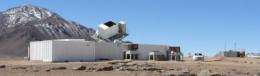
The QUIET experiment in operation in the Atacama Desert. The receiver in the mount on the roof of the building rapidly scans the sky, looking for radiation emitted shortly after the birth of the universe. Credit: QUIET collaboration
At stake is the potential elucidation of new physics, that which falls outside the scope of the standard model. This model, a set of theories that describes the behavior of matter and energy in the universe, cannot explain how points in the sky too far away to have ever been in contact have almost exactly the same temperature. A validation of inflation would solve that problem.
"If we see these gravity waves, they have been called the smoking gun of inflation," Winstein said.
The QUIET experiment began operating last October with an antenna array that contains 19 detectors. Since then, QUIET collaborators at the Jet Propulsion Laboratory in California have produced 91 detectors sensitive to the radiation at a higher frequency.
Over the past several months, the Chicago collaboration has assembled and calibrated these 91 detectors in the basement of the Laboratory for Astrophysics and Space Research.
Winstein's team has tested each detector, adjusting 10 critical voltages for each to yield the best performance. Correctly optimized voltages can improve detector performance by a large factor, Winstein said, making it possible to observe in one day what would have otherwise required a week. This newer, more sensitive array will begin operating in June.
High and dry operation
The QUIET experiment operates in Chile's Atacama Desert, at an altitude of 17,000 feet. "It's very dry, and that's important because this microwave radiation gets absorbed by water vapor," Winstein explained. "And we observe day and night, 10 to 11 months a year."
Observations will continue at least until the end of this year. The team must keep its detectors at a chilling minus 253 degrees Celsius (minus 423 degrees Fahrenheit, close to absolute zero) to boost the odds of detecting the extremely weak gravity-wave signals. These signals would be so weak that electronic noise could easily drown them out.
"One way to eliminate electronic noise is to get your detector very, very cold," said QUIET's Allison Brizius, a graduate student in physics. "The colder it gets, the quieter it gets, the better it can pick up a signal."
The QUIET experiment must both detect and amplify the signal, which puts out only about a billionth of a volt.
"We have to be very careful with such small signals not to introduce any other noise," Winstein said. "We've demonstrated that this technology works, and we're proposing to mass-produce these modules, nearly 2,000 of them."
Winstein comes from a particle physics background, a veteran of 30 years of experimental research at Fermi National Accelerator Laboratory, which also plays a role in QUIET. As a particle physicist, he was exploring physics at the highest energies that an accelerator could then achieve.
Now, as a cosmological physicist probing the CMB, he stands on the brink of reaching nearly to the Planck scale, the highest energies that the universe can create. The CMB, he said, is "probably our best handle on the overall structure of the universe and how it was born."
-
Cosmologists aim to observe first moments of universe
Feb 16, 2009 |
not rated yet |
0
-
Super-Sensors to Measure 'Signature' of Inflationary Universe (w/Video)
May 03, 2009 |
not rated yet |
0
-
Quark study breaks old puzzle in particle physics
Aug 27, 2004 |
not rated yet |
0
-
Researchers interpret asymmetry in early universe
Dec 16, 2008 |
not rated yet |
0
-
Researchers could herald a new era in fundamental physics
Feb 03, 2009 |
not rated yet |
0
-
Engineers build first sub-10-nm carbon nanotube transistor
Feb 01, 2012 |
4.9 / 5 (33) |
30
-
Something old, something new: Evolution and the structural divergence of duplicate genes
Jan 31, 2012 |
4.6 / 5 (7) |
1
-
The hidden nanoworld of ice crystals: Revealing the dynamic behavior of quasi-liquid layers
Jan 30, 2012 |
5 / 5 (5) |
1
-
Stock market network reveals investor clustering
Jan 27, 2012 |
3.9 / 5 (23) |
8
-
Of microchemistry and molecules: Electronic microfluidic device synthesizes biocompatible probes
Jan 26, 2012 |
5 / 5 (2) |
0
-
What are the chemical reaction happen indise lamp in tungsten
4 hours ago
-
What is the number of significant digits in a integer with trailing 0's ?
5 hours ago
-
Forces of Magnets Attraction>Repulsion?
5 hours ago
-
Underwater projectile affected by Coriolis Effect
6 hours ago
-
Thermodynamics q
9 hours ago
-
what is electricity???
13 hours ago
- More from Physics Forums - General Physics
More news stories
Researchers make better heat sensor based on butterfly wings
(PhysOrg.com) -- Scientists have long known that butterfly wings produce their iridescent colors by bouncing light around and between tiny ridges in structures made of chitin. More recently they’ve discovered ...
Rapunzel, Leonardo and the physics of the ponytail
(PhysOrg.com) -- New research provides the first mathematical understanding of the shape of a ponytail and could have implications for the textile industry, computer animation and personal care products.
3 hours ago |
4.7 / 5 (3) |
0
|
Explained: Sigma
It's a question that arises with virtually every major new finding in science or medicine: What makes a result reliable enough to be taken seriously? The answer has to do with statistical significance -- but ...
Feb 09, 2012 |
5 / 5 (21) |
87
Quantum physicist explains $100K offer for proof scaled-up quantum computing is impossible
(PhysOrg.com) -- MIT researcher Scott Aaronson has certainly riled the physics community with his offer this past Friday, of $100,000 to anyone who can prove that scaled-up quantum computing is impossible. ...
Hovering not hard if you're top-heavy, researchers find
Top-heavy structures are more likely to maintain their balance while hovering in the air than are those that bear a lower center of gravity, researchers at New York University's Courant Institute of Mathematical Sciences ...
Feb 10, 2012 |
5 / 5 (4) |
5
|
Manipulating genes with hidden TALENs
(PhysOrg.com) -- A better understanding of gene function in model plant and animal systems could be used to develop useful traits in livestock and crop plants, and might someday lead to developments in stem ...
Alien matter in the solar system: A galactic mismatch
This just in: The Solar System is different from the space just outside it.
Transforming galaxies
(PhysOrg.com) -- Many of the Universe's galaxies are like our own, displaying beautiful spiral arms wrapping around a bright nucleus. Examples in this stunning image, taken with the Wide Field Camera 3 on ...
'Smart' microcapsules in a single step
(PhysOrg.com) -- A new, single-step method of fabricating microcapsules, which have potential commercial applications in industries including medicine, agriculture and diagnostics, has been developed by researchers ...
Don't ignore kids' snores
(Medical Xpress) -- Your ears arent playing tricks on you that is the sound of snoring you hear from the bedroom of your preschooler. Snoring is common in children, but in some cases it can be a symptom of a ...
China's pollution puts a dent in its economy
Although China has made substantial progress in cleaning up its air pollution,a new MIT study shows that the economic impact from ozone and particulates in its air has increased dramatically. ...

May 15, 2009
Rank: 2.3 / 5 (3)
May 15, 2009
Rank: 1 / 5 (1)
May 16, 2009
Rank: 5 / 5 (1)
May 17, 2009
Rank: not rated yet
Just the fact that BB requires inflation faster than c in the early stages invalidates the whole thing. Once we declare that c is no longer the constant it is purported to be we introduce a whole can of worms of likely scenarios to describe everything in just about anyway we like.
May 17, 2009
Rank: not rated yet
Time will tell. All these gravitational wave experiments are simply trying to establish the new aether.
May 20, 2009
Rank: not rated yet
Jun 01, 2009
Rank: not rated yet
Gravity very well could be not a force but a reaction to warping of spacetime. Effectively a push of spacetime rather than a pull of gravity, similar to the force of a river pushing upon a person crossing it.