Super-efficient Transistor Material Predicted
May 15, 2009 by Lauren Schenkman Super-efficient Transistor Material Predicted

Enlarge

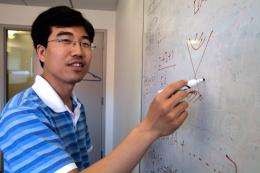
Xiao-Liang Qi. (Photo by Lauren Schenkman.)

(PhysOrg.com) -- New work by condensed-matter theorists at the Stanford Institute for Materials and Energy Science at SLAC National Accelerator Laboratory points to a material that could one day be used to make faster, more efficient computer processors.

In a paper published online Sunday in , SIMES researchers Xiao-Liang Qi and Shou-Cheng Zhang, with colleagues from the Chinese Academy of Sciences and Tsinghua University in Beijing, predict that a room temperature material will exhibit the quantum spin Hall effect. In this exotic state of matter, flow without dissipating heat, meaning a transistor made of the material would be drastically more efficient than anything available today. This effect was previously thought to occur only at extremely low temperatures. Now the race is on to confirm the room-temperature prediction experimentally.

Zhang has been one of the leading physicists working on the quantum spin Hall effect; in 2006 he predicted its existence in mercury telluride, which experimentalists confirmed a year later. However, the mercury telluride had to be cooled by liquid helium to a frigid 30 millikelvins, much too cold for real-world applications.

In their hunt for a material that exhibited the quantum spin Hall effect, Zhang and Qi knew they were looking for a solid with a highly unusual energy landscape. In a normal semiconductor, the outermost electrons of an atom prefer to stay in the valence band, where they are orbiting atoms, rather than the higher-energy conduction band, where they move freely through the material. Think of the conduction band as a flat plain pitted with small valence-band valleys. Electrons naturally "roll" down into these valleys and stay there, unless pushed out. But in a material that exhibits the quantum spin Hall effect, this picture inverts; the valence-band valleys rise to become hills, and the electrons roll down to roam the now lower-energy conduction band plain. In mercury telluride, this inversion did occur, but just barely; the hills were so slight that a tiny amount of energy was enough to push the electrons back up, meaning the material had to be kept extremely cold.

When Zhang, Qi and their colleagues calculated this energy landscape for four promising materials, three showed the hoped-for inversion. In one, bismuth selenide, the theoretical conduction band plain is so much lower than the valence band hills that even room temperature energy can't push the electrons back up. In physics terms, the conduction band and valence band are now inverted, with a sizeable difference between them.

"The difference [from mercury telluride] is that the gap is much larger, so we believe the effect could happen at room temperature," Zhang explained.

Materials that exhibit the quantum spin Hall effect are called topological insulators; a chunk of this material acts like an empty metal box that's completely insulating on the inside, but conducting on the surface. Additionally, the direction of each electron's movement on the surface decides its spin, an intrinsic property of electrons. This leads to surprising consequences.

Qi likens electrons traveling through a metal to cars driving along a busy road. When an electron encounters an impurity, it acts like a frustrated driver in a traffic jam, and makes a U-turn, dissipating heat. But in a topological insulator, Qi said, "Nature gives us a no U-turn rule." Instead of reversing their trajectories, electrons cruise coolly around impurities. This means the quantum spin Hall effect, like superconductivity, enables current to flow without dissipating energy, but unlike superconductivity, the effect doesn't rely on interactions between electrons.

Qi points out that, because current only flows on their surfaces, topological insulators shouldn't be seen as a way to make more efficient power lines. Instead, these novel compounds would be ideal for fabricating tinier and tinier transistors that transport information via electron spin.

"Usually you need magnets to inject spins, manipulate them, and read them out," Qi said. "Because the current and spin are always locked [in a topological insulator], you can control the spin by the current. This may lead to a new way of designing devices like transistors."

These tantalizing characteristics arise from underlying physics that seems to marry relativity and condensed matter science. Zhang and Qi's paper reveals that electrons on the surface of a topological insulator are governed by a so-called "Dirac cone," meaning that their momentum and energy are related according to the laws of relativity rather than the quantum mechanical rules that are usually used to describe electrons in a solid.

"On this surface, the electrons behave like a relativistic, massless particle," Qi said. "We are living in a low speed world here, where nothing is relativistic, but on this boundary, relativity emerges."

"What are the two greatest physics discoveries of the last century? Relativity and quantum mechanics." Zhang said. "In the semiconductor industry in the last 50 years, we've only used quantum mechanics, but to solve all these interesting frontier problems, we need to use both in a very essential way."

Zhang and Qi's new predictions are already spurring a surge of experiments to test whether these promising materials will indeed act as room-temperature topological insulators.

"The best feedback you can get is that there are lots of experiments going on," he said.

More information: http://www.nature.com/nphys/journal/vaop/ncurrent/abs/nphys1270.html

Provided by SLAC National Accelerator Laboratory (news : web)


print this article email this article download pdf blog this article bookmark this article     Stumble it Digg this share on Facebook retweet share on Reddit add to delicious
Rate this story - 4.7 /5 (36 votes)

Rank Filter

Move the slider to adjust rank threshold, so that you can hide some of the comments.


Display comments: newest first

  • SincerelyTwo - May 15, 2009
    • Rank: 1 / 5 (5)
    SUPER ADVANCED LEET MATHEMATICZ:!

    "2 plus 2 plus 1 / 5*d"

    lol,
  • NeilFarbstein - May 15, 2009
    • Rank: 1 / 5 (3)
    No, 1/5C !
  • Valentiinro - May 15, 2009
    • Rank: 2 / 5 (4)
    Couldn't be used to transmit power because it only travels along the surface? That is not a good enough reason. One could make a super high surface area cable or something, it might not be economical to do so in most situations, but couldn't something made of many many tiny layers or perhaps many tiny wires have a high surface area along which electrons could travel?
  • Nik_2213 - May 15, 2009
    • Rank: 5 / 5 (2)
    http://en.wikiped...itz_wire

    But you would have to insulate the individual, hair-fine strands...

    Whatever, to get a near-analog of *some* superconductivity effects running at ambient temperatures may throw up some neat effects...
  • Bob_Kob - May 16, 2009
    • Rank: 1 / 5 (1)
    hahaha wow these guys really worked overtime for that 2 2 1 / 5d
  • NeilFarbstein - May 16, 2009
    • Rank: 1 / 5 (1)
    James Tour's group is investigating long thin graphene strips made from unzipped buckytubes. They are called nanoribbons and they resemble nanowires more than flat graphene flakes.
  • sender - May 16, 2009
    • Rank: not rated yet
    Reminiscent of vanadium/TiO massless kinemetric experiments posted on physorg few weeks back. Semi-Dirac materials.
  • KBK - May 16, 2009
    • Rank: 1 / 5 (3)
    And why does one think that mercury is used in Alchemy?

    And why does David Radius Hudson say that alchemically created room temperature superconductors DO exist and that he has created many of them himself?

    Why?

    Why?

    Why?

    So..you are saying that it is real ONLY after it comes out of some research lab?

    BULLSHIT!

    Get with the program, people,look around you!!

    This is all academic (hah!) and is actually over 12,000 years old. More alchemy!
  • Alizee - May 17, 2009
    • Rank: 1 / 5 (1)
    Concept of watter transistor, based on capillary forces..

    http://aetherwave...ors.html
  • derricka - May 18, 2009
    • Rank: not rated yet
    Diamagnetism may be involved here. Bismuth and graphene (in a modified form, called pyrolytic graphite) are both highly diamagnetic materials. Both can be made to levitate on a strong magnet.

May 15, 2009 all stories

Comments: 10

4.7 /5 (36 votes)
  • Stumble this up

  • Digg this

  • share this

  • hide
  • Related Stories

  • It's all in the spin: Quantum physics cools down computers
    created Sep 25, 2007 | popularity not rated yet | comments 0
  • Researchers predict a new state of matter in semiconductors
    created Dec 14, 2006 | popularity not rated yet | comments 0
  • Making magnetic monopoles, and other exotica, in the lab
    created Feb 05, 2009 | popularity not rated yet | comments 0
  • Quantum Twist: Electrons Mimic Presence of Magnetic Field
    created Feb 12, 2009 | popularity not rated yet | comments 0
  • The Strange Case of the Disappearing Quasiparticles
    created Mar 08, 2006 | popularity not rated yet | comments 0


  • hide
  • Relevant PhysicsForums posts

  • Some Explanation with Rigid Rotator
    created 1hour ago
  • How to Make a Ferrofluid?
    created 5 hours ago
  • avoidance of admitting that we dont know somethin
    created 10 hours ago
  • Speed of light : missing energy
    created 14 hours ago
  • Can light produce darkness and can noise procude quiteness 4
    created 16 hours ago
  • Magnetic Oscillation Equations
    created 23 hours ago
  • More from Physics Forums - General Physics

Other News

Restored machine to explore mysteries of Big Bang (AP)

Restored machine to explore mysteries of Big Bang

Physics / General Physics

created 14 hours ago | popularity 4.4 / 5 (12) | comments 9

(AP) -- Scientists are preparing the world's largest atom smasher to explore the depths of matter after successfully restarting the $10 billion machine following more than a year of repairs.


nuclear power plant

Doubts raised on nuclear industry viability

Physics / General Physics

created Nov 19, 2009 | popularity 3.1 / 5 (20) | comments 19

(PhysOrg.com) -- The investment in nuclear power has been growing around the world over the last few years, being viewed as a means for countries to control their energy security, avoid the price fluctuations ...


Researchers Find Innate Correlations Among Different Power Law Phenomena

Researchers Find Innate Correlations Among Different Power Law Phenomena

Physics / General Physics

created Nov 17, 2009 | popularity 4.3 / 5 (15) | comments 13

(PhysOrg.com) -- Studying the patterns that emerge in natural and social phenomena is a popular area of research, although usually individual phenomena are studied separately from each other. In a recent study, ...


Scientists demonstrate 'universal' programmable quantum processor

Scientists demonstrate 'universal' programmable quantum processor

Physics / Quantum Physics

created Nov 15, 2009 | popularity 4.6 / 5 (21) | comments 11

Physicists at the National Institute of Standards and Technology have demonstrated the first "universal" programmable quantum information processor able to run any program allowed by quantum mechanics -- th ...


Proton's party pals may alter its internal structure

Proton's party pals may alter its internal structure

Physics / General Physics

created Nov 18, 2009 | popularity 4.6 / 5 (20) | comments 9

A recent experiment at the DOE's Thomas Jefferson National Accelerator Facility has found that a proton's nearest neighbors in the nucleus of the atom may modify the proton's internal structure.