Astronauts work through repair trouble at Hubble
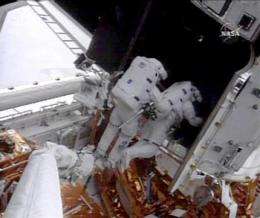
(AP) -- Spacewalking astronauts had to put a refurbished pair of gyroscopes into the Hubble Space Telescope after a brand new set refused to go in Friday, but scientists were satisfied nonetheless and confident the observatory would point precisely to ever more distant objects in the cosmos.
Replacing the gyroscopes was the top priority of the repair mission, and the struggle had NASA on edge for two hours.
Thanks to the spacewalkers' effort, Hubble ended up with four brand new gyroscopes and two refurbished ones that were original 19-year-old telescope parts, said to be almost as good as the new ones. The telescope also got fresh batteries.
It was the second spacewalk in as many days for the Atlantis astronauts, who once again were bedeviled by problems. On Thursday, another two-man team installed a powerful new camera and a computer data unit, after struggling with a stubborn bolt. NASA had hoped for an easier, less stressful spacewalk, but instead had to endure more drama.
As on Thursday, the astronauts got their work done, but it was harder and took longer than expected. Friday's spacewalk was one of the longest ever, lasting nearly 8 hours, and Mission Control told the weary crew members that they could sleep in and start Saturday's spacewalk a little late.
Michael Massimino, who was working from inside Hubble, and his partner, Michael Good, had no problem removing all six of Hubble's 10-year-old gyroscopes. But the last set of new gyroscopes wouldn't fit properly.
Mission Control instructed the men to go get a spare box of gyroscopes from the shuttle, and put that one in. This spare set originally was launched aboard Hubble in 1990 and returned in 1999.
The astronauts successfully installed the refurbished set. By then, however, five hours of the spacewalk had passed and they had yet to start on the other major chore of the day, the battery swap.
The gyroscopes were the No. 1 task, though. Three of the old gyroscopes no longer worked, and two others had been acting up. The other had seen a lot of use.
"My friend Leonidas has a couple of words for you guys that are appropriate right now," shuttle commander Scott Altman told the spacewalkers, referring to the ancient Spartan king. "Remember this day, men, for it will be yours for all time." Then Altman laughed. Leonidas died in battle in 480 B.C.
"We've got a little more work to do, but thanks," replied Massimino.
Hubble's deputy senior project scientist, Mal Niedner, said he was not concerned the astronauts had to resort to refurbished gyroscopes. They lack the latest anticorrosive wiring, but it's "the difference between an A and an A-plus."
In all, five spacewalks are planned so that the observatory - beloved by astronomers and many others for its breathtaking views of the universe - is at its apex while living out its remaining years. Scientists expect the upgraded Hubble to look back even further in time, to within 500 million to 600 million years of creation.
Good drove in the bolts for the gyroscope boxes as Massimino, a returning Hubble mechanic who is over 6-feet tall, worked from inside the telescope, where he had wedged himself in head first. "Trained my whole life for this," he said.
Massimino had a brief scare when his communication system fouled up at the start of the spacewalk. For a minute or two, no one could hear him.
That wasn't the only unnerving thing about this mission.
Space is particularly littered in this 350-mile-high orbit, and Atlantis and its crew face a greater risk of being slammed by a piece of junk. As a precaution, NASA has a rescue shuttle on standby, ready to launch in just three days if necessary.
Even though the spacewalk was running behind, the astronauts pressed on and replaced some batteries.
The hefty, nickel hydrogen batteries that came out were built before the telescope was launched in 1990. They come three to a pack, about the size of a big TV set with a mass of nearly 500 pounds. The final three batteries will be replaced early next week.
The unused new gyroscopes, meanwhile, will be analyzed once they're returned to Earth.
NASA hopes to get another five to 10 years of use out of Hubble, once the Atlantis astronauts plug in all the new equipment. They also will take a crack at fixing two broken science instruments this weekend.
The mission cost NASA more than $1 billion, one-tenth of what has been spent on Hubble over the decades.
---
On the Net:
NASA: http://www.nasa.gov/mission-pages/hubble/main/index.html
©2009 The Associated Press. All rights reserved. This material may not be published, broadcast, rewritten or redistributed.


