Andes Mountains Are Older Than Previously Believed
May 15, 2009 By Beth King
Andes Mountains are older than previously believed

Enlarge

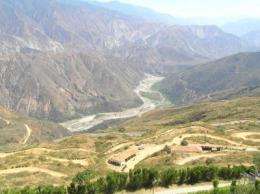
Sediments that gather at the base of mountains provide important clues about how and when the mountains were formed. Credit: Carlos Jaramillo, STRI

(PhysOrg.com) -- The geologic faults responsible for the rise of the eastern Andes mountains in Colombia became active 25 million years ago—18 million years before the previously accepted start date for the Andes’ rise, according to researchers at the Smithsonian Tropical Research Institute in Panama, the University of Potsdam in Germany and Ecopetrol in Colombia.

“No one had ever dated mountain-building events in the eastern range of the Colombian Andes,” said Mauricio Parra, a former doctoral candidate at the University of Potsdam (now a postdoctoral fellow with the University of Texas) and lead author. “This eastern sector of America’s backbone turned out to be far more ancient here than in the central Andes, where the eastern ranges probably began to form only about 10 million years ago.”

The team integrated new geologic maps that illustrate tectonic thrusting and faulting, information about the origins and movements of sediments and the location and age of plant pollen in the sediments, as well as zircon-fission track analysis to provide an unusually thorough description of basin and range formation.

As mountain ranges rise, rainfall and erosion wash minerals like zircon into adjacent basins, where they accumulate to form sedimentary rocks. Zircon contains traces of uranium. As the uranium decays, trails of accumulate in the zircon crystals. At high temperatures, fission tracks disappear like the mark of a knife disappears from a soft block of butter. By counting the microscopic fission tracks in zircon minerals, researchers can tell how long ago how long ago rocks began to be uplifted, or exhumed toward the earth surface.

Classification of nearly 17,000 pollen grains made it possible to clearly delimit the age of sedimentary layers.

The use of these complementary techniques led the team to postulate that the rapid advance of a sinking wedge of material as part of tectonic events 31 million years ago may have set the stage for the subsequent rise of the range.

“The date that mountain building began is critical to those of us who want to understand the movement of ancient animals and plants across the landscape and to engineers looking for oil and gas,” said Carlos Jaramillo, staff scientist from STRI. “We are still trying to put together a big tectonic jigsaw puzzle to figure out how this part of the world formed.”

This work was published in the Geological Society of America Bulletin in April 2009.

More information: Mauricio Parra, Andres Mora, Carlos Jaramillo, Manfred R. Strecker, Edward R. Sobel, Luis Quiroz, Milton Rueda and Vladimir Torres. Eastern Orogenic wedge advance in the northern Andes: Evidence from the Oligocene-Miocene sedimentary record of the Medina Basin, Eastern Cordillera, Colombia. Geological Society of America Bulletin. 2009: 121:780-800. doi:10.1130/B26257.1

Provided by Smithsonian Tropical Research Institution

4.9 /5 (7 votes)  

Filter


Move the slider to adjust rank threshold, so that you can hide some of the comments.


Display comments: newest first

blackle4ps3
May 16, 2009

Rank: 1 / 5 (1)
the earth was hit by moon , rested at south pole then went into orbit asteroid belt was part of earth
Rank 4.9 /5 (7 votes)
Related Stories
Relevant PhysicsForums posts
  • Discrepancy between oxygen and carbon-dioxide levels
    createdFeb 09, 2012
  • where gems are found in the world
    createdFeb 09, 2012
  • Wind Waves in Reservoir ~ Wind run-up and Wind set-up
    createdFeb 08, 2012
  • Balance of oxygen in the atmosphere
    createdFeb 01, 2012
  • The case for a methanol-based economy
    createdJan 30, 2012
  • Weather in a rotating cylinder
    createdJan 25, 2012
  • More from Physics Forums - Earth

More news stories

Humans may have helped the decline of African rainforests 3000 years ago

(PhysOrg.com) -- Large areas of rainforests in Central Africa mysteriously disappeared over three thousand years ago, to be replaced by savannas. The prevailing theory has been that the cause was a change ...

Space & Earth / Environment

created Feb 10, 2012 | popularity 4.3 / 5 (13) | comments 13 | with audio podcast report

Could Venus be shifting gear?

(PhysOrg.com) -- ESA’s Venus Express spacecraft has discovered that our cloud-covered neighbour spins a little slower than previously measured. Peering through the dense atmosphere in the infrared, the ...

Space & Earth / Space Exploration

created 20 hours ago | popularity 5 / 5 (7) | comments 8 | with audio podcast

NASA budget will axe Mars deal with Europe: scientists

US President Barack Obama's budget proposal to be submitted next week for 2013 will cut NASA's budget by 20 percent and eliminate a major partnership with Europe on Mars exploration, scientists said Thursday.

Space & Earth / Space Exploration

created 23 hours ago | popularity 5 / 5 (2) | comments 20

Mars Science Laboratory computer issue resolved

(PhysOrg.com) -- Engineers have found the root cause of a computer reset that occurred two months ago on NASA's Mars Science Laboratory and have determined how to correct it.

Space & Earth / Space Exploration

created 21 hours ago | popularity 4.7 / 5 (6) | comments 4 | with audio podcast

Two new moons for Jupiter

Advances in technology have lead to the discovery of new planets outside of our Solar System, and now even new moons in our own backyard.

Space & Earth / Space Exploration

created 20 hours ago | popularity 4 / 5 (1) | comments 7


Anonymous knocks CIA website offline (Update)

The website of the Central Intelligence Agency was inaccessible on Friday after the hacker group Anonymous claimed to have knocked it offline.

New error-correcting codes guarantee the fastest possible rate of data transmission

Error-correcting codes are one of the triumphs of the digital age. They’re a way of encoding information so that it can be transmitted across a communication channel — such as an optical fiber o ...

Small modular reactor design could be a 'SUPERSTAR'

(PhysOrg.com) -- Though most of today's nuclear reactors are cooled by water, we've long known that there are alternatives; in fact, the world's first nuclear-powered electricity in 1951 came from a reactor ...

New power source discovered

(PhysOrg.com) -- Researchers at the Massachusetts Institute of Technology (MIT) and RMIT University have made a breakthrough in energy storage and power generation.

The power of estrogen -- male snakes attract other males

A new study has shown that boosting the estrogen levels of male garter snakes causes them to secrete the same pheromones that females use to attract suitors, and turned the males into just about the sexiest ...

Google users warned of threat to smartphone wallets

Users of Google smartphone wallets were being warned on Friday that there is a way to crack pass codes intended to thwart thieves from going on illicit shopping sprees.