Flourishing eagles feast on Maine's rare seabirds
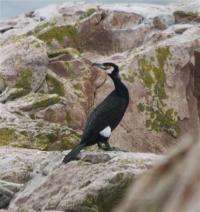
(AP) -- Bald eagles, bouncing back after years of decline, are swaggering forth with an appetite for great cormorant chicks that threatens to wipe out that bird population in the United States.
The eagles, perhaps finding less fish to eat, are flying to Maine's remote rocky islands where they've been raiding the only known nesting colonies of great cormorants in the U.S. Snatching waddling chicks from the ground and driving adults from their nests, the eagles are causing the numbers of the glossy black birds to decline from more than 250 pairs to 80 pairs since 1992.
"They're like thugs. They're like gang members. They go to these offshore islands where all these seabirds are and the birds are easy picking," said Brad Allen, a wildlife biologist with the Maine Department of Inland Fisheries and Wildlife. "These young eagles are harassing the bejesus out of all the birds, and the great cormorants have been taking it on the chin."
The recovery of the bald eagle population has been well-documented, growing from 400 pairs to more than 10,000 pairs in the lower 48 states since the 1960s. But the revival has changed the natural order of things in Maine and other states, threatening other bird species.
With more eagles around and fewer fish in the waters than in the past, young eagles are turning to other birds to satisfy their hunger. Eagles are opportunistic feeders and will go after the easiest prey they can find, bird experts say.
In Alaska, many eagles have shifted their diet from fish to seabirds. In the Midwest, they've been known to eat baby blue herons. And besides Maine's great cormorants, eagles are also feasting on baby double-breasted cormorants, gulls, eider ducks and even loons.
Nobody's raising a stink about the eagles' taste for double-breasted cormorants and gulls because those birds are so numerous and considered nuisances by many.
But the great cormorants are another matter, because their numbers in Maine are so small, said John Drury, of Vinalhaven, who's been counting seabirds on Maine islands for more than 25 years. Although the birds are widespread from Europe to eastern Canada, they are uncommon in Maine, which represents their southern range in the Northwest Atlantic.
Drury last summer counted only 80 great cormorant nests, the smallest number since 1984, the year after they were first spotted on Maine islands. Without protection, he fears the Maine population could be wiped out.
Governmental agencies and conservation groups have put countless hours and dollars toward protecting other seabird populations such as terns - but little has been done for great cormorants, he said.
"We like to have diversity of species," Drury said. "If we're going to spend all that time and energy to protect terns, then cormorants deserve as much attention."
At one time there were an estimated 50,000 pairs of bald eagles in the continental U.S. But their numbers declined from hunting and habitat loss. It was the widespread use of the pesticide DDT that almost did them in. DDT accumulated in fish, a major food source for eagles, which resulted in eagles laying eggs with weakened shells. By 1963, there were only 417 pairs of eagles left in the lower 48 states.
The bald eagle began a gradual recovery after it was listed on the federal Endangered Species list in 1967. DDT was banned in the U.S. in 1972.
There are now more than 10,000 pairs, according to the U.S. Fish and Wildlife Service. Maine's 500 pairs represent the largest population in the Northeast, up from less than 30 pairs in the 1960s. New Hampshire has about a dozen pairs and Vermont has one. Minnesota, Wisconsin and Florida each have more than 1,000 pairs of bald eagles, the agency said.
The bald eagle was taken off the federal endangered species list two years ago; Gov. John Baldacci is set to sign a bill this month taking it off Maine's endangered and threatened species list.
But all those eagles need to eat.
In the Midwest, eagles have targeted young blue herons, said Jody Millar, the national eagle recovery coordinator for Fish and Wildlife, based in Moline, Ill.
And in Alaska, researchers have documented a shift in bald eagles' diet from fish to marine birds that's linked to changes in the coastal ecosystem.
A growing number of killer whales caused a chain of ecological events that reduced the number of otters and amount of kelp providing habitat for fish, Robert Anthony reported in the journal Ecology. With fewer fish and baby otters to eat, eagles began raiding nests of other birds.
In Maine, eagles have been spotted eating loon chicks and have occasionally been known to carry off adult loons, said Sally Stockwell, director of conservation at Maine Audubon.
Off the coast, eagles have taken to eating all types of seabirds on rocky remote islands and ledges where, in years past, the seabirds didn't have any predators. If fish - the eagles' natural diet - were more plentiful, perhaps they wouldn't be so inclined to go after other birds, Drury said.
"They'll catch whatever is easiest to catch," he said. "There are more birds now and less fish."
Drury was on Seal Island last week to chase bald eagles away from cormorant nests. Besides eating the babies, eagles are driving the adults from their nests, leaving the eggs exposed to other predators, he said. The eggs will hatch in late May or early June, and the chicks will learn to fly by mid-August, he said.
Greg Butcher, director of bird conservation for the National Audubon Society in Washington, hasn't heard of the eagle resurgence affecting bird populations elsewhere, but said he wouldn't be surprised if it's happening. Whatever the case, it is sure to generate debate among the nation's millions of birders, he said.
"We're in an interesting age where most people think birds are either overabundant or too rare," he said. "It's hard to get it just right."
©2009 The Associated Press. All rights reserved. This material may not be published, broadcast, rewritten or redistributed.


