Astronauts to undertake fourth walk to repair Hubble telescope
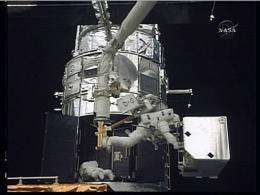
May 17, 2009 by Mark Carreau In this image obtained from NASA video, astronauts work to service the Hubble space telescope

Enlarge

In this image obtained from NASA video, astronauts work to service the Hubble space telescope. US astronauts will undertake a fourth in a series of five daily spacewalks intended to equip the 19-year-old Hubble Space Telescope for at least another five years of valuable scientific work

US astronauts on Sunday will undertake a fourth in a series of five daily spacewalks intended to equip the 19-year-old Hubble Space Telescope for at least another five years of valuable scientific work.

Fellow spacewalkers Mike Massimino and Mike Good will attempt an intricate repair of Hubble's Space Telescope Imaging Spectrograph, a black hole hunter.

The spectrograph was installed in the telescope during a 1997 shuttle mission but has been inactive since a 2004 power failure.

The repair plan is similar to the one that revived the Advanced Camera for Surveys on Saturday. However, Massimino must extract 111 small screws without losing a single one.

The spacewalk is scheduled to begin at 9:16 am EDT (1316 GMT) and will last approximately six and a half hours.

On Saturday, another pair of astronauts, John Grunsfeld and Drew Feustel, revived the crippled camera and installed a second new scientific instrument aboard the Hubble.

Since hoisting Hubble into Atlantis's cargo bay last week, the shuttle's seven astronauts have achieved six of the mission's highest priorities.

In addition to the Saturday's camera revival and installation of the new Cosmic Origin Spectrograph, the list of achievements include the addition of the Wide Field Camera-3, a new , and power storage batteries.

Hubble, a cooperative project between NASA and the European Space Agency, is headed for a new scientific summit, a perch from which astronomers can search for the oldest star systems, map the large scale structure of the universe and study planet forming processes around other stars.

"We are batting 1,000," said Dave Leckrone, NASA's chief Hubble astronomer, told a news briefing. "We have just an extraordinary capability to image the universe, much more powerfully that what we had before by far."

Saturday's spacewalk breathed new life into the camera for surveys, a seven-year-old instrument that was crippled by a short circuit in January 2007.

The breakdown slowed a campaign to unravel the mysteries of and , two little understood forces that influence the structure and expansion of the universe.

During the repair, Grunsfeld, a 50-year-old astronomer, and Feustel, a 43-year-old geologist, opened the camera to extract and replace four circuit boards and attach a new external power source.

Grunsfeld, who is visiting the space telescope for a third time, removed 32 tiny screws using an assortment of hand ratchets and cutters to revive the imager. A custom cover plate kept the tiny fasteners from floating into the telescope, where it could have caused harm.

Saturday's outing began with the installation of the new Cosmic Origins Spectrograph, an instrument that analyzes the light from stars, planets and other astronomical objects rather than taking pictures.

The new instrument will rely on the light from distant quasars to illuminate the vast web-like structures that extend across the universe encircling regions of interstellar gas and dust.

The new spectrograph promises to aid astronomers as they track the stellar genesis of carbon and the other chemical elements needed for life.

The spacewalkers made room for the spectrograph by removing an optical module installed in Hubble in 1993.

Astronauts on the long ago mission equipped the observatory with the Corrective Optics Space Telescope Axial Replacement, an instrument that overcame an optical flaw in the telescope's light gathering mirror.

The flaw surfaced in the weeks following Hubble's 1990 launch.

In Saturday's there was a notable absence of the stuck bolts and equipment misalignments that marred spacewalks on Thursday and Friday and pushed the outings well beyond their planned six and a half hour limits.

(c) 2009 AFP


print this article email this article download pdf blog this article bookmark this article     Stumble it Digg this share on Facebook retweet share on Reddit add to delicious
Rate this story - 5 /5 (3 votes)

Rank Filter

Move the slider to adjust rank threshold, so that you can hide some of the comments.


Display comments: newest first

  • yyz - May 17, 2009
    • Rank: not rated yet
    Fingers crossed that Hubble%u2019s Space Telescope Imaging Spectrograph (STIS) is successfully repaired on today%u2019s (Sunday) spacewalk. Its super-high resolution spectra are just what%u2019s needed to probe the constituents of planetary atmospheres on transiting planets discovered by Kepler, and to look closely at other known transiting exoplanets. STIS observations of a single transiting exoplanet provided the first characterization of an exoplanets atmosphere.
  • SparkyMetal - May 18, 2009
    • Rank: not rated yet
    They did it! I hoped, but didn't really think they'd be able to, pull off today's walk. These guys are heros :) Hope the next one is equally successful & they get back safe and sound.

May 17, 2009 all stories

Comments: 2

5 /5 (3 votes)
  • Stumble this up

  • Digg this

  • share this

  • hide
  • Related Stories

  • Spacewalkers equip Hubble with new computer
    created May 15, 2009 | popularity not rated yet | comments 0
  • Spacewalkers pull off toughest Hubble repairs yet
    created May 16, 2009 | popularity not rated yet | comments 0
  • NASA announces details of Hubble servicing mission
    created Jan 08, 2008 | popularity not rated yet | comments 0
  • New Science Instruments for Hubble
    created Oct 16, 2007 | popularity not rated yet | comments 0
  • IMAX Camera Returns to Space to Chronicle Hubble Space Telescope
    created Sep 25, 2007 | popularity not rated yet | comments 0


  • hide
  • Relevant PhysicsForums posts

  • The shape of our solar system's orbits.
    created 12 hours ago
  • Above or Below the Line of Nodes
    created 16 hours ago
  • Supernova vs. Nova?
    created 23 hours ago
  • Supernova's Gamma Rays and Comets
    created Nov 06, 2009
  • Our Moon
    created Nov 06, 2009
  • Question about a Carl Zeiss lens
    created Nov 05, 2009
  • More from Physics Forums - General Astronomy

Other News

Success in 'space elevator' competition (AP)

Success in 'space elevator' competition (Update 3)

Space & Earth / Space Exploration

created Nov 05, 2009 | popularity 4.3 / 5 (33) | comments 50

(AP) -- A robot powered by a ground-based laser beam climbed a long cable dangling from a helicopter on Wednesday to qualify for prize money in a $2 million competition to test the potential reality of the ...


Space hotel taking bookings for 2012 opening

Space hotel taking bookings for 2012 opening

Space & Earth / Space Exploration

created Nov 05, 2009 | popularity 4.4 / 5 (20) | comments 11

(PhysOrg.com) -- The first orbiting space hotel is on track to open for its first customers in 2012, but hurry, as bookings are filling fast.


'Dropouts' pinpoint earliest galaxies

'Dropouts' pinpoint earliest galaxies

Space & Earth / Astronomy

created Nov 06, 2009 | popularity 4.1 / 5 (9) | comments 11

Astronomers, conducting the broadest survey to date of galaxies from about 800 million years after the Big Bang, have found 22 early galaxies and confirmed the age of one by its characteristic hydrogen signature ...


This undated file picture shows part of the Pastoruri snowcapped mountain in the central Peruvian Andes

'Whitewash' could slow global warming: Peruvian scientist

Space & Earth / Earth Sciences

created Nov 04, 2009 | popularity 1.4 / 5 (9) | comments 11

A Peruvian scientist has called on his country to help slow the melting of Andean glaciers by daubing white paint on the rock and earth left behind by receding ice so they will absorb less heat.


In a Galaxy Far, Far Away...

In a Galaxy Far, Far Away...

Space & Earth / Astronomy

created Nov 06, 2009 | popularity 4.8 / 5 (4) | comments 10

(PhysOrg.com) -- Astronomers have published the discovery of the farthest known object in the cosmos: a star that exploded when the universe was only 630 million years old -- only 4.6% of its current age. ...