New system for detection of single atoms: Records photon bursts from optical cavity
May 17, 2009 New system for detection of single atoms

Enlarge

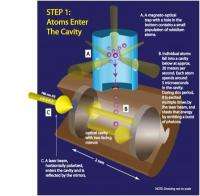
Step one in single-atom detection system. Credit: Joint Quantum Institute

Scientists have devised a new technique for real-time detection of freely moving individual neutral atoms that is more than 99.7% accurate and sensitive enough to discern the arrival of a single atom in less than one-millionth of a second, about 20 times faster than the best previous methods.

The system, described in Advance Online Publication at the web site by researchers at the Joint Quantum Institute (JQI) in College Park, MD, and the Universidad de Concepción in Chile, employs a novel means of altering the polarization of laser light trapped between two highly-reflective mirrors, in effect letting the scientists "see" atoms passing through by the individual photons that they scatter.

New system for detection of single atoms
Enlarge

Step two in single-atom detection system. Credit: Joint Quantum Institute

The ability to detect single atoms and molecules is essential to progress in many areas, including research, chemical detection and biochemical analysis.

"Existing protocols have been too slow to detect moving atoms, making it difficult to do something to them before they are gone. Our work relaxes that speed constraint," says coauthor David Norris of JQI. "Moreover, it is hard to distinguish between a genuine detection and a random 'false positive' without collecting data over a large period of time. Our system both filters the signal and reduces the detection time."

The scientists trap and cool a small population of atoms (rubidium is used in the current experiment) in a vacuum enclosure in such a way that they drop slowly, one at a time, through a hole 1.5 millimeters wide at the bottom of the trap. [See Figure 1.] The atom then falls about 8 centimeters until it enters a tiny chamber, or cavity, that is fitted on opposite sides with highly reflective mirrors that face one another at a distance of about 2 millimeters. Passing through the center of both mirrors is a laser beam of wavelength 780 nanometers - just slightly longer than visible red light. The beam excites the atom as it falls between the mirrors, causing it to reradiate the light in all directions.

That arrangement is a familiar one for labs studying the interaction of atoms and photons. The JQI system, however, has two distinctively unique features.

First, the researchers use two polarizations of cavity light simultaneously: one (horizontal) which is pumped in to efficiently excite the atoms, and the other (vertical) which only appears when emitted by an atom inside the cavity. [See Figure 2.] Although the descent of the atom through the chamber takes only 5 millionths of a second, that is 200 times longer than it takes for the atom to become excited and shed a photon, so this process can happen multiple times before the atom is gone.

Second, they create a magnetic field inside the cavity, which causes the laser light polarization to rotate slightly when an atom is present. Known as the Faraday effect, this phenomenon is typically very weak when observed with a single atom. However, since the light reflecting between the mirrors passes by the atom about 10,000 times, the result is a much larger rotation of a few degrees. This puts significantly more of the into the vertical polarization, making the atoms easier to "see."

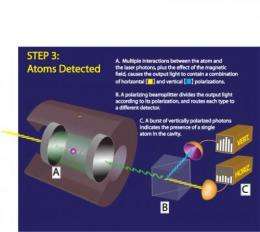
The light eventually escapes from the cavity and is fed through a polarizing beamsplitter which routes photons with horizontal polarization to one detector, and vertical polarization to another. Each arriving photon generates a unique time stamp whenever it triggers its detector. [See Figure 3.]
New system for detection of single atoms
Enlarge

Step three in single-atom detection system. Credit: Joint Quantum Institute

Although the detector for the vertically polarized light should only be sensitive to light coming from an atom in the cavity, it can be fooled occasionally by stray light in the room. But because there are multiple emissions from each atom, there will be a burst of photons whenever an atom passes between the mirrors. This is the signature that the researchers use to confirm an atom detection.

"The chief difficulty lies in verifying that our detector is really sensitive enough to see single atoms, and not just large groups of them," says team leader Luis A. Orozco of JQI. "Fortunately, the statistics of the light serve as a fingerprint for single-atom emission, and we were able to utilize that information in our system."

More information: "Photon Burst Detection of Single in an Optical Cavity," M.L. Terraciano, R. Olson Knell, D.G. Norris, J. Jing, A. Fernandez and L.A. Orozco, http://www.nature.com/nphys/index.html, DOI 10.1038/NPHYS1282 .

Source: University of Maryland (news : web)


print this article email this article download pdf blog this article bookmark this article     Stumble it Digg this share on Facebook retweet share on Reddit add to delicious
Rate this story - 5 /5 (13 votes)

Rank Filter

Move the slider to adjust rank threshold, so that you can hide some of the comments.


Display comments: newest first

  • blackle4ps3 - May 18, 2009
    • Rank: 1 / 5 (1)
    electric plasma grid to extract radioactive particles.seemingly a plasma grid (plasma type unknown) could attract or extract radioactive particles like a magnet & using microwave zone before the grid to incinerate radioactive particles before they get to grid.also radioactive waste microwave incinerator,projects that could lead to new discoveries and a cleaner planet.ideas from movies sahara,spys like us
  • latersville - May 20, 2009
    • Rank: not rated yet
    How does one make a "small population of rubidium atoms" drop one at a time into the trap? The article says they do it with temperature somehow. Also, why such a large hole? The idea of making a single atom do something you want it to, when and exactly where you want it to, is hard for me to grasp. Please, don't be too unkind in your responses.

May 17, 2009 all stories

Comments: 2

5 /5 (13 votes)
  • Stumble this up

  • Digg this

  • share this

  • hide
  • Related Stories

  • Physicists Turn Rubidium Atom Into a Single-Photon Server
    created Mar 12, 2007 | popularity not rated yet | comments 0
  • Controlling Photons for Use in Quantum Computing
    created Feb 13, 2007 | popularity not rated yet | comments 0
  • Detector can count atom by atom
    created Aug 10, 2006 | popularity not rated yet | comments 0
  • Atoms Under Control
    created Oct 11, 2005 | popularity not rated yet | comments 0
  • Scientists demonstrate quantum state exchange between light and matter
    created May 22, 2007 | popularity not rated yet | comments 0


  • hide
  • Relevant PhysicsForums posts

  • Some Explanation with Rigid Rotator
    created 1hour ago
  • How to Make a Ferrofluid?
    created 5 hours ago
  • avoidance of admitting that we dont know somethin
    created 10 hours ago
  • Speed of light : missing energy
    created 14 hours ago
  • Can light produce darkness and can noise procude quiteness 4
    created 16 hours ago
  • Magnetic Oscillation Equations
    created 22 hours ago
  • More from Physics Forums - General Physics

Other News

Restored machine to explore mysteries of Big Bang (AP)

Restored machine to explore mysteries of Big Bang

Physics / General Physics

created 14 hours ago | popularity 4.4 / 5 (12) | comments 9

(AP) -- Scientists are preparing the world's largest atom smasher to explore the depths of matter after successfully restarting the $10 billion machine following more than a year of repairs.


nuclear power plant

Doubts raised on nuclear industry viability

Physics / General Physics

created Nov 19, 2009 | popularity 3.1 / 5 (20) | comments 19

(PhysOrg.com) -- The investment in nuclear power has been growing around the world over the last few years, being viewed as a means for countries to control their energy security, avoid the price fluctuations ...


Researchers Find Innate Correlations Among Different Power Law Phenomena

Researchers Find Innate Correlations Among Different Power Law Phenomena

Physics / General Physics

created Nov 17, 2009 | popularity 4.3 / 5 (15) | comments 13

(PhysOrg.com) -- Studying the patterns that emerge in natural and social phenomena is a popular area of research, although usually individual phenomena are studied separately from each other. In a recent study, ...


Scientists demonstrate 'universal' programmable quantum processor

Scientists demonstrate 'universal' programmable quantum processor

Physics / Quantum Physics

created Nov 15, 2009 | popularity 4.6 / 5 (21) | comments 11

Physicists at the National Institute of Standards and Technology have demonstrated the first "universal" programmable quantum information processor able to run any program allowed by quantum mechanics -- th ...


Proton's party pals may alter its internal structure

Proton's party pals may alter its internal structure

Physics / General Physics

created Nov 18, 2009 | popularity 4.6 / 5 (20) | comments 9

A recent experiment at the DOE's Thomas Jefferson National Accelerator Facility has found that a proton's nearest neighbors in the nucleus of the atom may modify the proton's internal structure.