First direct observations of biological particles in high-altitude ice clouds

May 17, 2009
Scripps researcher Kerri Pratt with aerosol time-of-flight mass spectrometer (ATOFMS) aboard a specially outfitted C-130 aircraft operated by the National Center for Atmospheric Research in the skies over Wyoming. Scripps-led researchers made the first direct detections of airborne bacteria in clouds aboard the aircraft, and reported the results in the May 17 online edition of the journal Nature Geoscience. Credit: Andrew J. Heymsfield, NCAR
A team of UC San Diego-led atmospheric chemistry researchers moved closer to what is considered the "holy grail" of climate change science when it made the first-ever direct detection of biological particles within ice clouds.
The team, led by Kerri Pratt, a Ph.D. student of atmospheric chemistry Professor Kim Prather, who also holds appointments at Scripps Institution of Oceanography as well as the Department of Chemistry and Biochemistry at UCSD, sampled water droplet and ice crystal residues at high speeds from an aircraft flying through clouds in the skies over Wyoming in fall 2007. Analysis of the ice crystals revealed that they were made up almost entirely of either dust or biological particles such as bacteria, fungal spores and plant material. While it has long been known that microorganisms or parts of them get airborne and travel great distances, this study is the first to yield in-situ data on their participation in cloud ice processes.
Results of the Ice in Clouds Experiment - Layer Clouds (ICE-L), funded by the National Science Foundation (NSF) and the National Center for Atmospheric Research (NCAR), appear May 17 in the advance online edition of the journal Nature Geoscience.
"If we understand the sources of particles that nucleate clouds and their relative abundance, then we can determine the impact of these different sources on climate," said Pratt.
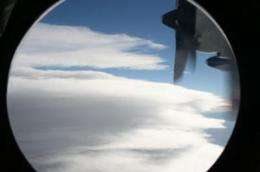
View from a specially outfitted C-130 aircraft operated by the National Center for Atmospheric Research in the skies over Wyoming. Scripps-led researchers made the first direct detections of airborne bacteria in clouds aboard the aircraft, and reported the results in the May 17 online edition of the journal Nature Geoscience. Credit: Andrew J. Heymsfield, NCAR
The effects of tiny airborne particles called aerosols on cloud formation have been some of the most difficult aspects of weather and climate for scientists to understand. In the climate change science field, which derives many of its projections from computer simulations of climate phenomena, the actions of aerosols on clouds represent what scientists consider the greatest uncertainty in modeling predictions for the future."By sampling clouds in real time from an aircraft, these investigators were able to get information about ice particles in clouds at an unprecedented level of detail," said Anne-Marine Schmoltner of the NSF's Division of Atmospheric Sciences. "By determining the chemical composition of the very cores of individual ice particles, they discovered that both mineral dust, and, surprisingly, biological particles play a major role in the formation of clouds."
Aerosols, ranging from dust, soot, sea salt to organic materials, some of which travel thousands of miles, form the skeletons of clouds. Around these nuclei, water and ice in the atmosphere condense and grow leading to precipitation. Scientists are trying to understand how they form as clouds play a critical role by both cooling the atmosphere and affect regional precipitation processes.
ICE-L was the first aircraft-based deployment of the aircraft aerosol time-of-flight mass spectrometer (A-ATOFMS) nicknamed "Shirley," which was recently developed at UCSD with funding from NSF. The ICE-L team mounted the mass spectrometer and an ice chamber run by Colorado State University researcher Paul DeMott onto a C-130 aircraft operated by NCAR and made a series of flights through a type of cloud known as a wave cloud. The researchers performed in-situ measurements of cloud ice crystal residues and found that half were mineral dust and about a third contained nitrogen, phosphorus and carbon — the signature elements of biological matter.
The second-by-second analysis speed allowed the researchers to make distinctions between residues of water droplets and ice nuclei in real-time. Ice nuclei are rarer than droplet nuclei and are more likely to create precipitation.
The A-ATOFMS also allowed the unambiguous measurement of biological particles in the cloud ice, which scientists previously concluded serve as ice nuclei based on simulations in laboratory experiments and precipitation measurements. Based on modeling and the chemical composition of measured dust, the ICE-L team was able to identify the source of the dust as Asia or Africa. "This has really been kind of a holy grail measurement for us," said Prather. "Understanding which particles form ice nuclei, which occur at extremely low concentrations and are inherently difficult to measure, means you can further understand processes that result in precipitation. Any new piece of information you can get is critical."
The findings suggest that the biological particles that get swept up in dust storms help to induce the formation of cloud ice and that their region of origin makes a difference. Prather said initial evidence is increasingly suggesting that dust transported from Asia could be influencing precipitation in North America, for example.
Researchers hope to use the ICE-L data to design future studies timed to events when such particles may be playing a bigger role in triggering rain- or snowfall.
-
Rain, snow forms with aid of living organisms: study
Feb 28, 2008 |
not rated yet |
0
-
Cloud formation affected by human activity, study says
Sep 12, 2006 |
not rated yet |
0
-
Scientists to track impact of Asian dust and pollution on clouds, weather, climate change
Apr 18, 2007 |
not rated yet |
0
-
Saharan Dust Affects Thunderstorm Behavior in Florida
Jan 12, 2005 |
not rated yet |
0
-
Atmospheric lead causes clouds to form more easily, could change pattern of rain and snow
Apr 19, 2009 |
not rated yet |
0
-
Engineers build first sub-10-nm carbon nanotube transistor
Feb 01, 2012 |
4.9 / 5 (30) |
30
-
Something old, something new: Evolution and the structural divergence of duplicate genes
Jan 31, 2012 |
4.6 / 5 (7) |
1
-
The hidden nanoworld of ice crystals: Revealing the dynamic behavior of quasi-liquid layers
Jan 30, 2012 |
5 / 5 (3) |
1
-
Stock market network reveals investor clustering
Jan 27, 2012 |
3.9 / 5 (23) |
8
-
Of microchemistry and molecules: Electronic microfluidic device synthesizes biocompatible probes
Jan 26, 2012 |
5 / 5 (1) |
0
-
Discrepancy between oxygen and carbon-dioxide levels
6 hours ago
-
where gems are found in the world
10 hours ago
-
Wind Waves in Reservoir ~ Wind run-up and Wind set-up
Feb 08, 2012
-
Balance of oxygen in the atmosphere
Feb 01, 2012
-
The case for a methanol-based economy
Jan 30, 2012
-
Weather in a rotating cylinder
Jan 25, 2012
- More from Physics Forums - Earth
More news stories
New views show old NASA Mars landers
(PhysOrg.com) -- The High Resolution Imaging Science Experiment (HiRISE) camera on NASA's Mars Reconnaissance Orbiter recorded a scene on Jan. 29, 2012, that includes the first color image from orbit showing ...
Space & Earth / Space Exploration
21 hours ago |
4.9 / 5 (7) |
9
|
Black holes and star formation
(PhysOrg.com) -- It has long been recognized that galaxy mergers or even close interactions can play a vital role in shaping the morphology of galaxies. One way they can do so, it is thought, is by triggering ...
20 hours ago |
4.1 / 5 (7) |
5
|
Deconstructing a mystery: What caused Snowmaggedon?
In the quiet after the storms, streets and cars had all but disappeared under piles of snow. The U.S. Postal Service suspended service for the first time in 30 years. Snow plows struggled to push the evidence ...
Space & Earth / Earth Sciences
13 hours ago |
4.7 / 5 (3) |
1
|
Ocean microbe communities changing, but long-term environmental impact is unclear
As oceans warm due to climate change, water layers will mix less and affect the microbes and plankton that pump carbon out of the atmosphere but researchers say it's still unclear whether these processes ...
Space & Earth / Earth Sciences
15 hours ago |
5 / 5 (2) |
2
|
Researchers create 3-D laser maps that show how earthquake changes landscape
Geologists have a new tool to study how earthquakes change the landscape down to a few inches, and it's giving them insight into how earthquake faults behave. In the Feb. 10 issue of the journal Science, a team ...
Space & Earth / Earth Sciences
15 hours ago |
5 / 5 (4) |
0
|
Fighting crimes against biodiversity: How to catch a killer weed
Invasive species which have the potential to destroy biodiversity and influence global change could be tracked and controlled in the same way as wanted criminals, according to new research from Queen Mary, University of London.
A novel method for simultaneously measuring blood pressure and arterial stiffness
Arterial stiffness due to is a major contributor to cardiovascular disease but is very difficult to measure. It also can influence blood pressure readings since these rely on the time taken for arteries to return to normal ...
Study finds that red blood cell transfusion decreases fatigue in women with acute postpartum anemia
In a study to be presented today at the Society for Maternal-Fetal Medicine's annual meeting, The Pregnancy Meeting , in Dallas, Texas, researchers will report findings that show that in women with acute postpartum ...
Study weighs risks and benefits of birthing facilities
In a study to be presented today at the Society for Maternal-Fetal Medicine's annual meeting, The Pregnancy Meeting , in Dallas, Texas, researchers will report findings that indicate that the risk of obstetric intervention ...
FDA-approved drug rapidly clears amyloid from the brain, reverses Alzheimer's symptoms in mice
Neuroscientists at Case Western Reserve University School of Medicine have made a dramatic breakthrough in their efforts to find a cure for Alzheimer's disease. The researchers' findings, published in the journal Science, show t ...
'Dark plasmons' transmit energy
Microscopic channels of gold nanoparticles have the ability to transmit electromagnetic energy that starts as light and propagates via "dark plasmons," according to researchers at Rice University.

May 27, 2009
Rank: not rated yet
http://www.panspermia.org/
in fact the theory goes further and says that organisms will be present in the cometary tail of the earth and any other biologically active planet as well.
It only makes sense to find organisms that high up. they will become electrically charges in earth atmosphere and as such travel even greater distances than if just by wind alone. Even escaping Earth atmosphere.
its good news that climatologists will take into thought biology's effect on climate. Seeing they they found organisms that high up, and ther was nothing special about these measurements, we can probably assume with good degree of certainty that this situation is global, universal and omnipotent, at all levels of earth atmosphere.