Scientists identify world's largest leatherback turtle population
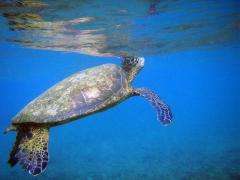
An international team of scientists has identified a nesting population of leatherback sea turtles in Gabon, West Africa as the world's largest. The research, published in the May issue of Biological Conservation, involved country-wide land and aerial surveys that estimated a population of between 15,730 and 41,373 female turtles using the nesting beaches. The study highlights the importance of conservation work to manage key sites and protected areas in Gabon.
Leatherbacks are of profound conservation concern around the world after populations in the Indo-Pacific crashed by more than 90 percent in the 1980s and 1990s. The International Union for Conservation of Nature (IUCN) lists leatherback turtles as critically endangered globally, but detailed population assessments in much of the Atlantic, especially Africa, are lacking.
The research was led by the University of Exeter working in collaboration with the Wildlife Conservation Society (WCS) which spearheads the Gabon Sea Turtle Partnership, a network of organisations concerned with the protection of marine turtles in Gabon
During three nesting seasons between 2002 and 2007, the team's members carried out the most comprehensive survey of marine turtles ever conducted in Gabon. This involved aerial surveys along Gabon's 600 km (372 mile) coast, using video to capture footage for evaluation, and detailed ground-based monitoring. By covering the entire coastline, they were not only able to estimate the number of nests and nesting females, but also to identify the key sites for leatherback nesting, data which are crucial to developing conservation management plans for the species. Leatherbacks were first described nesting in Gabon in 1984.
Lead author on the paper, Dr Matthew Witt of the University of Exeter, said: "We knew that Gabon was an important nesting site for leatherback turtles but until now had little idea of the size of the population or its global ranking. We are now focusing our efforts on working with local agencies to coordinate conservation efforts to ensure this population is protected against the threats from illegal fisheries, nest poaching, pollution and habitat disturbance, and climate change."
The study also revealed that around 79 percent of the nesting occurs within National Parks and other protected areas. This gives added hope that Gabon can continue to be one of the world's most important countries for these magnificent creatures.
Dr Angela Formia of the Wildlife Conservation Society, a co-author of the paper, said: "These findings show the critical importance of protected areas to maintain populations of sea turtles. Gabon should be commended for creating a network of National Parks in 2002 that have provided a sanctuary for this endangered species as well as other rare wildlife."
Leatherback turtles:
• The leatherback is the largest sea turtle, reaching up to nearly two metres (6.5 feet) in length and 540kg (1190 pounds) in weight.
• Unlike other sea turtles, the leatherback does not have a hard shell. Its shell is made-up of a mosaic of small bones covered by firm, rubbery skin with seven longitudinal ridges.
• Leatherbacks are the most widely spread marine turtles, and are found in the Pacific, Indian and Atlantic oceans, particularly in tropical regions.
• Leatherbacks are the deepest diving of all sea turtles. The deepest recorded dive is 1.2 kilometres (3/4 mile), which is slightly more than the deepest known dive of a sperm whale.
• As with other reptiles, the sex of leatherbacks is determined by the temperature of eggs during incubation. With leatherbacks, temperatures above 29 degrees centigrade (84 degrees Fahrenheit) will result in female hatchlings.
• Leatherbacks are strong swimmers and tagged individuals have been known to cross ocean basins and are known to travel many thousands of kilometres in search of their jellyfish prey.
More information: To see turtles currently being tracked from Gabon see: www.seaturtle.org/tracking/?project_id=340
Source: University of Exeter (news : web)


