New tool isolates RNA within specific cells (w/Video)
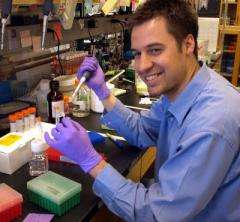
A team of University of Oregon biologists, using fruit flies, has created a way to isolate RNA from specific cells, opening a new window on how gene expression drives normal development and disease-causing breakdowns.
While DNA (deoxyribonucleic acid) provides an identical genetic blueprint in every cell, RNA (ribonucleic acid) decodes genetic instructions that turn protein molecules on and off in different cell types.
The new tagging method, tested in a variety of subsets of Drosophila brain cells, is described in a paper put on line ahead of regular publication by the journal Nature Methods. Instead of scientists needing to physically separate cell types, they now can inject a chemically modified gene from the one-celled organism Toxoplasma gondii and activate it in only one cell type within a tissue. Only newly generated RNA in this cell type is then tagged and isolated.
"By analyzing RNA from different cell types, we can begin to understand how cellular differences are generated," said lead author Michael R. Miller, a National Science Foundation-funded doctoral student in the lab of Chris Doe, a UO biologist and Howard Hughes Medical Institute (HHMI) investigator. "Our new TU-tagging method should be useful for isolating cell-type specific RNA from other organisms, including mammals, and should be useful in broad areas of research including studies of development, neurobiology and disease."
The new non-toxic, non-invasive method makes it possible to "listen in" to the messages -- in fact, messenger RNA -- that the nucleus is sending each cell, without perturbing the cell, Doe said. "It is much like eavesdropping on a phone conversation, rather than pulling the person out of the house for questioning. The cell has no idea that its RNAs are being 'tagged' for isolation and study. That's good, because we get a more accurate idea of what the cell is saying."
That, Doe added, could be helpful for 'listening' to host cells before and after the initiation of a disease to determine how cells respond, or, for example study healthy immune cells versus bacterially-challenged immune cells or neurons before they learn a task and after they learn a task to determine what changes in the cell are caused by the experience.
The new UO-developed tool builds on work led by co-author Michael D. Cleary, who as a doctoral student at Stanford University unveiled the T. gondii-based approach for use in analyzing RNA synthesis and decay in 2005 in Nature Biotechnology. Cleary, now a faculty member at the University of California, Merced, worked on the UO project as a postdoctoral fellowship funded by the National Institutes of Health and HHMI.
Cleary's group built its tool with the enzyme uracil phosphoribosyltransferase (UPRT), a nucleotide salvage enzyme that prepares nucleotides for incorporation into newly synthesized RNA. By altering the nucleotide analog 4-thiouracil, the UPRT enzyme caused RNA to become tagged with thiouracil (TU), allowing the "TU-tagged" RNA to be purified from untagged RNA.
In Doe's lab, Miller, Cleary and research technician Kristin J. Robinson of the UO's institutes of Neuroscience and Molecular Biology manipulated Drosophila so that they would only express UPRT in specific target cells. The group tested the new approach in embryos, larvae and adults using microarray technology to detect cell type-specific gene expression. The researchers say the method should work in other systems, including vertebrates, by using gene transfer, retroviral delivery, electrical pulses of molecules through cell membranes, or messenger RNA injection.
Source: University of Oregon (news : web)


