Air-fueled battery could last up to 10 times longer
May 18, 2009
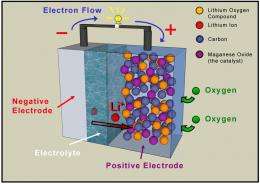
Diagram of the STAIR (St Andrews Air) cell. Oxygen drawn from the air reacts within the porous carbon to release the electrical charge in this lithium-air battery.
A new type of air-fuelled battery could give up to ten times the energy storage of designs currently available.
This step-change in capacity could pave the way for a new generation of electric cars, mobile phones and laptops.
The research work, funded by the Engineering and Physical Sciences Research Council (EPSRC), is being led by researchers at the University of St Andrews with partners at Strathclyde and Newcastle.
The new design has the potential to improve the performance of portable electronic products and give a major boost to the renewable energy industry. The batteries will enable a constant electrical output from sources such as wind or solar, which stop generating when the weather changes or night falls.
Improved capacity is thanks to the addition of a component that uses oxygen drawn from the air during discharge, replacing one chemical constituent used in rechargeable batteries today. Not having to carry the chemicals around in the battery offers more energy for the same size battery. Reducing the size and weight of batteries with the necessary charge capacity has been a long-running battle for developers of electric cars.
The STAIR (St Andrews Air) cell should be cheaper than today's rechargeables too. The new component is made of porous carbon, which is far less expensive than the lithium cobalt oxide it replaces.
This four-year research project, which reaches its halfway mark in July, builds on the discovery at the university that the carbon component's interaction with air can be repeated, creating a cycle of charge and discharge. Subsequent work has more than tripled the capacity to store charge in the STAIR cell.
Principal investigator on the project, Professor Peter Bruce of the Chemistry Department at the University of St Andrews, says: "Our target is to get a five to ten fold increase in storage capacity, which is beyond the horizon of current lithium batteries. Our results so far are very encouraging and have far exceeded our expectations."
"The key is to use oxygen in the air as a re-agent, rather than carry the necessary chemicals around inside the battery," says Bruce.
The oxygen, which will be drawn in through a surface of the battery exposed to air, reacts within the pores of the carbon to discharge the battery. "Not only is this part of the process free, the carbon component is much cheaper than current technology," says Bruce. He estimates that it will be at least five years before the STAIR cell is commercially available.
The project is focused on understanding more about how the chemical reaction of the battery works and investigating how to improve it. The research team is also working towards making a STAIR cell prototype suited, in the first instance, for small applications, such as mobile phones or MP3 players.
Source: Engineering and Physical Sciences Research Council (news : web)


So should we still call it a lithium battery? Or a carbon battery?
And why mp3 players first? Quick turn around in product deployment? I think some electric car manufacturers would be more than willing to get this out quicker. Some may even be studying the diagram to see if they can replicate it now :-)
R&D has more to do then just theory! It also has to do with practicality and oh yea Lawyers!!
If they rush this to the market and let say Motorola puts it in your cell phone that is in your pocket, and then like a number of batteries in laptops it starts on fire you get seriously injured and they get sued.
R&D works give it time!!!
The question I have is if it takes in oxygen what does it out gas?
Its air. How heavy do you think it can be?
cobalt oxide? 6.11 g per cubic centimeter.
@real, should off gas O2 that it oxidized in the run down process when it is recharging. If the Carbon is a consumable then it's not really rechargable.
Exploding cell phone batteries have killed people(I think every single one of those cases have involved having the phone in your breast pocket, next to your heart though).
Nothing.
Oxygen is 2.5 times heavier than lithium. Now, most of this battery is not lithium and lithium will absorb oxygen in a 50% ratio, so it's not going to be anywhere that dramatic. But if you were to take lithium metal and set fire to it, the lithium oxides would be 1.2 times heavier than the lithium metal and after absorbing water from the air the lithium hydroxide would be 2.6 times heavier than lithium metal.
We have had metal air batteries/fuel cells which is what they really are for decades. Since Alum or Zinc/air are cheaper it's not a big deal.
They are recharged by replacing the racks of metal grids. And yes the military uses them and have for decades.
it could clean the CO2 in the air at the ame time. This will truly save our planet of green house gases!
I must take exception to the term "air-fuelled." The "fuel" is the material oxidized at the anode. The cathode reaction is oxidation. "Air-fueled" is a contradiction.
There was an air-cell battery (several in fact) here in Australia in the 1920s, and probably all over, which was a carbon-zinc cell, with porous carbon anode, caustic soda (sodium hydroxide) electrolyte, and no depolariser. The carbon allowed free (slow) access of oxygen from the atmosphere. It was designed to supply valve/tube filaments (typically 2V) in coffin radios. Two cells were required (about 2.4V to 2.8V) and a rheostat to cut down the voltage. The cell was about a 6 inch (150mm) glass cube, and probably delivered up to 0.5A continuously. It could deliver more for short bursts, but you then had to wait for it to depolarise (disperse generated gas bubbles), before reusing. You added fresh electrolyte and new zinc as needed.
Oops, meant to say "reduction." i.e. reduction of O2 to OH-