Astronauts finish repairs on Hubble space telescope
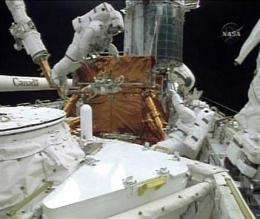
(AP) -- Spacewalking astronauts completed repairs to the Hubble Space Telescope on Monday, leaving it more powerful than ever and able to peer even deeper into the cosmos - almost to the brink of creation. The last humans to lay hands on Hubble outfitted the observatory with another set of fresh batteries, a new sensor for precise pointing and protective covers. That equipment, along with other improvements made over the last five days, should allow the telescope to provide dazzling views of the universe for another five to 10 years.
"Hubble is returned to flagship status, and it now has a full arsenal of instruments," said Jon Morse, NASA's director of astrophysics.
It was the fifth and final spacewalk for the shuttle Atlantis crew, and the final visit by astronauts ever to Hubble.
As the spacewalk drew to a close, Hubble's chief mechanic, John Grunsfeld, accidentally bumped one of the telescope's antennas and knocked off its cap with his backpack.
"Oh, I feel terrible," he groaned.
Mission Control quickly assured the astronauts the antenna was fine.
"Sorry, Mr. Hubble, have a good voyage," Grunsfeld said after he covered up the tip.
"Consider it a goodbye kiss, John," one of his crewmates said.
The astronauts planned to set Hubble free Tuesday.
During this emotional last house call, astronauts gave Hubble two state-of-the-art science instruments and fixed two others.
The $220 million worth of new instruments should allow the telescope to gaze farther back into time - within 500 million or 600 million years of the first moments of the universe.
Prior to the repairs, Hubble was able to look back to within 800 million years.
"This is a very important moment in human history," said Hubble senior project scientist David Leckrone. "We will rewrite the textbooks at least one more time."
Hubble program manager Preston Burch acknowledged that the telescope still has some original parts, but noted "in many ways it is a brand-new observatory and far, far more capable than the Hubble of 1990."
Mission Control congratulated the astronauts for successfully completing "electronic brain surgery" Monday during a spacewalk that lasted more than seven hours.
In addition to the batteries and the sensor, Grunsfeld and Andrew Feustel installed steel foil sheets to protect against radiation and the extreme temperature changes of space.
It was messy work. Pieces of the old insulation broke off and floated harmlessly away.
"I was hoping to retrieve those for memories," said Grunsfeld, an astrophysicist who has spent more time working on the orbiting Hubble than anyone. He's visited Hubble twice before, and plans to use the telescope once he's back on Earth to study the moon.
As he applied the new insulation with a roller, a voice from space sang "rollin', rollin', rollin'" to the theme song from the TV show Rawhide.
But the total 37 hours of spacewalks were by no means routine. The astronauts had some trouble removing an old camera and had to install a refurbished pair of gyroscopes after a brand-new set refused to go in.
Sunday's spacewalk was particularly exasperating: a stuck bolt almost prevented astronauts from fixing a burned-out science instrument. Brute force saved the day.
During the mission, the four spacewalkers, two per team, managed to fix two science instruments that had broken down years ago and were never meant to be tinkered with in orbit.
They also replaced a faltering science data-handling device and installed a docking ring so a robotic craft can latch on and steer the telescope into the Pacific sometime in the early 2020s.
All told, this visit to Hubble cost more than $1 billion.
"We have a saying ... 'Science never sleeps,' and our work is just beginning,'" said Morse, the astrophysics director. "And we can't wait to get out there and use Hubble for its intended purposes."
NASA hopes to crank Hubble back up by summer's end, following extensive testing of its new parts.
But already scientists have gotten more than they expected out of Hubble when it was launched in 1990 with a projected lifetime of 15 years.
Once its blurred vision was corrected in 1993 and NASA's reputation was restored, the telescope began churning out breathtaking images: among other things, stars in the throes of birth and death.
Back at the launch site, NASA maintained its vigil in case another shuttle needed to rush to the rescue. Atlantis escaped serious launch damage a week ago, but was susceptible to all the space junk in Hubble's 350-mile-high orbit. The astronauts will perform one last survey of their ship after releasing the telescope.
NASA took unprecedented steps to have Endeavour on the pad as a rescue ship, because the Atlantis astronauts have nowhere to seek shelter if they cannot return to Earth because of shuttle damage. The space station is in another, unreachable orbit.
The increased risk prompted NASA to cancel the mission five years ago in the wake of the Columbia accident. It was reinstated two years later.
With NASA's three remaining space shuttles set for retirement next year, there will no way for astronauts to return to Hubble. The new spacecraft under development will be much smaller and less of a workhorse than the shuttle, and lack a big robot arm for grabbing the telescope.
Hubble's replacement, the James Webb Space Telescope, will be launched in 2014 by an unmanned rocket and placed in an orbit inaccessible to astronauts.
NASA officials said the farewell to Hubble would be bittersweet.
"We all recognize we've gotten almost 20 years of service out of it. And it will be cranking along there for another five years," said Burch, the program manager. "Maybe it is time to move on."
---
On the Net:
NASA: http://www.nasa.gov/mission-pages/hubble/main/index.html
©2009 The Associated Press. All rights reserved. This material may not be published, broadcast, rewritten or redistributed.


