Did modern humans eat Neanderthals?
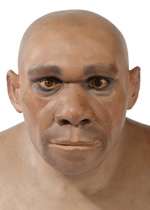
May 18, 2009 Model head of a Neanderthal man.

Model head of a Neanderthal man. Image: Natural History Museum

Modern humans may have eaten Neanderthals, scientists report in the Journal of Anthropological Sciences this month.

Scientists carried out a detailed study of jaws and teeth uncovered from the Les Rois cave in south-west France. The site has evidence of a stone and bone tool industry from 35,000 years ago called the Aurignacian, made by some of the first in Europe, or Cro-Magnons.

Examining jawbones

One of the jawbones was clearly that of a Cro-Magnon child. Another jawbone, also belonging to a child, showed some Neanderthal features in the teeth, such as teeth growth line patterns. It also had cut marks that suggest the tongue was removed, perhaps along with some of the teeth.

Different theories

So the team says this could be evidence that early modern humans in Europe ate Neanderthals, or that they treated the Neanderthal child’s remains in some way, for example as a trophy.

An alternative possibility the team suggests is that there may have been a varied or hybrid population of Cro-Magnons and Neanderthals living together, or the remains may have belonged to Cro-Magnons with more primitive characteristics than normal.

‘Any one of these explanations would be important for our understanding of events in Europe about 35,000 years ago,’ says Chris Stringer, Research Leader in at the Natural History Museum.

Sensational evidence?

'But if this site really does have co-existing Neanderthals and Cro-Magnons, it would be sensational evidence in support of one or other of the two leading scenarios for the disappearance of the Neanderthals,' explains Stringer.

Neanderthals

Neanderthals, Homo neanderthalensis, are our best-known extinct relatives. They overlapped with modern humans, Homo sapiens, in Europe between 35-40,000 years ago, disappearing about 30,000 years ago.

Explanations for the disappearance of Neanderthals
One scenario for Neanderthal extinction is that they were replaced by the Cro-Magnons after a period of co-existence and possible interaction. This may have included direct competition between them.

Another scenario is that the Neanderthal and Cro-Magnon populations interbred and blended with each other during their possible co-existence, although many scientists, including Stringer, consider that hybridisation would have been the exception rather than the rule.

Caution needed

However, Stringer says we should not get carried away. ‘We should bear in mind that the tantalising second jawbone bearing cut marks is very incomplete and the authors acknowledge that their identification of it as Neanderthal is only probable, rather than definite.’

More research at Les Rois

There is much more to be uncovered at Les Rois and some of the team will be carrying out more excavations in the future.

‘This will hopefully add finds to help solve the intriguing mystery of the children of Les Rois, their identity, and their fates, both in terms of events 35,000 years ago, and in terms of what they can tell us about human evolution in general, and the fate of the ,’ concludes Stringer.

More information: Journal of Anthropological Sciences Vol 87: http://www.isita-org.com/jass/Contents/ContentsVol87.htm

Source: American Museum of Natural History (news : web)


print this article email this article download pdf blog this article bookmark this article     Stumble it Digg this share on Facebook retweet share on Reddit add to delicious
Rate this story - 3.4 /5 (15 votes)

Rank Filter

Move the slider to adjust rank threshold, so that you can hide some of the comments.


Display comments: newest first

  • thales - May 18, 2009
    • Rank: 4.5 / 5 (2)
    Scientists carried out a detailed study of jaws and teeth uncovered from the Les Rois cave in south-west France.


    Yes, a place where the diet frequently consists of fava beans and a nice Chianti. Coincidence?!
  • smiffy - May 19, 2009
    • Rank: 3 / 5 (2)
    What won't the French eat?
  • Soylent - May 19, 2009
    • Rank: not rated yet
    What won't the French eat?


    Deep-fried mars bars(yes, they exist).
  • otto1923 - May 19, 2009
    • Rank: not rated yet
    Well, of course they did, humans have been eating each other for millenia. Resistance to certain prions is only one clue. The next tribe is always a little less human aren't they? Not too much difference between hunting and fighting, and why leave all that good protein strewn about the battlefield, especially when you were fighting over food to begin with? Religions evolved to accomodate.
  • denijane - May 20, 2009
    • Rank: 5 / 5 (1)
    What I see evidence for is that for some reason the two jaws were of two very unfortunate kids lived in the same place. Nothing else.

    If anything, I'd think that they maybe the two kids grew together and was later killed by another tribe.

    Seriously, can we eat teeth? I think not. Very premature conclusions. Why eating each other is more probable than living together? We haven't found any evidences of fights between the two species, maybe they just happily coexisted and even mixed with the better genes overtaking the weaker ones?
  • otto1923 - May 20, 2009
    • Rank: not rated yet
    Humans conquered one natural enemy after another until they could expand without restraint. They spread throughout the world escaping overcrowding and violence behind them. We need only look at early accounts of hunter-gatherer cultures to know that tribal warfare was a constant throughout prehistory. Hunting animals is easy- any animal can do it. Hunting humans who are hunting us is hard. This is what made our brains grow to such an unwieldy size so quickly- competition among equals.
  • KBK - May 23, 2009
    • Rank: not rated yet
    It is interesting to note that wild Chimps in the Deep Congo regularly go on raiding parties and attack nearby Chimp groups.

    They tend to, nearly every time --eat who they capture.

    It seems to be part of a very old story.

May 18, 2009 all stories

Comments: 7

3.4 /5 (15 votes)
  • Stumble this up

  • Digg this

  • share this

  • hide
  • Related Stories

  • Neanderthal/human relationship questioned
    created Sep 12, 2005 | popularity not rated yet | comments 0
  • Neanderthal Man Was An Innovator, Study Says
    created Jun 19, 2007 | popularity not rated yet | comments 0
  • Scientists redate Neanderthal fossils
    created Jan 05, 2006 | popularity not rated yet | comments 0
  • Handsome by Chance
    created Aug 02, 2007 | popularity not rated yet | comments 0
  • Daily grind: Fossil molars add to Neanderthal debate
    created Nov 22, 2006 | popularity not rated yet | comments 0


  • hide
  • Relevant PhysicsForums posts

  • What is transpulmonary pressure?
    created Nov 24, 2009
  • Is there a gay gene?
    created Nov 23, 2009
  • Super quick question about Starling forces?
    created Nov 22, 2009
  • Questions about diffusion
    created Nov 22, 2009
  • More from Physics Forums - Biology

Other News

Ancient Greek Temple

Houses of the rising sun: Research sheds new light on Ancient Greeks

Other Sciences / Archaeology & Fossils

created 2 hours ago | popularity not rated yet | comments 2

New research at the University of Leicester has identified scores of Sicilian temples built to face the rising Sun, shedding light on the practices of the Ancient Greeks.


Explained: The Discrete Fourier Transform

Explained: The Discrete Fourier Transform

Other Sciences / Mathematics

created 6 hours ago | popularity 3.5 / 5 (8) | comments 5

(PhysOrg.com) -- In 1811, Joseph Fourier, the 43-year-old prefect of the French district of Isčre, entered a competition in heat research sponsored by the French Academy of Sciences. The paper he submitted ...


Biology, training and profit sharing make best traders

Biology, training and profit sharing make best traders

Other Sciences / Mathematics

created 6 hours ago | popularity not rated yet | comments 1

(PhysOrg.com) -- Cambridge researchers have identified a group of traders consistently able to outperform the market, even during the credit crisis.


Political views may skew perception of skin tone, new study finds

Other Sciences / Social Sciences

created 19 hours ago | popularity 3.6 / 5 (5) | comments 5

(PhysOrg.com) -- Political affinity could influence how some people view the skin tone of biracial political candidates, according to a new study from the University of Chicago Booth School of Business, New York University ...


In College Football, Home Field Advantage Often Overestimated

Other Sciences / Mathematics

created 19 hours ago | popularity 4 / 5 (1) | comments 0

This year, many of college football's biggest rivalry games take place over Thanksgiving weekend. A win earns bragging rights for the year. Visiting teams are often thought to be at a considerable disadvantage, especially ...