NASA to Test World's Largest Rocket Parachutes for Ares I
May 18, 2009 NASA to Test World's Largest Rocket Parachutes for Ares I

Enlarge

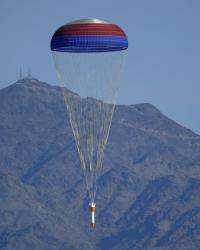
During a test drop in late February 2009, the Ares drogue parachute successfully extracted the main parachute, which enabled the recovery of the 50,000-pound test drop article. Image Credit: NASA/ATK

(PhysOrg.com) -- With Memorial Day just around the corner, NASA plans a spectacular aerial display May 20 of the newly designed parachute recovery system for its Ares I rocket. The centerpieces for the test are the three massive main parachutes -- measuring 150 feet in diameter and weighing 1-ton each -- the largest rocket parachute ever manufactured.

The Ares I, the first in NASA's Constellation Program, will send explorers to the , the moon and beyond in coming decades. The main parachutes are a primary element of the rocket's deceleration system, which includes a pilot , drogue parachute and the three main parachutes. Deployed in a cluster, the main parachutes open at the same time, providing the drag necessary to slow the descent of the huge solid for a soft landing in the ocean.

The primary objective of the test is to measure the drag area of the three main parachutes in the cluster configuration. Engineers expect the drag area will be somewhat less than three times the drag area of a single chute. They also will observe the inflation and interaction characteristics of the parachutes while opened in the cluster pattern.

This will be the third test involving the upgraded main parachute, and the first cluster test involving all three parachutes. The test is targeted for 7:30 a.m. CST, at the U.S. Army's Yuma Proving Ground near Yuma, Ariz. It will be the eighth in an ongoing series of parachute tests supporting development of the Ares I recovery system. Researchers will drop a 41,500-pound load from a U.S. Air Force C-17 aircraft flying at an altitude of 10,000 feet.

ATK Launch Systems near Promontory, Utah, is the prime contractor for the first stage booster. ATK's subcontractor, United Space Alliance of Houston, is responsible for design, development and testing of the parachutes at its facilities at NASA's Kennedy Space Center in Fla.

Provided by JPL/NASA (news : web)


print this article email this article download pdf blog this article bookmark this article     Stumble it Digg this share on Facebook retweet share on Reddit add to delicious
Rate this story - not rated yet

Rank Filter

Move the slider to adjust rank threshold, so that you can hide some of the comments.


Display comments: newest first

  • dbren - May 18, 2009
    • Rank: not rated yet
    Groucho: What would you want to jump out of a plane with no parachute?

    Chico: Hah! I got pair'a shoes!

May 18, 2009 all stories

Comments: 1

not rated yet
  • Stumble this up

  • Digg this

  • share this

  • hide
  • Related Stories

  • NASA Successfully Tests Parachute for Ares Rocket
    created Mar 02, 2009 | popularity not rated yet | comments 0
  • NASA Successfully Tests Parachute for Ares Rocket
    created Jul 25, 2008 | popularity not rated yet | comments 0
  • NASA Conducts Second Test of Main Parachute for Ares Rockets
    created Nov 16, 2007 | popularity not rated yet | comments 0
  • Test in Development of NASA's New Crew Rocket is Successful
    created Jan 30, 2009 | popularity not rated yet | comments 0
  • Ares Super-chute
    created Mar 16, 2009 | popularity not rated yet | comments 0


  • hide
  • Relevant PhysicsForums posts

  • The shape of our solar system's orbits.
    created Nov 07, 2009
  • Above or Below the Line of Nodes
    created Nov 07, 2009
  • Supernova vs. Nova?
    created Nov 07, 2009
  • Supernova's Gamma Rays and Comets
    created Nov 06, 2009
  • More from Physics Forums - General Astronomy

Other News

Deep creep means milder, more frequent earthquakes along Southern California's San Jacinto fault

Deep creep means milder, more frequent earthquakes along Southern California's San Jacinto fault

Space & Earth / Earth Sciences

created 14 hours ago | popularity 4.7 / 5 (3) | comments 0

With an average of four mini-earthquakes per day, Southern California's San Jacinto fault constantly adjusts to make it a less likely candidate for a major earthquake than its quiet neighbor to the east, the ...


Success in 'space elevator' competition (AP)

Success in 'space elevator' competition (Update 3)

Space & Earth / Space Exploration

created Nov 05, 2009 | popularity 4.3 / 5 (33) | comments 50

(AP) -- A robot powered by a ground-based laser beam climbed a long cable dangling from a helicopter on Wednesday to qualify for prize money in a $2 million competition to test the potential reality of the ...


In a Galaxy Far, Far Away...

In a Galaxy Far, Far Away...

Space & Earth / Astronomy

created Nov 06, 2009 | popularity 4.8 / 5 (5) | comments 17

(PhysOrg.com) -- Astronomers have published the discovery of the farthest known object in the cosmos: a star that exploded when the universe was only 630 million years old -- only 4.6% of its current age. ...


'Dropouts' pinpoint earliest galaxies

'Dropouts' pinpoint earliest galaxies

Space & Earth / Astronomy

created Nov 06, 2009 | popularity 4.2 / 5 (10) | comments 13

Astronomers, conducting the broadest survey to date of galaxies from about 800 million years after the Big Bang, have found 22 early galaxies and confirmed the age of one by its characteristic hydrogen signature ...


Space hotel taking bookings for 2012 opening

Space hotel taking bookings for 2012 opening

Space & Earth / Space Exploration

created Nov 05, 2009 | popularity 4.4 / 5 (21) | comments 11

(PhysOrg.com) -- The first orbiting space hotel is on track to open for its first customers in 2012, but hurry, as bookings are filling fast.