New study may help understand how Alzheimer's robs sufferers of episodic memory
Memory loss is love's great thief. Those who suffer aren't just the ones who can't remember—family, friends and loved ones agonize over how to react when the disorder begins its often inexorable progress.
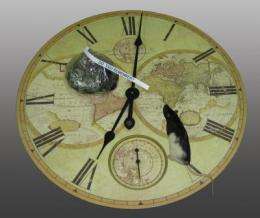
Now, just-published research from scientists at the University of Georgia is offering new insights into how one kind of memory works. The study, published this week in the online edition of The Proceedings of the National Academy of Sciences, shows that laboratory rats have "episodic-like memory" and could open novel ways to study life-robbing loss of memory in humans.
"This research shows that rats remember the time at which they encounter a distinctive event, in addition to what the event was and where it happened," said Jonathon Crystal, an associate professor in the Department of Psychology's Neuroscience and Behavior Program in UGA's Franklin College of Art and Sciences. "These experiments provide insight into the memory system that retains the time of occurrence of earlier events."
Co-author of the paper was Wenyi Zhou, a doctoral student in Crystal's laboratory. The work was supported by a grant from the National Institute of Mental Health.
Memory loss in humans can be caused by an array of diseases, such as Parkinson's and Huntington's, but the great destroyer of memory is Alzheimer's disease, which is progressive and, at least for the present, irreversible. Drugs used to treat cancer can cause memory loss, as can certain forms of mental illness or traumatic brain injuries. Memory loss often ends an independent life for those who suffer it, and researchers around the world are looking for ways to slow or stop damage to memory, especially through pharmaceuticals.
Still, much remains unknown about the disorder, and so having an effective animal model of memory will be critical to understanding how and why memory fades.
The paper deals with one specific kind: "episodic memory." In this kind of remembering, unique past events are recalled and can be placed in time and at a specific location. For years, many scientists believed that only humans have episodic memory, and that supposition may have limited approaches to studying the problem.
Crystal argues in this PNAS paper, however, that behavioral experiments can show that rats do have such memory. If confirmed, the implications are considerable because it would give researchers a way to study this type of memory in a nonhuman model.
"It has been argued that retrieval of episodic memories is analogous to traveling back in time," he said. "Recent studies with nonhuman animals suggest that animals remember specific episodes from their past, but there has been controversy over whether episodic-like memory in rodents is the same as it is in humans."
The experiment reported this week involved setting up a situation in which rats were "asked" to remember the time of day at which they encountered a distinctive event, in addition to what occurred and where it happened. The event was the feeding of chocolate-flavored pellets—chocolate being a flavor that rats, like humans, crave.
The rats were fed in the morning and afternoon on separate days, but chocolate was available at only one time and place. Rats adjusted their revisits to the chocolate location by using the time of day rather than how long ago the event occurred.
"Our results suggest that at the time of memory assessment, rats remember when a recent episode occurred, similar to human episodic memory," said Crystal.
Zhou agrees.
"As a memory system that is late to develop in childhood and is the first to decline in old age, episodic memory has attracted intensive attention in the scientific community recently," she said. "Because there are many limitations in human studies, I think the development of a rodent model of episodic memory will provide an invaluable tool for understanding the underlying mechanisms. It will also bridge the gap between studies of memory in humans and animals."
The problem at hand for those studying human memory loss isn't as simple as "Where did I leave my car keys?" The question at hand is more like, "What happened to me yesterday?" Until researchers understand memory more—through studies such as this one—memory loss will remain the great thief of human love.
Source: University of Georgia (news : web)


